John Veson’s introduction to shipping came with weekend office visits. His father took him along to work, and he learned to code there. Before the university degrees, before Microsoft, before the chief executive’s title, there was a child in a software business, discovering that instructions typed into a computer could do something useful for people moving ships.
It is an origin with very little ceremonial grandeur. No garage is required. An office will do. The important detail is the proximity: software and the work it served were in the same room.
Michael Veson founded the predecessor business in 1979, developing automated tables of distances between ports. That is a satisfyingly concrete beginning for a family company. How far is it from here to there? The son’s career would involve a longer version of the question, with a detour through a different corner of technology.
A weekend education
Veson studied computer science and economics at Brown, graduating with honors, and earned an MBA at Harvard. His working life included Microsoft, where he was part of the Internet Explorer development team and managed strategic consulting projects. His background put software engineering beside the practical questions of how organizations use technology.
A browser and a shipping application make an unlikely pair at first glance. One opens onto almost everything; the other must understand a particular business in considerable detail. Yet both have to give a person a usable way into something complicated. That is a useful lens on the career that followed, even if no neat educational plan could have guaranteed it.
Shipping was familiar territory. Familiarity, however, did not make a return inevitable. Asked years later whether he had anticipated the company’s trajectory, Veson gave an answer that lets a little air into the usual founder biography.
“Not at all. I actually tried to step away from the industry.”
John Veson, July 2025
The family business was a starting point. He still had to decide whether it would become his work.
The decision to come back
That decision took shape in 2003. John Veson and Eva Douzinas co-founded Veson Nautical and acquired the assets of Veson Inc. The distinction matters: the father’s company supplied the lineage; the two founders established the business that carries the name today.
Veson had been associated with the earlier business since 1992 and helped create the architecture of its Integrated Maritime Operations System, IMOS. The return gave that technical involvement a new organizational home. In 2004, the company relaunched the software with standardized modules for chartering, operations, and financials.
Consider what those three words ask of a system. A commercial agreement has to survive contact with the voyage itself, and the voyage eventually has to appear in the accounts. A useful screen in one department can become a nuisance in another if the information does not travel with it. Even without an ocean, that is enough to make a software project interesting.
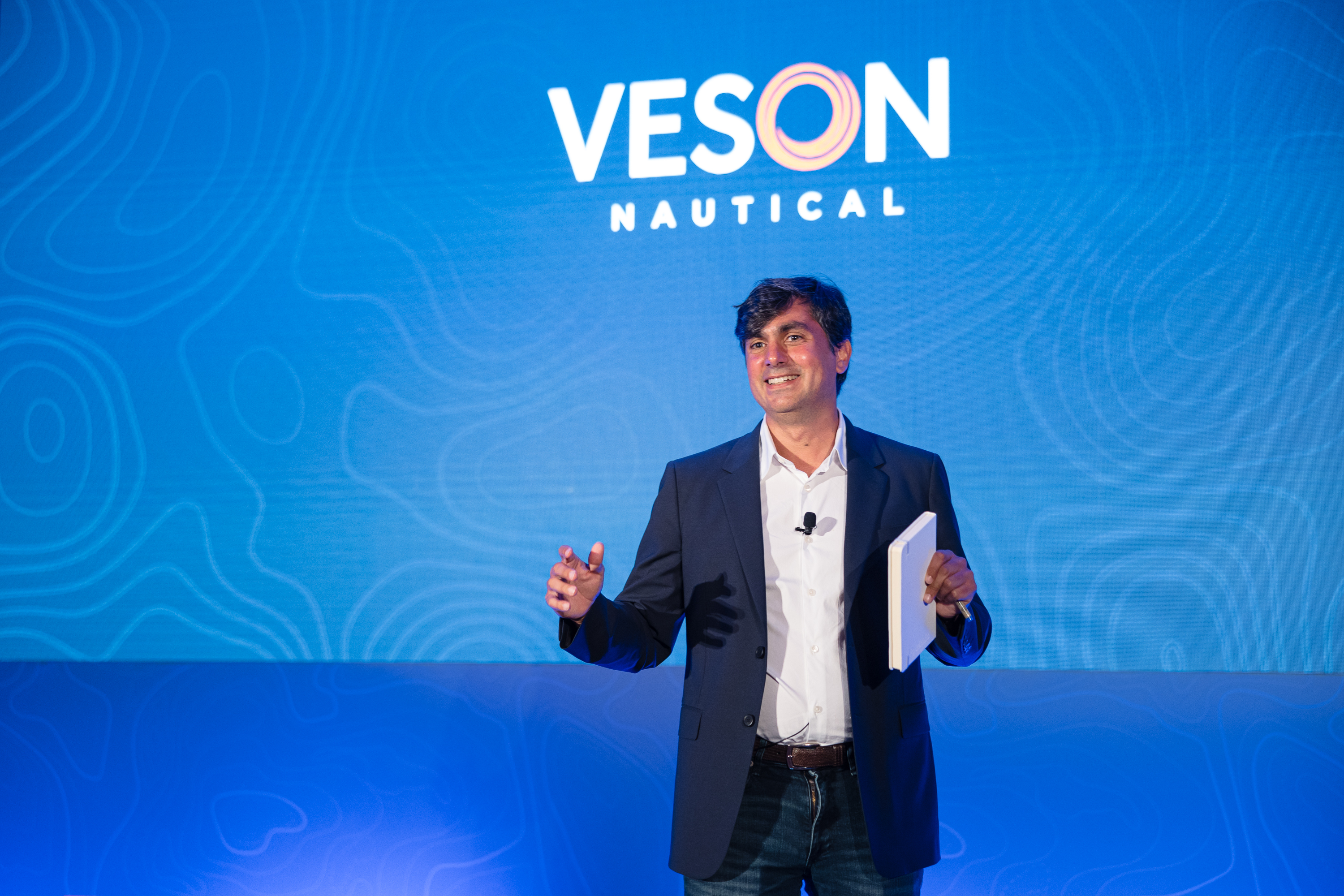
His public account of the return emphasizes shipping’s international reach and difficult workflows. The attraction lay in the number of useful things technology could still do. There is a difference between inheriting a name and choosing a problem. His account makes room for both.
Fourteen years before the first equity partner
The business developed for years before its first institutional equity investment. When Pamlico Capital invested in February 2017, Veson Nautical had offices in Boston, London, and Singapore, and served more than 8,000 users at over 200 clients. John Veson, Sean Riley, and other managers retained significant ownership and continued running the company.
The announcement recorded thirteen consecutive years of growth. It gives the story a tempo that a list of product launches cannot quite convey. There had already been a long stretch of selling, implementing, supporting, and improving software before a private equity partner entered the picture.
In March 2022, Francisco Partners announced a significant investment alongside existing shareholders, including Pamlico and Veson himself. The stated uses included product development, organic expansion, and targeted acquisitions. The company had already acquired Oceanbolt, adding maritime and commodity trade-flow intelligence.
For Veson, this was another stage in a business he continued to own as well as lead. The practical challenge expanded along with the means: bringing additional products and teams into a company whose customers still needed the daily work to hold together.
Q88 joined in May 2022, adding vessel information and software, including expertise in managing specifications. Shipfix followed in December 2023 with AI-assisted communication and pre-fixture tools. A ship has dimensions and ownership details; a prospective deal also arrives through messages. Both can matter before anyone commits to a voyage.
The acquisitions suggest a recurring commercial idea: put relevant information closer to the point where someone needs to act. Buying the pieces is one job. Making the pieces convenient to use together is a continuing obligation.
The customers who stay in the story
There is a quieter measure of the company’s development in a visit to Copenhagen. In 2022, Veson and colleague Graham Piasecki went to NORDEN to mark ten years since the shipping company introduced IMOS on October 1, 2012.
NORDEN publicly thanked them for the visit and the continuing support. The anniversary offers a pleasingly ordinary counterweight to the language of digital transformation. After a decade, the relationship still involved people showing up at one another’s offices. Software may be delivered through a network; trust occasionally benefits from a journey.
Another customer connection surfaced in 2025, when Cargill’s Eric Aboussouan welcomed an expanded technology agreement and recalled meeting John Veson fifteen years earlier. His post made the relationship sound rather more cheerful than the average procurement document.
These are small details, but they belong in a personal story. A founder’s work leaves traces in other people’s calendars, visits, and recollections. The business is also a collection of conversations long enough for somebody to remember the beginning.
A common language for a voyage
In a 2023 podcast conversation, Veson discussed combining public information, such as vessel-position data, with a company’s private records and accumulated knowledge. He also made the point that problems of standards extend beyond shipping. Other industries have had to learn how to make information intelligible across organizational boundaries.
That observation tempers the romance of a maritime technology story. Ships supply excellent photographs. The less photogenic work is agreeing what a piece of information means, keeping it consistent, and making it available to the next person. A port call is easy to say. Getting different systems to describe it the same way is a project.
Oceanbolt offered one route into that larger information problem. Veson appeared in a webinar alongside its co-founder Niclas Dæhli Priess to discuss a platform covering trade flows, vessel positions, congestion, and port activity. The presentation also addressed programmatic access for people who wanted to work with the data in their own systems. A useful interface could coexist with other ways of reaching the information.
By August 2025, Veson was explaining how AI could examine structured voyage records and help teams understand previous chartering performance. The emphasis was on drawing attention to relevant details in a body of operational history. Reviewing past results line by line takes time. A tool that helps locate the consequential detail has a clear job to do.
The promise deserves a practical test: can a person understand a result well enough to decide what to do next? An elegant answer on a screen still has to meet an untidy commercial situation.
Still close enough to make a prototype
At the Geneva Summit in March 2026, Veson described three directions for the platform: organizing unstructured material such as messages and PDFs, letting clients connect their own data feeds without custom development, and adapting the interface to a person’s role. The themes are close cousins of the original problem. Information must arrive in a form someone can use.
The unified Veson Platform launched on June 30, bringing IMOS, CoCaptain AI, Mail, and new data products into a shared interface. At launch, the company reported more than 38,000 users across 2,400 organizations in over 100 countries. Those are company figures, and they describe the scale at which a product decision can now be felt.
That autumn supplied a smaller and perhaps more revealing scene. In an account of the Singapore Summit’s client panel, AET’s Joey Chua described taking a challenge to Veson. The CEO started prototyping a solution and shared his thinking with the AET team.
It is a modest anecdote to place beside an international software business. A client raises a problem. The founder makes something that gives them a way to discuss an answer. The incident suggests that the engineer remains available inside the executive.
Veson closed the Singapore gathering with a look at the company’s experiments and future direction. There will be more interfaces, more releases, more decisions about what belongs together. For now, the prototype offers a fitting place to pause: an idea brought close enough to another person’s work that they can begin improving it.