A strategy can look immaculate in a presentation. It has arrows, verbs and a pleasing sense that Tuesday will obey the wishes of Monday. Then the meeting ends. The arrows turn into owners, budgets, launch dates, dependencies and the awkward question of who told the regional team. John Rueca has built a career in that transformation. His own description is spare: “I've spent my career helping executive teams turn strategy into execution.” There are no fireworks in the sentence. That is rather the point.
Rueca is Chief of Staff to the CMO at Menlo Security, with a remit spanning marketing operations and strategic programs. He sits close enough to executive intent to understand the why, and close enough to the working machinery to notice when the how has gone missing. In a cybersecurity company, that machinery is particularly busy. Products change. Threats change. The language for explaining both changes shortly afterward, usually while a campaign is already in flight.
His job is a study in connective tissue. A chief of staff is not simply an executive's second calendar, and marketing operations is not merely the department that keeps the software licenses in a neat row. Together, the roles ask for translation: from priority to program, from program to accountable work, and from technical argument to something a customer can use. The glamour is modest. The leverage is not.
The operator's operating system
Rueca's route to the CMO's office passed through enterprise IT. His public career includes Symantec, followed by NortonLifeLock, where he held a Chief of Staff to the CIO / IT Service Owner role. The names matter because they place him inside large technology organizations where a simple request can cross systems, functions and time zones before lunch. They also reveal a useful continuity. Whether the executive at the center is responsible for technology or marketing, somebody must make a portfolio of priorities behave like a system.
Earlier colleagues remember the manner as much as the output. One described Rueca as empathetic and steady enough that projects became “worry-free for leadership.” Another, who worked with him at Symantec, emphasized energy, collaboration and the ability to carry several complex programs from end to end. These are recommendations, not laboratory measurements. Still, they identify the human mechanics of the role: people hand difficult work to operators they believe will neither drop it nor turn it into theatre.
“I've spent my career helping executive teams turn strategy into execution.”John Rueca, on his professional focus
There is an appealing economy to that line. Strategy and execution are often treated as separate provinces, with a border checkpoint staffed by slide decks. Rueca's career makes them look more like alternating breaths. The executive team sets direction. The operating layer tests whether the direction can survive contact with resources, sequencing and reality. What returns to leadership is not merely status. It is information about whether the strategy itself is sound.
Loyola Marymount University
Four years at the Los Angeles university, before a career in enterprise technology operations.
Symantec
Complex business and technology programs, remembered by colleagues for collaboration and end-to-end ownership.
NortonLifeLock
Chief of Staff to the CIO / IT Service Owner, connecting executive technology priorities to delivery.
Menlo Security
Chief of Staff to the CMO, leading marketing operations and strategic programs.
Then the browser ate the perimeter
At Menlo Security, Rueca's operating craft meets a market argument with large consequences: much of modern work now happens inside a browser, so the browser must be treated as a security control point. Employees meet applications there. Contractors arrive on unmanaged devices. Files enter. Sensitive text leaves. Phishing pages impersonate familiar institutions. AI assistants and agents add a new actor, one capable of moving at machine speed with fewer of the skeptical pauses a person might take.
Rueca's public posts favor concrete bundles over abstract alarm. One recent explanation grouped the problem into four parts: phishing and zero-day threats; sensitive-data leakage into AI tools; dangerous files; and access to private applications from contractor or unmanaged devices. Menlo's pitch is that these should be handled from one browser-level control plane. Rueca's marketing instinct is visible in the structure. One surface. Four recognizable problems. A self-guided demonstration with a stated length of twelve minutes.
That last detail is revealing. Twelve minutes is not a technological feature. It is a promise about the buyer's attention. The operator's job is to make sure the organization can keep it. A useful demonstration requires the product narrative, the interface, the examples and the follow-up to agree with one another. Marketing operations, when it works, is the backstage choreography that lets the customer experience one coherent idea.
A workshop, not a weather report
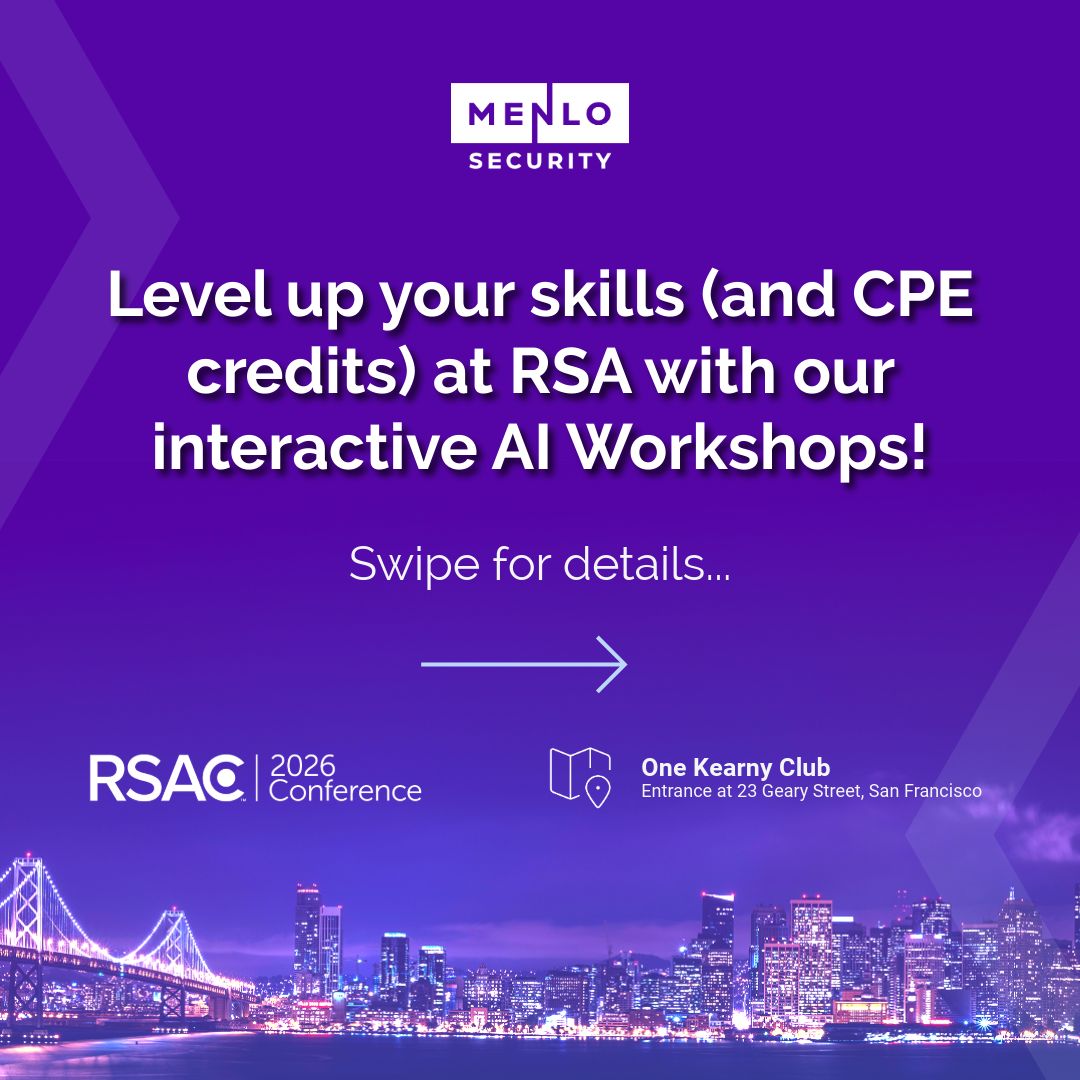
For RSAC 2026, Rueca promoted Menlo workshops built around simulated AI threats. The sessions were deliberately small, with eight to ten participants, and offered continuing-education credit. One scenario addressed zero-touch prompt injection and a new phishing frontier. Another covered accidental data leakage to AI and the forensic work that follows. The format replaced the usual conference weather report - disruption is coming, clouds everywhere - with a room, a scenario and something to do.
That preference for practical framing appears elsewhere in his updates. When Menlo discussed evasive browser attacks, Rueca focused on the architectural tradeoff: risky code should not keep running on an endpoint, but protection should not make ordinary applications painful to use. When he shared commentary on AI governance, he highlighted the tension security leaders actually face - protecting new systems without slowing useful adoption. The common move is to take a large claim and find the operational hinge inside it.
The same pattern shaped his response to a leadership change at Menlo. He welcomed the company's next chapter and placed it against a specific demand: securing both people and AI-driven agents. It was a concise statement, but it located organizational change inside the market change. That is chief-of-staff thinking in public form. New leadership is not merely a personnel announcement. It alters how a company meets the moment in front of it.
Urgency without coordination is only noise with a calendar invite.The operating lesson
What the rest of us can steal
Rueca does not publish a grand theory of operations. His record offers something more useful: repeatable clues. First, compress the problem without flattening it. “Browser security” becomes a short set of moments a customer recognizes. Second, attach the message to an experience. A workshop, report or demo lets an argument encounter reality. Third, preserve the user's working life. Security that breaks the application or demands a new routine may be defensible on paper and ignored in practice.
Four problems are easier to organize than a fog of danger. A named set gives teams a shared checklist.
A twelve-minute demo turns “learn more” into a bounded decision. Respect for attention is part of operations.
Strategy is only as strong as the moment one team passes work, context and accountability to the next.
Colleagues remember empathy and approachability because programs run through trust before they run through software.
Fourth, make calm a capability. The colleague who called Rueca's projects worry-free was describing an outcome leaders prize and spreadsheets rarely capture. Calm does not mean an absence of urgency. It means the urgency has acquired owners, checkpoints and choices. A well-run program can still be hard. It simply does not require everyone to rediscover the plan each morning.
Finally, treat execution as a form of intelligence. The calendar knows things the strategy document does not. So do the campaign manager, the product specialist, the regional lead and the person answering customer questions. An operator gathers those signals and returns them to the executive agenda. The result is not blind compliance with a plan. It is a plan that gets wiser as people attempt it.
The useful middle
Rueca's career has moved from CIO-adjacent operations to the CMO's office, from established security names to a company trying to define the browser as a modern control point. The thread is not a particular technology. It is the organizational problem beneath technology: how to help a group of specialists move in the same direction without pretending their work is simple.
This is why chief-of-staff work can be both hard to see and easy to miss when it is gone. Successful launches appear to belong to the launch. Clear decisions appear to belong to the meeting. A coherent campaign appears to have arrived fully dressed. Behind each is the useful middle - the questions, handoffs, reminders and revisions that turn intention into motion.
Cybersecurity will keep supplying urgency. AI agents will supply more. Rueca's public work suggests a steadier response: name the concrete risk, build the program, respect the user and make the next action obvious. Strategy gets its moment on the slide. Execution gets every morning after. He has chosen the mornings.