The computer was moving. So was the risk.
The browser looks harmless. It has bookmarks, a back button and perhaps a frankly unreasonable number of open tabs. For Amir Ben-Efraim, that familiar window became the place to build a company. His wager was that an ordinary tool, used almost without thought, deserved a more deliberate kind of protection.
By February 2026, Menlo Security, the company he co-founded, reported more than $140 million in annual recurring revenue. That month, Bill Robbins succeeded him as chief executive, while Ben-Efraim continued as executive chairman. A founder who had spent years explaining why the browser mattered was handing daily operations to someone else, with another change in computing already under way.
AI agents were beginning to use the same browser environment as employees. The user at the keyboard, once the obvious center of the picture, could now be software. Ben-Efraim's continuing remit covered long-term vision, strategy and partnerships. The setting had changed again; the question running through his career remained recognizable: where has computing gone, and has security arrived there yet?
Cupertino, with an Apple II
At twelve, Ben-Efraim moved from Israel to Silicon Valley. He has described the difficulty of adapting to another language and culture. In Cupertino, he experimented with an Apple II and watched Apple buildings appear around him. Computing was something he could try for himself, in a place where the industry was visibly taking shape.
He studied electrical engineering at UC Berkeley, graduating in 1991, and later earned a master's in electrical engineering at Stanford and an MBA at UCLA. His early work at Amdahl involved software simulations of CPU subsystems. He also watched technically ambitious mainframe projects get canceled as customers turned toward personal computers and workstations.
An engineer could produce an elegant answer and still find that the market had moved to another question. His subsequent move toward business gave that experience a practical outlet. At Check Point Software, his work included business development and partnerships. He was learning how a technical product found its way into another company's decisions.
A firewall inside the box
In 2007, Ben-Efraim co-founded Altor Networks and became its CEO. Server virtualization was changing the geography of a data center. Several virtual machines could share physical hardware, with communication occurring inside an environment that conventional physical security equipment was poorly placed to observe.
Altor built security for that virtual setting. Its offerings included a firewall designed for virtual networks and intrusion detection. The business put protection nearer the activity it needed to govern. To understand the appeal, imagine installing every security camera outside a building while the interesting conversations happen between rooms.
Juniper Networks was already a technology partner when it invested in Altor in early 2010. On December 6 that year, the relationship became an acquisition. Juniper announced a cash purchase price of approximately $95 million, net of the Altor shares it already owned. A partnership had given the larger company a close view of the technology and the people developing it.
Ben-Efraim joined Juniper and served as vice president of cloud security, helping shape its approach to virtualized data centers and public and private clouds. The acquisition connected his startup's work to a broader security portfolio. It also placed him inside a larger organization, where a product's future depended on more than the ingenuity of its original team.
- 2007Altor Networks begins. Security moves inside virtual environments.
- 2010Juniper acquires Altor; Ben-Efraim joins the company.
- 2013Menlo Security is founded.
- 2026Ben-Efraim continues as executive chairman; Bill Robbins becomes CEO.
The browser gets its own boundary
Menlo's corporate history dates its founding to 2013. By its public emergence from stealth in 2015, Ben-Efraim was arguing for a change in how businesses dealt with web threats. Trying to classify incoming material as good or bad left room for unfamiliar attacks to pass through. His company proposed isolating web activity in the cloud before it could reach the employee's device.
The experience had to remain familiar. People still needed to open pages and use applications. A security product that made everyday work irritating would create a fresh problem even as it tried to solve an old one. Menlo's early proposition depended on keeping the visible browsing experience while separating the device from potentially dangerous web content.
There was academic work behind that proposition. Adaptive Clientless Rendering, the technology used to mirror remote browser content, grew out of research in Berkeley professor Dawn Song's laboratory. Berkeley's account connects Song and graduate student Gautam Altekar with experienced security executives, including Ben-Efraim and Poornima DeBolle.
That is a useful correction to the tidy picture of a solitary founder and a sudden idea. Menlo brought together research, product work and commercial experience. Ben-Efraim helped turn an architectural approach into something an organization could buy and deploy. The invention needed a route from a laboratory to an employee opening a link on an ordinary working day.
Keep the tabs. Change the protection.
The everyday browser remained central as Menlo expanded. In February 2024, it launched its Secure Enterprise Browser offering, adding controls for existing browsers alongside its cloud browser capabilities. Ben-Efraim described the direction in plain commercial terms: customers could continue using browsers they already preferred.
That choice says something about his approach to selling security. A company asking employees to change tools must account for habit, compatibility and the work of deployment. Menlo made continuity part of its proposition. Chrome or Edge could remain familiar while an enterprise gained more control over the browser session, application access and data.
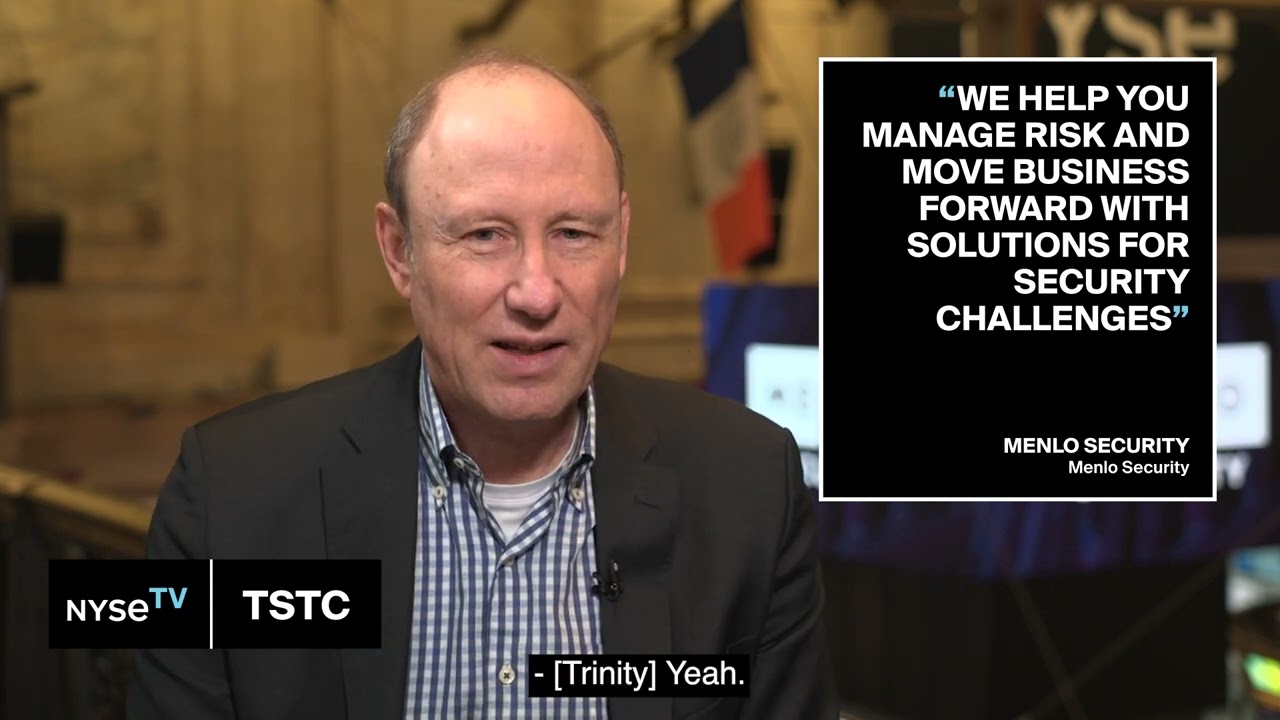
In a 2024 appearance with NYSE's Trinity Chavez, he discussed the browser as an enterprise asset. The phrase gives a mundane piece of software a different status. A browser is where an employee may reach company applications, external information and generative AI tools. Treating it as infrastructure changes what a business expects to manage.
The goal also helps explain why user experience keeps appearing in his account of Menlo. Security is purchased by organizations but encountered by individuals. Their immediate test is often whether they can complete the task in front of them. A protected session that preserves that ability has a more persuasive introduction than another instruction to abandon a familiar routine.
The people he chose twice
Ben-Efraim's history with investor Ashmeet Sidana offers a more personal view of company building. Sidana was the first investor and a board member at Altor. When Ben-Efraim started Menlo, he chose him again. He described Sidana as “an advisor, a friend, a trusted confidant.”
The sequence matters more than a general endorsement of venture capital. One company had already tested the relationship. Ben-Efraim returned to it at the beginning of another. His account gives trust a concrete form: a person who understands the uncertain period when a business is still a largely blank sheet of paper.
Menlo later attracted a wider group of backers. In November 2020, it announced a $100 million Series E led by Vista Equity Partners at an $800 million valuation. The stated uses of the money included engineering, product delivery and expansion of its commercial operations. Building the technology and building the machinery to sell it had become parallel obligations.
His own explanation of entrepreneurship brings those obligations together. “The combination of technology and business is what makes an entrepreneur,” he said in a 2021 podcast. The sentence is less glamorous than the customary mythology of disruption. It also describes his education and working life rather well: technical understanding joined to the question of who will use a product and why.
“The combination of technology and business is what makes an entrepreneur.”
Amir Ben-Efraim / The Founder Formula, 2021
A number, then another kind of recognition
In October 2024, Ben-Efraim announced that Menlo had passed $100 million in annual recurring revenue. The company also reported more than 1,000 customers and eight million users globally. These were company-reported measures, but they gave the browser argument an observable commercial scale beyond its original technical explanation.
Recurring revenue is a particularly relevant measure for this story. It describes the continuing business of supplying a service. A demonstration can show that an idea works once; an enterprise service must keep earning a place in customers' operating budgets. That ongoing obligation is where the engineering and business sides of his career meet.
There were other forms of recognition. In 2021, Goldman Sachs selected him among its 100 Most Intriguing Entrepreneurs for the Builders + Innovators Summit. His response credited the team's work and its ability to deliver value to customers. The award put his name on the invitation, while his explanation placed the achievement with the people building the company.
Berkeley records a different milestone: his Founders' Pledge was fulfilled in 2025. The university also records him as a member of its class of 1991. Those two dates connect a student of electrical engineering with an entrepreneur giving back through the institution's founder community, decades after graduation.
Menlo’s reported service revenue milestones. ARR is annual recurring revenue.
The next user may never touch a keyboard
The February 2026 leadership change gave Ben-Efraim a new position within the company he had helped establish. Robbins, who joined Menlo as president in 2024, took responsibility for day-to-day operations and continued product innovation. Ben-Efraim remained involved in the longer view as executive chairman.
The timing returns the story to a familiar pattern. Virtualization had moved activity inside servers. Cloud applications had made the browser a workplace. AI agents now introduced another kind of participant in that workplace. The company's plans included expanding capabilities across AI security, secure access and data security.
His earlier ambitions had already reached beyond a single product. He wanted Menlo's approach to become a standard part of enterprise browsing, working alongside the large browser providers. The attraction was practical: protect people where they already work, with less disruption to the tools they use.
There is a pleasing continuity between the child trying an Apple II and the chairman considering software that browses for itself. Each belongs to a moment when a computer can do something newly useful. Ben-Efraim has built his career around the less festive question that follows: what else can now get through the door?
Follow the conversation
- Menlo Security / company website ↗
- Amir Ben-Efraim / LinkedIn ↗
- Watch / NYSE conversation with Trinity Chavez ↗
- Listen / The Founder Formula ↗
- Read / 2025 interview on browser security ↗
- Explore / Berkeley research behind Menlo ↗
- Read / the February 2026 leadership announcement ↗
- Read / Ben-Efraim on Menlo’s $100M ARR milestone ↗