A bill is a remarkably persistent form of correspondence. It survives changes of address, fashions in technology, and almost every attempt to ignore it. John Morris has built much of his career around what happens next: the movement of money from someone who owes it to someone expecting it. There is little theatre in that description. There is, however, a business.
Morris co-founded Atlanta-based REPAY in 2006 with Shaler Alias. Twenty years later, he remains its chief executive and a director. The company’s name expands to Realtime Electronic Payments, which has the pleasing economy of telling you what the business does before anyone has opened a presentation. Its territory includes loan repayments, business payables, and, following its 2026 acquisition of KUBRA, a broader stretch of consumer billing.
To follow Morris’s career is to follow the paper trail as it gradually becomes electronic. The checks came first. The stock-market ticker arrived later.
An accountant before an entrepreneur
Morris studied accounting at the University of Georgia, earning both a B.B.A. and a master’s degree. He began his professional life at KPMG, where he earned his CPA credential. Between 1994 and 1997, he worked in corporate finance at Bass Hotels and Resorts, including as director of corporate finance, with responsibilities involving capital projects and acquisitions.
Those are useful places to become acquainted with the distance between a handsome idea and a balanced set of accounts. Hotels require capital. Acquisitions require judgment. Accounting requires somebody to notice when the numbers have quietly declined to agree. His early résumé puts financial operations at the beginning of the story, before the payments companies and their subsequent transactions.
In 1997, Morris began his tenure as president of Security Check Atlanta. He was also a co-founder of the check verification and processing business. During his time there, it added more than 24,000 merchant locations. It appeared at number 91 on Inc.’s list of fast-growing private companies in 2001 and number 196 in 2002.
Security Check was sold in 2008. After its acquisition by Payliance, Morris worked there as executive vice president of sales and marketing. The progression matters: accounting, corporate finance, running a processor, then selling payment services. Each role placed him at a different point in the same commercial journey.
The opportunity inside an ordinary repayment
REPAY’s beginning overlapped with that earlier business. Morris and Alias founded it in 2006; Morris became chief executive in 2010. Its early opportunity lay in consumer finance businesses whose customers needed to make payments, but whose payment options had not kept pace with electronic commerce.
The founders concentrated on merchants with particular operating requirements, including lenders and businesses handling receivables. Accepting a payment in that setting involves more than a button. A lender needs the transaction to fit its records and the borrower’s account. The software already used to run the business becomes part of the problem, and part of the opportunity.
That helps explain Morris’s long association with integrated payments. REPAY builds payment capabilities into the software its clients use. The practical attraction is easy to understand: fewer separate steps between receiving money and knowing where it belongs. For a customer, convenience can be a brief interaction. For the business receiving the money, it has to survive the rest of the working day.
By 2018, REPAY had more than 100 employees across six offices and had completed three acquisitions in two years. Morris and Alias were named Southeast finalists in EY’s Entrepreneur Of The Year program. They were finalists, a distinction quite sufficient without promoting them retrospectively to winners.
“The REPAY team has remained true to our values”
John Morris, 2018
Learning to grow with other people at the table
In 2013, REPAY undertook a majority recapitalization with New Capital Partners. James Outland and Ryan Berg joined the board. In Morris’s account of that partnership, their contribution included advice on scaling the business, adding infrastructure, and expanding its executive leadership.
The investor helped recruit a finance chief and a technology chief, and helped establish a sponsor-bank relationship. REPAY also pursued its own gateway technology and an acquisition strategy. These details give the familiar phrase “growth capital” some actual furniture: people, banking arrangements, systems, and decisions about what to own.
Morris has described the relationship in terms of both practical advice and lasting friendships. It is a useful glimpse of his public voice. When discussing the company’s development, he has made room for the people who helped build its capacity, alongside the transactions that changed its ownership.
Corsair acquired a controlling interest in 2016, while the founding shareholders stayed in senior leadership. The ownership changed again when REPAY entered the public markets. Corsair retained a minority stake through that transaction and sold its remaining holding in September 2020. Morris’s tenure continued across those changes. The chief executive’s chair had a longer occupant than several seats around the investment table.
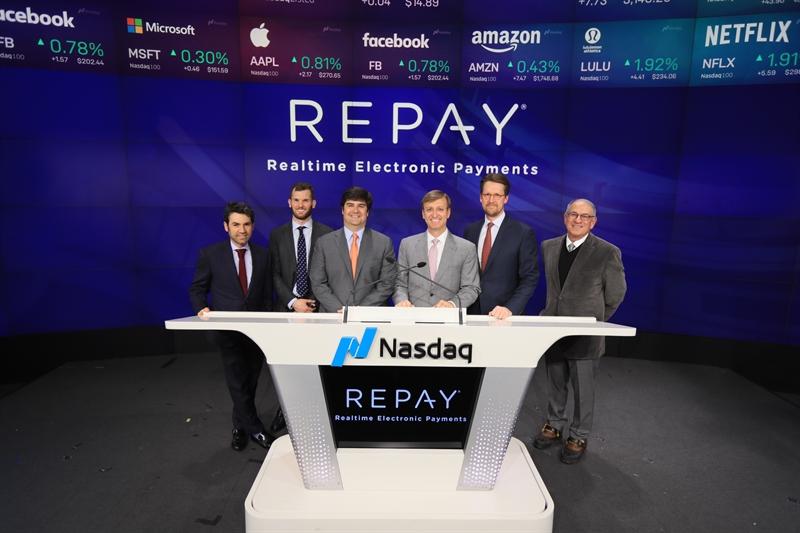
Four letters on Nasdaq
REPAY completed its combination with Thunder Bridge Acquisition on July 11, 2019. Its shares began trading under RPAY the following day. The transaction used a special purpose acquisition company, taking an established payments business into public ownership.
The photograph at Nasdaq supplies the occasion’s natural glamour: suits, screens, a podium, and the company name large enough to leave no guest uncertain about the host. Yet the business beneath that ceremony still depended on transactions moving reliably through clients’ systems.
Public ownership also supplies a recurring examination. Every quarter brings figures, questions, and comparisons with earlier promises. For a founder, it makes the distinction between building a company and explaining its performance unusually visible. Morris has continued to do both.
Why the back office still interests him
REPAY’s expansion into business payments brought Morris to another place where paper retained its privileges: accounts payable and accounts receivable. These are the offices responsible for paying suppliers and collecting what customers owe. Their vocabulary may lack romance, but their mistakes are seldom inexpensive.
In an interview about business payments, Morris discussed the appeal of automation in terms of cost, visibility, working capital, and security. He also stressed the demand for services tailored to particular industries. The underlying proposition is practical: a payment service should fit the way a business operates.
That approach has carried into newer products. On REPAY’s May 2026 earnings call, Morris described putting bills into consumers’ native Apple or Google wallets. He also discussed REPAY Voice AI, an interactive service for billers. Both examples address familiar activities: seeing a bill and communicating about payment.
There is something agreeably grounded about that ambition. A phone wallet already accompanies its owner through the day. A billing interaction already needs an answer. The commercial question is whether a new capability makes those existing habits work better, and whether clients adopt it. Fashionable technology eventually has to meet an ordinary customer.
A $372 million next chapter
On June 1, 2026, REPAY completed its acquisition of KUBRA for $372 million in cash, funded through debt financing and cash on hand. KUBRA added bill presentment and communications capabilities, extending the company’s work across the steps that precede a payment as well as the payment itself.
At closing, Morris said the combined business was expected to engage with more than 40% of households in the United States and Canada each month and process over $130 billion in annual payment volume. Morris presented those figures as expectations for the combined operation.
The transaction gives his career a neat circularity. He started with accounting and checks; he now oversees a business reaching further into the design, delivery, and settlement of bills. The circle also contains a substantial integration assignment. Owning more capabilities creates work as well as possibilities.
The August results showed that distinction clearly. Second-quarter revenue was $100.7 million, up 33% from a year earlier, including approximately $21 million from KUBRA’s first month. REPAY reported approximately 6% organic revenue growth, a non-GAAP measure. It also recorded a net loss of $11.5 million. These figures describe different parts of the same quarter; an acquisition’s contribution and growth within the existing business deserve separate attention.
Cash consideration for KUBRA. The acquisition expanded REPAY into a broader bill payment and communications business.
After twenty years, another working day
The year also brought a personal change in the company’s leadership. Alias departed as president and a director effective February 27, 2026. REPAY described the transition as mutual and amicable and said it did not plan to fill the president’s role at that time. Morris and the existing executive team would continue overseeing operations and strategy.
In thanking his co-founder, Morris singled out “his contributions and his friendship.” After two decades of building together, the second word gives the announcement a human scale that an organization chart cannot provide.
Morris’s continuing connection to the University of Georgia includes service on its Entrepreneurship Board. His own entrepreneurial education, meanwhile, has included successive investors, acquisitions, a public listing, and the obligation to make the assembled businesses function together.
The next test is already on his desk: integrating KUBRA, developing the combined offering, and delivering the growth he has outlined. A founder can enjoy an anniversary. His customers will still expect their payments to arrive.