John Bucknell has a photograph of his father standing in front of Apollo 11. It is a tidy family credential for someone who would eventually work on rocket engines. The less tidy part came after college: he wanted aerospace, found few openings, and went into cars. The route back to space would run through Detroit, where a complicated machine has to survive an encounter with a purchasing department.
That detour gives his present ambition its particular character. Bucknell is the founder and CEO of Virtus Solis, which is developing a system to gather solar energy in orbit and transmit it to Earth. The proposal sounds at home in a space conference. His preoccupation with making its hardware affordable belongs just as comfortably in an automotive engineering meeting. Somewhere between those rooms is the business he is trying to build.
The education Detroit supplied
He finished his undergraduate degree in 1995. His education includes mechanical engineering at Cleveland State University and a master’s in systems engineering at the University of Michigan-Dearborn. The latter involved a thesis on a 1300cc racing V8 engine. Even the academic work had moving parts. A small racing engine is an unusually compact way to discover how many engineering decisions can argue with one another.
His automotive career included General Motors and Chrysler. At GM, he worked in advanced powertrain technology strategy; at Chrysler, his work involved advanced powertrain controls. These are useful places to learn that a component lives inside a system, and that improving one number does not necessarily improve the whole machine. A powertrain must reconcile performance, controls, manufacturing and cost. The compromises arrive together.
In 2011, Bucknell joined SpaceX and worked on early development of the Raptor engine. The assignment brought his interest in aerospace together with his experience in manufacturing. Later came a propulsion leadership role at Divergent, whose work involved additive manufacturing and robotic assembly. Across those changes, the recurring subject was how to move sophisticated hardware toward production. His employers changed more dramatically than that underlying question.
The rocket he decided against
Virtus Solis was not his first proposed destination. Bucknell initially considered a launch vehicle. By his account, reaching a commercial product would have required about $2 billion, in a field already crowded with launch startups. He reconsidered. There is a useful piece of founder biography in that decision: technical interest did not automatically settle what business he should enter. A rocket could be fascinating and still be a difficult place to start a company.
He examined other space businesses before concentrating on solar power. His argument was that progress in launch, electronics and automated manufacturing had changed the economics of an older idea. Rather than depend on a single new invention, the business would combine capabilities developed elsewhere. The proposed advantage would emerge from their arrangement and cost. It is an approach that makes his varied employment history look less like wandering.
Virtus Solis incorporated in 2019. Building it also required a less photogenic form of endurance. By August 2023, Bucknell said he had pitched more than 500 venture capitalists over roughly four years. Whatever the eventual outcome, that is a substantial number of occasions to explain the same idea to someone who may be checking the time. A capital-intensive project has to keep acquiring permission to continue its education.
Six weeks, a gap, and a power meter
The early experimental work offers a more intimate view of his methods than the orbital diagrams do. Virtus Solis completed its first laboratory wireless-power test in December 2021, after six weeks of design and construction. Bucknell described an uneven result: the team’s own components exceeded expectations, while some purchased components disappointed. The overall system met the team’s goals. The distinction matters because it records what the hardware actually taught them.
He connected that process to lessons from manufacturing: get a mechanism working, improve its reliability, then reduce its cost. That sequence has consequences for how an ambitious project spends its time. A test need not resemble the finished power station to be useful. It needs to answer a question that will change the next design. The early laboratory gap was small enough to cross; the eventual commercial distance remained another matter.
Received across 5 meters at 10 GHz in the company’s second reported demonstration.
In May 2022, the company reported receiving 4.91 watts across five meters at a frequency of 10 gigahertz. It reported recovering 23 percent of the radiated power at the receiver. These were test results under specified conditions. For an engineer, their value includes the less dramatic business of checking whether the analytical tools describe the equipment that was built. Bucknell said the as-built system matched the simulation.
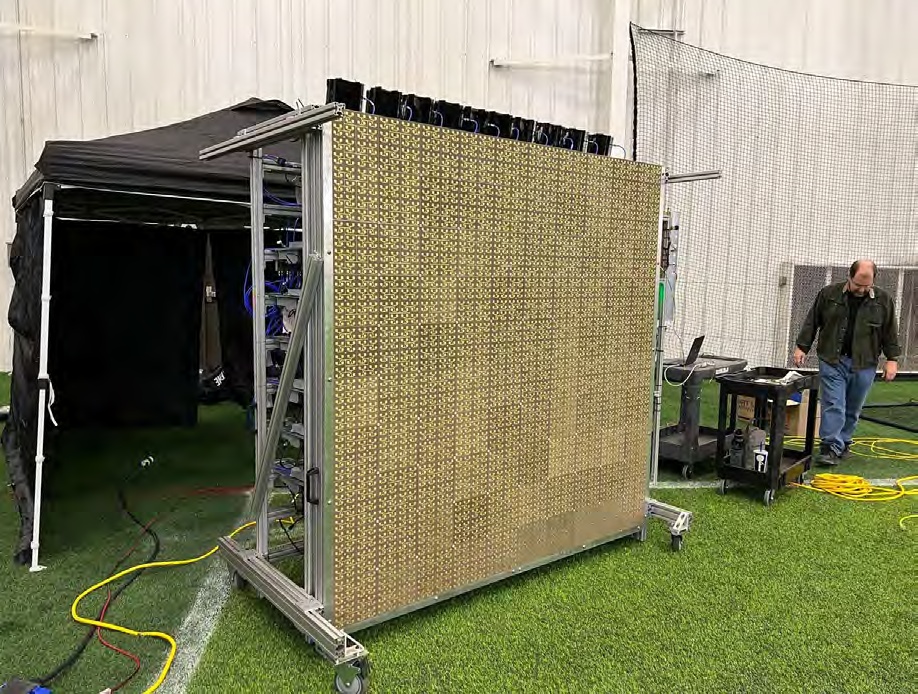
A later company presentation documented a March 21, 2023 demonstration over 100 meters, with 6,400 elements combined into a steerable phased array. That progression gives the story something firmer than a sequence of promises. The team had equipment to assemble, aim and measure. It also leaves the scale of the remaining task visible. Moving energy across a test site and operating an orbital power service demand different kinds of proof.
A power station made of repetitions
The proposed architecture makes Bucknell’s manufacturing interests concrete. Virtus Solis describes small satellite units grouped into large arrays. Its published design specifies units 1.65 meters across, with a target of one kilowatt delivered to the ground per unit. Multiply the units and the power station grows. The appeal of the approach depends heavily on whether those repetitions can be produced and assembled economically. Repetition is where factory experience earns its place in the conversation.
The company proposes using highly elliptical Molniya orbits and transmitting energy at 10 gigahertz to receiving stations called rectennas. Those stations convert the incoming radio-frequency energy into electricity. The design connects several businesses that are often discussed separately: solar generation, spacecraft, radio-frequency electronics and electrical infrastructure. Every conversion and every interface becomes part of the service a future customer would be buying.
- 01CollectSolar cells gather sunlight in orbit.
- 02TransmitArrays send microwave energy toward Earth.
- 03ConvertRectennas turn the received energy into electricity.
- 04DeliverPower serves the grid or a direct customer.
In an early technical interview, Bucknell described choosing intentionally simple robotic assembly and drawing on skills from wireless communications, automotive electronics and controls software. The recruitment logic is revealing. Much of the know-how he wanted already had a day job somewhere else. His task was to bring it into the same project. A space company organized around that idea has reasons to look well beyond the usual aerospace hiring pool.
Bucknell has also publicly endorsed an engineering culture in which people understand the function of the whole system and contribute across boundaries. His compact statement of the principle is worth keeping:
“We are smarter together than individually.”
John Bucknell · on systems engineering
It is a practical preference for someone whose product crosses so many disciplines. A decision that pleases the satellite designer may create work for the receiver designer. An improvement in one subsystem may disappear when the cost of integrating it arrives. Collaboration, in this setting, has a measurable purpose: the complete machine must make sense. The organizational design has to help people notice when it does not.
The electricity buyer enters the picture
On September 30, 2026, Virtus Solis announced a 20-year power purchase agreement with Brae Systems. The initial commitment covers 100 megawatts of prospective supply for subsea data-center infrastructure, with an option to increase to 250 megawatts within three years of initial commercial operations. That brings a specific buyer into Bucknell’s story. It describes future electricity, with the engineering work still ahead of delivery.
The announcement also sets the next major public wireless-power demonstration for March 2027. A customer agreement and a demonstration schedule sit alongside each other for a reason. One concerns demand; the other concerns the means of meeting it. The commercial case becomes more concrete without making the technical work disappear. For Bucknell, the next chapters have obligations attached to them that a general expression of interest would not carry.
Company documents a 100-meter terrestrial power-beaming demonstration.
Company announces the Brae Systems agreement for future supply.
March public wireless-power demonstration is scheduled.
There is another revealing detail in the financing. Enduring Planet describes providing working capital against a $2 million Department of Energy cooperative development contract. Eligible expenses were largely reimbursed after they were incurred, so materials and development costs had to be financed in advance. A company can have support for an engineering program and still need cash to keep it moving. The timing of the bank balance can become an engineering constraint.
That is an earthly problem for an orbital project, and a useful corrective to its scale. Someone has to order the parts before anyone can admire the result. Bucknell’s ambition is broad access to affordable energy. The route toward it includes semiconductor development, financing arrangements and the coordination of work that is rarely visible in a rendering. His manufacturing education keeps returning to the foreground.
Still teaching the engines
His public work also returns to smaller machines. A February 2025 Formula SAE workshop listed Bucknell to teach aerodynamics development and internal-combustion engine development. The aerodynamics session connected tires, vehicle behavior, aerofoil selection, cooling and simulation. These are the questions students encounter when a collection of promising parts must become a car. The workshop provides a modest continuity between his earlier engineering interests and his current company.
It is an appealing place to leave him: still concerned with how the pieces affect one another. Apollo supplied a family connection to space. Automotive work supplied an education in production. Virtus Solis asks whether those experiences can help make a new kind of electricity business function. The photograph of his father belongs to a completed mission. Bucknell’s own project remains on the workbench, with measurements to take and a customer to supply.
Follow the work
- Virtus Solis website Technology, team and company updates
- John Bucknell on LinkedIn Engineering commentary and announcements
- Watch the CogX 2023 presentation Includes a wireless-power demonstration
- Read the career and space-solar conversation Infinite Frontiers · May 2025
- Watch the Balerion Space Ventures conversation March 2026
- Listen to Failing to Success Career choices and early risk-taking
- Read the Brae Systems announcement September 2026
- Browse the engineering blog Tests, talks and development updates