Before there was a company, there was an irritation. Joel Theisen was a nurse working close enough to older adults to see what the forms and handoffs concealed. A service could be competently delivered while the person receiving it still felt smaller at the end. One professional handled the immediate task. Another appeared later. The family kept the map, if anyone did. Theisen found the logic too narrow for the lives passing through it. He has spent the decades since turning that irritation into an organization.
The business now called Lifespark began in Minnesota in 2004 as AgeWell Home Care. Theisen raised about $500,000 from friends and family and started it with Carole Overby and Beth Nemec. His ambition was not simply to dispatch better help into a home. He wanted a preventive, planning-oriented model that could hold the physical, social, emotional and practical dimensions of a person's life in one frame. The distinction sounds gentle. Operationally, it is demanding. Every extra piece of context creates another responsibility.
Theisen had already learned what could happen when capital and purpose pulled in different directions. Before AgeWell, he led AdvoLife, a venture-backed company in California. He later described feeling pressure to steer that earlier business toward monetizing the existing model. The experience left him wanting more control when he tried again. AgeWell's first money came from people who knew him, and the new company began with a thesis he could refuse to dilute.
“To be an out-of-the-box thinker, you first have to be in the box.”Joel Theisen
A nurse learns the shape of the box
Theisen graduated from Viterbo University with a nursing degree in 1990. His early work included critical care and home- and community-based services. It gave him the unusual founder's advantage of knowing the machinery from the floor rather than the slide deck. He could see why the system behaved as it did, where its boundaries sat, and how easily a person became a collection of episodes.
He began describing that motion as a roller coaster: crisis, response, discharge, repeat. The metaphor became one of his most durable pieces of company language because it made fragmentation visible. People do not experience service lines. They experience Tuesday afternoon, a ride that did not arrive, a daughter who has become an amateur coordinator, or the small pleasure that restores momentum to a week. The life is continuous even when the institutions are not.
The response was what became a Life Plan, a view of the person that extends beyond a conventional list of needs. Over time, the company assembled more of the capabilities required to make that plan useful: private-pay home services, skilled home health, senior living, transportation, geriatric primary care, urgent response and hospice. Theisen's company was becoming broad because the customer was already whole.
The useful trick hidden in a name
Names became a running strategic device. AgeWell eventually became Lifesprk, dropping the “a.” Theisen explained the move as taking age out of the center and putting the emphasis on living. In 2021, the company restored the vowel and became Lifespark, a rebrand meant to signal that the business had grown beyond home care into a broader senior-services platform. The typography changed. The provocation did not.
“Spark” is a small word asked to do a great deal of cultural labor. It refers to curiosity, meaning, fun, connection and the visible return of enthusiasm. The company talks about helping people “age magnificently.” Its employees ride the metaphorical “purple bus.” The vocabulary is bright enough to raise a skeptical eyebrow, yet it serves a serious operational purpose: it gives a sprawling organization a shared answer to what the work is for.
Theisen compresses the idea even further: “Culture is our Strategy.” The unusual capitalization belongs to the company. More important is the direction of causality. Culture is not the pleasant mist hovering over execution. It determines who joins, what they notice and how they behave when a manual cannot settle the question. In a relationship business, those decisions are the product.
Fail forward, then get quiet
Theisen favors two leadership instructions that create a useful tension. One is “fail forward,” an invitation to test, learn and keep moving. The other is “slow down and get clear.” Speed without reflection produces an impressive collection of wrong turns. Reflection without movement produces a tasteful notebook. His version of company building needs both rhythms.
Lifespark's history shows the oscillation. It entered senior living. It built partnerships with health systems and payers. In 2020, it raised $16.1 million to support growth and a technology platform. In 2021, a $20 million Series B led by a Virgo-managed fund, with participation from Minnesota insurer UCare, backed further expansion of its operating system and value-based approach. The list can read like a march toward integration. Each move also created a fresh surface on which the company's original question could be tested.
The test is whether scale protects context or flattens it. Technology is useful to Theisen when it helps a team see more of the person and coordinate sooner. He is wary of letting the economic model become the point. In one interview, he warned that entrepreneurs can become so focused on the business case that they forget what they are about. It is a particularly founder-like warning: build the machine, but do not let the machine rewrite the reason.
Assisted living serves a narrow slice. The strategic question lives in the remainder.
Theisen used the 2% figure onstage to challenge an industry accustomed to competing inside the existing category.His latest argument to the senior-living industry begins with an awkward number: only 2 percent of older adults use assisted living. An operator can regard the figure as a share to fight over. Theisen sees 98 percent of the market choosing something else and asks what that choice says about the offer. It is the kind of reframing that makes a comfortable category feel suddenly provisional.
Lifespark's COMPLETE senior living model is the present answer. It combines property operations with in-house clinical capabilities, urgent response, a path through later-life services, and structured programs aimed at growth, strength and connection. By 2025, the company was operating dozens of communities. That September, it became the operator for five Wisconsin properties acquired by LTC Properties in a $195 million transaction. Theisen described the moment as an opportunity to integrate health and housing into a more complete experience.
The residents take the stage
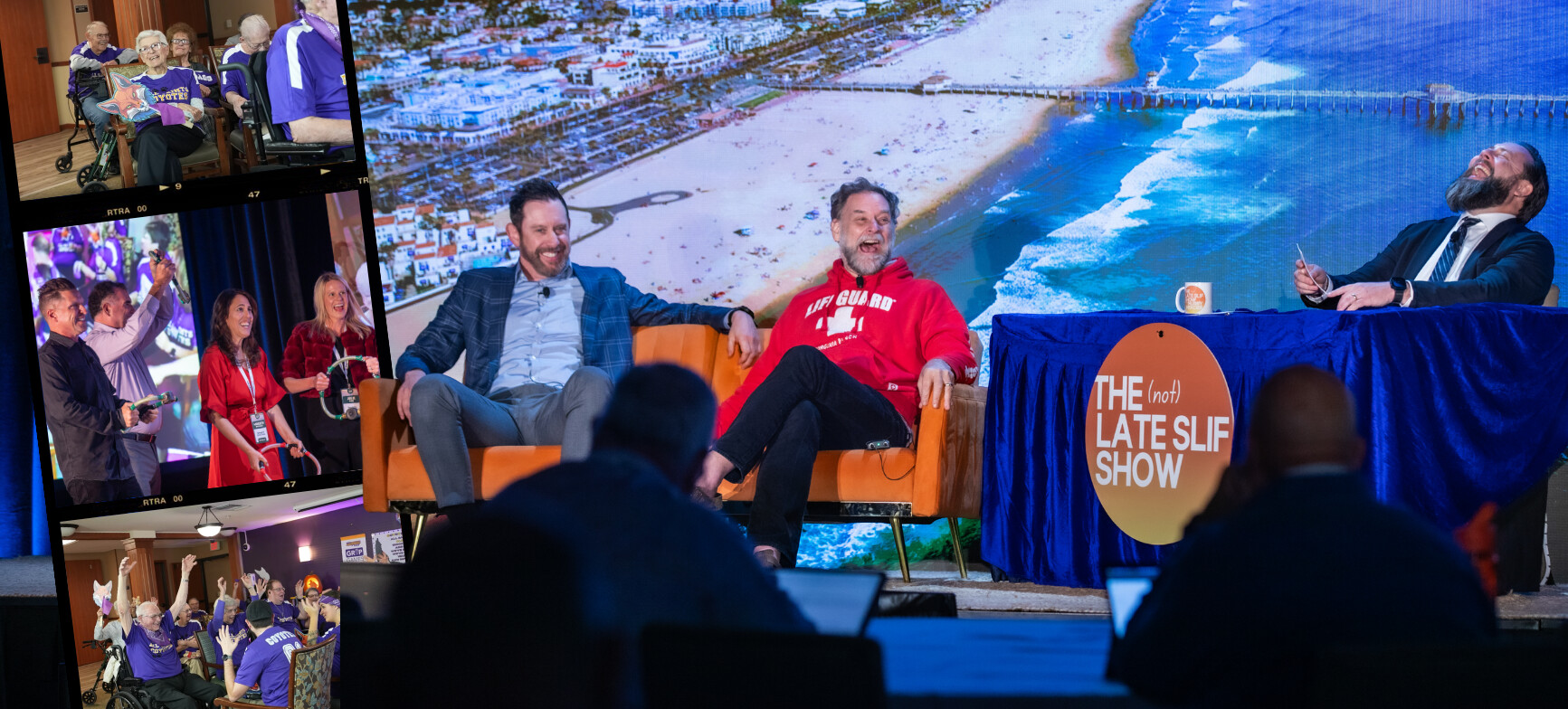
The model becomes easier to understand when the residents stop behaving like recipients. At a 2025 industry forum, Theisen appeared with physician and aging advocate Dr. Bill Thomas. Their discussion covered revenue, risk and the limits of the existing market. Then the stage turned into a contest. Residents from a Lifespark community, appearing by video, competed against the conference audience in a grip-strength game.
The residents won, 58.3 liters to 38.1. The scoreboard was funny. The reversal was the point. The older adults were teammates, competitors and performers with a cash prize at stake. They had trained over weeks in a league that combined measurement with ceremony, broadcasts, team colors and bragging rights. A conventional wellness activity had been redesigned as sport.
This is where Theisen's thesis becomes personal rather than architectural. A complete model is not complete because it owns more boxes. It earns the word only if the person inside the system has more room to act. Community, as Thomas put it, becomes the central amenity. Theisen's business supplies the scaffolding. The resident still supplies the life.
“My true joy is seeing the renewed spark in peoples' eyes.”Joel Theisen
There is an endurance athlete's patience in this story. Theisen competes in Ironman triathlons and speaks warmly about getting outdoors. He has also kept the same founder's problem in view for more than two decades while changing nearly everything around it: name, capital structure, partnerships, technology, service mix and physical footprint. The finish line, inconveniently, keeps moving.
The honors along the route are less revealing than the sequence. The Twin Cities named him to its 40 Under 40 in 2007. LeadingAge Minnesota put him among its 50 for the Next 50 a decade later. Viterbo gave its 1990 graduate a professional achievement award in 2021. Each marker arrived while the company was still changing shape. He was never being congratulated for completing the idea, only for carrying it farther.
His public manner fits the undertaking. Theisen speaks in vivid labels, laughs easily onstage and returns often to words such as purpose, courage and curiosity. He can discuss an operating model and an Ironman race without making either sound tidy. The common thread is voluntary difficulty: choose a demanding course because the destination matters, accept that discomfort will deliver information, and keep enough humor available for the miles when elegance deserts you.
That may be why “spark” has survived every version of the company. It names an outcome no spreadsheet can fully own and no single service can reliably deliver. Theisen's wager is that an organization can still arrange itself in ways that make the outcome more likely. Begin with the life. Keep the context. Give people a team, useful choices and reasons to look forward. Then build the business complicated enough to honor that simple idea.