Joel Makower went to journalism school with a working theory and no particular destination. Reporting, he figured, was licensed curiosity: permission to stick his nose into other people’s business until he found a subject that fit. The experiment ran for years. He wrote about consumers, office buildings and the uneasy traffic between technology and daily life. Then, near the beginning of the 1990s, the subject finally introduced itself. Business was beginning to reckon with the environment, and almost nobody knew how to cover the meeting.
Makower did not arrive by way of a corporate sustainability office. Such offices barely existed. He came through a book. Penguin asked him to adapt a British bestseller about green consumption for American readers. His answer was characteristically inconvenient: the original would not travel; the American edition would need to be rewritten. So he wrote it. The Green Consumer appeared around Earth Day 1990, a moment of enormous public attention, and made him an instant authority on a movement he soon suspected was mostly imaginary.
A nationally syndicated column followed, reaching about 90 newspapers. Yet when Makower looked over his shoulder for the American green consumer, he found himself largely alone. The more interesting story was inside companies. Executives were grappling with energy, water, waste and toxic materials, less from romance than necessity. Here was an untidy beat with enough tension to last a lifetime: environmental limits on one side, profits and operations on the other.
“I’m either a journalist cursed with an entrepreneurial streak or an entrepreneur cursed with a journalistic streak.”Joel Makower
The newsletter in the envelope
In 1991, he launched The Green Business Letter, a monthly subscription newsletter printed on paper, folded into envelopes and entrusted to the mail. Makower now calls it a “dead-tree snail mail newsletter,” an affectionate insult that captures both the era and his allergy to solemnity. The format was small. The question was not: could environmental responsibility become part of ordinary management rather than an annual burst of public relations?
This was less a sudden conversion than an accumulation. When an early book about office environments failed to attract a publisher, Makower published it himself, then built a book-packaging business. During the 1980s he helped bring roughly 15 books into existence. He had already learned the entrepreneur’s lesson that an unanswered editorial question can become a product, and the journalist’s lesson that a product is merely another reason to ask better questions.
Sometime in the early 1990s, sitting at his desk in Washington, he remembered his original plan for journalism. He had wanted to wander until he found a field that matched his interests and values. Sustainable business was sprawling, technical, political and perpetually unfinished. “Holy crap,” he remembers saying aloud. “I found it. I’m home.” It is difficult to improve on that as a career strategy, though it does require patience.
The Green Consumer turns a generalist reporter into a public guide to green markets.
The Green Business Letter shifts the lens from shoppers to the companies making the goods.
GreenBiz.com goes live as a nonprofit knowledge hub for business and the environment.
Makower and B2B publishing executive Pete May commercialize the site and build a company.
GreenBiz Group becomes Trellis Group, keeping its mission while widening the frame.
The web arrives, without a revenue plan
Makower was an information pack rat before the phrase had any glamour. He kept clips, folders and references. When the web arrived, he realized that digital culture had bestowed a promotion upon his habit. He was now a content aggregator. GreenBiz.com grew from that instinct: gather the useful knowledge about business and the environment in one place and make it accessible.
There was a flaw. At the end of the 1990s, Makower could see no business model for giving information away online. He formed a nonprofit and launched the site anyway. It collected some funding, merged into a larger nonprofit and continued. Then, at a Silicon Valley event in 2005, a B2B media salesman named Pete May approached him. May liked selling but disliked what he sold. He wanted into the environmental field and suggested commercializing GreenBiz.
Makower pointed out that he did not own the site. He bought its intellectual property from the nonprofit for a six-figure sum. He also warned May that there was no business model. May had news: by then, advertising was one. The partnership became a company in 2007. It held its first event in 2009. Media supplied authority; events and professional networks increasingly supplied the business.
One subject, expanding rooms
Illustrative evolution of formats, not a revenue chart. Each new form widened the conversation from readers to participants.
The room becomes the medium
The pivotal insight at GreenBiz was that a successful conference is not only a sequence of intelligent people standing near microphones. It is a community seeing itself. For the first Circularity conference, the team budgeted for perhaps 500 or 600 people. Registration had to close around 850 because the room reached its fire-code limit. Attendees looked around with a species of professional relief. The scattered specialists had become a visible field.
Peer networks took the idea further. Sustainability leaders inside large companies often carry expansive mandates with small teams. They must negotiate with finance, procurement, operations and what Makower once called the “big thick impenetrable wad” of middle management. A trusted room lets them compare notes without performing certainty. Sometimes, he has said, the meetings resemble group therapy. That is not a criticism. Honest work often begins when somebody admits the slide would alarm the chief executive.
Makower’s favorite sight at the company’s events is not his own name on the program. It is the team executing under pressure, then going out together afterward. He has stepped away from day-to-day operations, leaving no employees reporting directly to him, while remaining chairman, writer, interviewer and public interpreter. The founder’s satisfaction has shifted from controlling the machine to watching the machine develop manners of its own.
“Sustainability is too important to be left to sustainability professionals.”Joel Makower
A specialist argues against specialization
His advice to younger practitioners sounds odd from a man so closely identified with a field: learn something besides sustainability. Learn finance, marketing, supply chains, procurement or human resources, then carry environmental understanding into those functions. A small sustainability department can propose. The rest of the company decides what gets bought, built, financed and sold.
That advice also explains his own usefulness. Makower speaks fluent business without pretending business is moving quickly enough. His compact verdict on even leading companies is “aggressively incremental.” The phrase is almost complimentary until the second word lands. Energy savings, cleaner materials and carbon targets may be genuine; they can also remain painfully smaller than the climate, biodiversity and equity crises require.
He has received the Hutchens Medal from the American Society for Quality, whose citation praised his ability to turn stories into profitable action, and was inducted into the International Society of Sustainability Professionals Hall of Fame. He has written or co-written more than a dozen books, including Strategies for the Green Economy and The New Grand Strategy. Yet his public persona is less oracle than well-briefed skeptic, ready with a statistic, an awkward caveat and a joke about his attention span.
In 2023, after 48 years of uninterrupted professional life, Makower took a couple of months away. He called the break “mental rewilding.” He returned to longer work and a changing institution. In 2024, GreenBiz Group became Trellis Group, a name meant to suggest connection, support and a framework for growth. The company changed its sign; the underlying editorial problem stayed obstinately put.
Still in the middle
By 2026, Makower was writing about climate silence, the possible irrelevance of the chief sustainability officer, and whether incremental work inside companies can touch the systems outside them. He had also turned toward the music industry, where artists, venues, tours and fans offer cultural influence beyond conventional corporate programs. The subject keeps mutating. That is precisely why it held him.
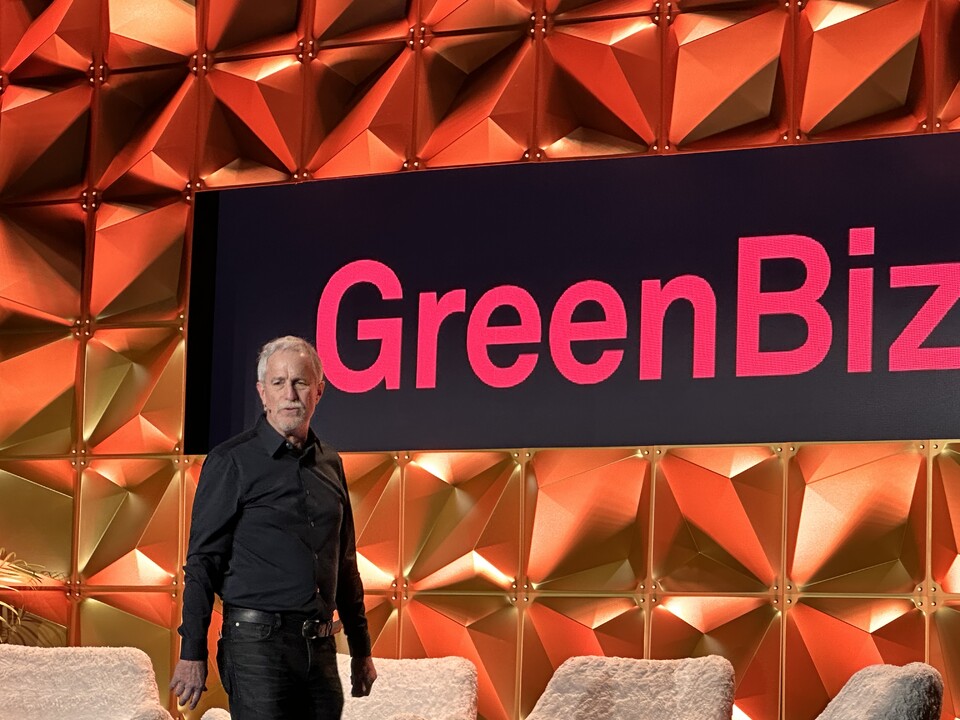
At GreenBiz 26, he framed the current moment as the middle of a story, the part where confidence wavers and allies become scarce. “We are not losing. We’re learning,” he told the room. The line is hopeful without being comfortable. Middles are where the complications live, and a journalist can do useful work there.
Makower has spent more than three decades making a profession legible to itself: first in an envelope, then on a screen, then in ballrooms and private peer conversations. His achievement is not that he solved the argument between commerce and climate. Nobody has. It is that he built places where the argument could become more specific, more candid and harder to ignore. The curiosity that began as a license to snoop became something sturdier: an institution with an open notebook.