The first door in Joe Noplis's story was an office door at Tate High School. He was a teenager in Pensacola, the sort of age when adults keep asking what comes next and every answer sounds both enormous and provisional. The principal, Ralph Godwin, knew something about the United States Air Force. Noplis stopped to talk with him several times while passing the office. Those conversations stayed with him. Years later, writing in remembrance of Godwin, Noplis said the principal's knowledge helped him make the decision to serve.
There are careers that look carefully engineered in retrospect, each job a polished stepping stone toward the next. Noplis's looks different. It has the consistency of a compass. The locations changed, the uniforms changed, and the people being protected changed. The direction did not.
He graduated from Tate in 1985 and enlisted in the Air Force in 1986. He became a military policeman and rose to sergeant. His service, listed from 1986 through 1997, took him around the world. During Operation Desert Shield and Operation Desert Storm, he deployed in support of U.S. Central Command at MacDill Air Force Base in Tampa. Long before security became a line on a school staff directory, it was his profession.
The craft of noticing
Military policing is a job defined partly by what does not happen. A gate stays orderly. A restricted space stays restricted. A routine movement remains routine. That makes its successes oddly private. The work is visible, but the result is often an absence: no breach, no escalation, no reason for everyone else to interrupt the day.
Noplis carried that craft into civilian federal law enforcement. The public record does not offer a scrapbook of cases, and the discretion feels appropriate to the work. What it does establish is the arc: he eventually retired in Miami as a federal law-enforcement K-9 sergeant. A professional partnership with a working dog adds another language to the job. The handler watches the surroundings and the dog; the dog reads traces unavailable to the handler. Neither works well without trust, repetition and an exact feel for the other.
At some point in this federal chapter, Noplis was associated professionally with the Federal Reserve System. His surviving LinkedIn listing connects his name, the Federal Reserve and Green Cove Springs, Florida, while the supplied professional title is the compact government abbreviation “LEO” - law-enforcement officer. The sparse wording is almost a miniature of the career itself: title, institution, duty. No ornament required.
He also completed a Bachelor of Arts in Intelligence Studies at American Military University. The degree fits the practical logic of the jobs he chose. Security begins before action, in the patient work of assembling signals, judging context and deciding what deserves a closer look. The dramatic moment is the smallest part of it. Preparation owns the larger share.
“He always said hello to all the students and we always respected this great man.”Joe Noplis, remembering Tate High principal Ralph Godwin
A career comes back to school
Today Noplis is back among school corridors, though now he stands on the adult side of that old office door. Southwest Florida Christian Academy lists him on its Security and Safety Team. It is a smaller geography than military or federal service: classrooms, fields, parking areas, the converging currents of arrival and dismissal. Smaller does not mean simpler. A school is a village on a bell schedule, full of young people practicing independence under the care of adults.
The academy describes his purpose plainly: helping provide a safe and secure environment for students, faculty and staff. Plain language suits the assignment. Nobody arrives at school hoping security will become the day's main event. The measure of good work is that algebra, lunch, rehearsals, practices and the hundred small dramas of growing up can occupy the foreground.
Schools also ask for a particular kind of presence. Authority has to coexist with approachability. The person noticing an unfamiliar vehicle may, five minutes later, be giving directions to a late parent or greeting a student who walks the same route every morning. Noplis's professional history is unusually long preparation for that balance. Military policing supplied the discipline of a post. Federal work supplied experience inside a large institution. Family and community life supplied the human scale. At a school, all three meet before the first bell.
There is a pleasing symmetry here. A principal's patient conversation helped a student imagine military service. Four decades later, that former student helps make a school safe enough for other consequential conversations to happen. It would be too tidy to claim that life planned the loop. It is enough to notice that the loop exists.
Noplis has been married to Teri since 1988, close to the beginning of his Air Force years. They have three adult children and four grandchildren. They are active members of McGregor Baptist Church. Those facts fill in the civilian landscape around the résumé: a marriage stretching across postings and professions, then children, grandchildren and a church community in Southwest Florida.
Service after the service
Retirement ended Noplis's federal K-9 career, but it did not end his inclination to take a post. VFW Post 8463 in Cape Coral lists him as its post service officer for the Air Force. The title is less familiar than commander or quartermaster, yet it carries the useful spirit of the organization. A service officer helps fellow veterans navigate the questions and systems that follow military life. It is a job made of listening, directing and following through.
His name also appears as a membership contact for the USAF Police Alumni Association, an organization built around what it calls the bond of the blue beret. Its mission joins memory with mutual aid: preserve the history of Air Force police, honor service and sacrifice, and support the people still doing the work. Noplis's presence there makes sense. The boy who sought information from a knowledgeable principal became the veteran whose name is offered when somebody else has a question.
The association's language is revealing. A bond is not a medal or a date on a résumé. It is a relationship carried forward. For former military police, shared procedures and shared pressures become a kind of shorthand. Noplis's work with veterans gives that shorthand a practical destination: someone can ask, and someone who understands can answer.
This is how a career in public service acquires a second life. Experience stops being only a private possession and becomes a map another person can borrow. A former military policeman understands the culture a young Air Force veteran is leaving. A retired federal officer understands how institutions speak. A grandfather working at a school understands that security is personal long before it is procedural.
The settings changed from base to agency to school. The central habit did not: notice early, stay steady, help the day remain ordinary.
It is tempting to write security stories as collections of alarms. Noplis's story is more revealing when read as a collection of continuities. He chose the Air Force after high school. He spent 11 years in uniform. He shifted to federal law enforcement, became a K-9 sergeant, and retired. He earned a degree that formalized the analytical side of his experience. Then he kept going, serving students and fellow veterans in roles where knowledge matters most when it is made available to somebody else.
His old principal understood that availability. Godwin said hello to students. He stopped to answer questions. The gesture was modest, the effect durable. Noplis remembered it more than two decades later, down to the route past the office and the conversations about the Air Force. Influence often travels disguised as ordinary courtesy.
The dependable person in the frame
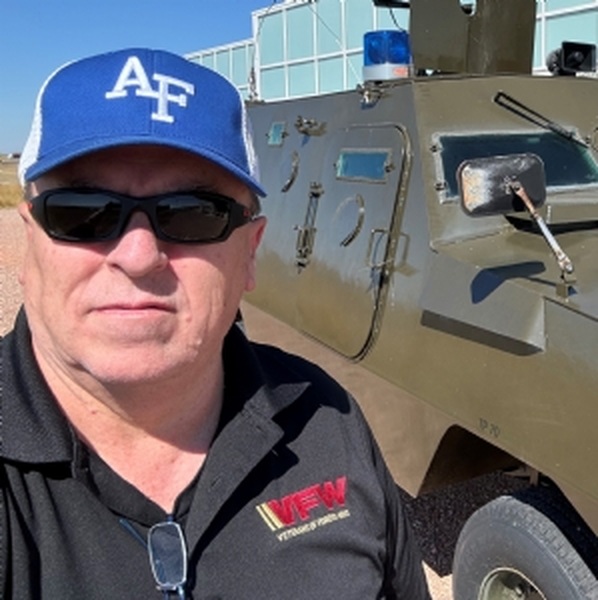
A photograph on the VFW roster shows Noplis in sunglasses and an Air Force cap, standing beside a military vehicle. It is not a ceremonial portrait. The sunlight is sharp; the framing is casual; reading glasses hang from his shirt. The picture has the appealing practicality of someone who came to see the machinery and happened to face the camera.
His school portrait supplies the complementary image: no sunglasses, a broad smile, a navy polo with the Kings crest. Between those pictures lies the distance from military service to school service, but not a reinvention. The same biography fits both frames.
Noplis's career makes a modest argument about purpose. It need not arrive as a lightning strike or a personal brand. Sometimes it is simply the work a person keeps choosing when the scenery changes. Guard the post. Learn the system. Train with the dog. Answer the veteran. Watch the school door. Make room for everyone else to do what they came to do.
At Tate High, a principal once made time for a student considering the Air Force. Noplis walked through that door and spent a career on the other side of it: present, observant and ready to help. The remarkable part is not that he returned to a school. It is how little of the essential job changed.