A reporter receives a press release announcing that a company is delighted. It is delighted to welcome someone, delighted to unveil something, or delighted to have been named to a list. The reporter has twelve minutes before the meeting, no empty space in tomorrow's paper and 146 unread messages. Delight, in this economy, is not news.
This tiny collision - between the institution that must speak and the newsroom that can ignore it - is where Catalyst Communications Group makes its living. The Tampa consultancy was founded in 2017 by Preston Rudie, who spent two decades reporting for print, radio and television, then three years as communications and district director for Congressman David Jolly. Rudie had been the person deciding which pitch deserved attention. Then he became the person making the pitch.
The change of side did not require him to discard the old rules. It made those rules the product.
The shortest route into a newsroom may be to hire the people who used to say no.
The Catalyst wager
The rejection desk became the strategy desk
Rudie's biography contains a conspicuous number: 24 Regional Emmy awards, plus six Edward R. Murrow awards. The more useful credential may be all the stories he did not cover. Reporting trains a person to detect the distance between an organization's preferred announcement and the thing an audience would repeat at dinner. Capitol Hill adds a second education - how public institutions move, how a phrase mutates under scrutiny, and why an answer that is technically accurate can still sound evasive on television.
Catalyst has turned that double education into a staff model. Its public roster includes former reporters, news directors, a longtime metro columnist, municipal communicators, a lobbyist, public-affairs operators, a video director and a creative-services lead. In October 2025 the firm said its 15 members represented more than 250 years of combined experience working in and with media. The roster has continued to grow. This is not the familiar agency pyramid in which the most senior person appears at the pitch and the most junior person writes the copy.
Who buys that experience? Private companies, nonprofits, government bodies, executives and elected officials - people whose work is complicated enough to explain badly and visible enough that a bad explanation costs something. Catalyst says it works at local, state and national level. Its deepest map is Florida: Tampa, Orlando, Miami, the state Capitol press corps and the Associated Press. The 2026 hiring of South Florida communications veteran Rachael Lobeck gave the firm an explicit foothold in Miami.
One firm, nine ways to avoid becoming the wrong headline
The obvious service is media relations: find the story, prepare the spokesperson, approach the right reporter and measure the coverage. Around it sits the less photogenic work that makes a public moment hold together. Catalyst writes speeches and opinion pieces, shapes internal and external messages, manages social channels, stages press events, trains people for interviews and steps in when a crisis has turned every phone into a small alarm.
The communications stack
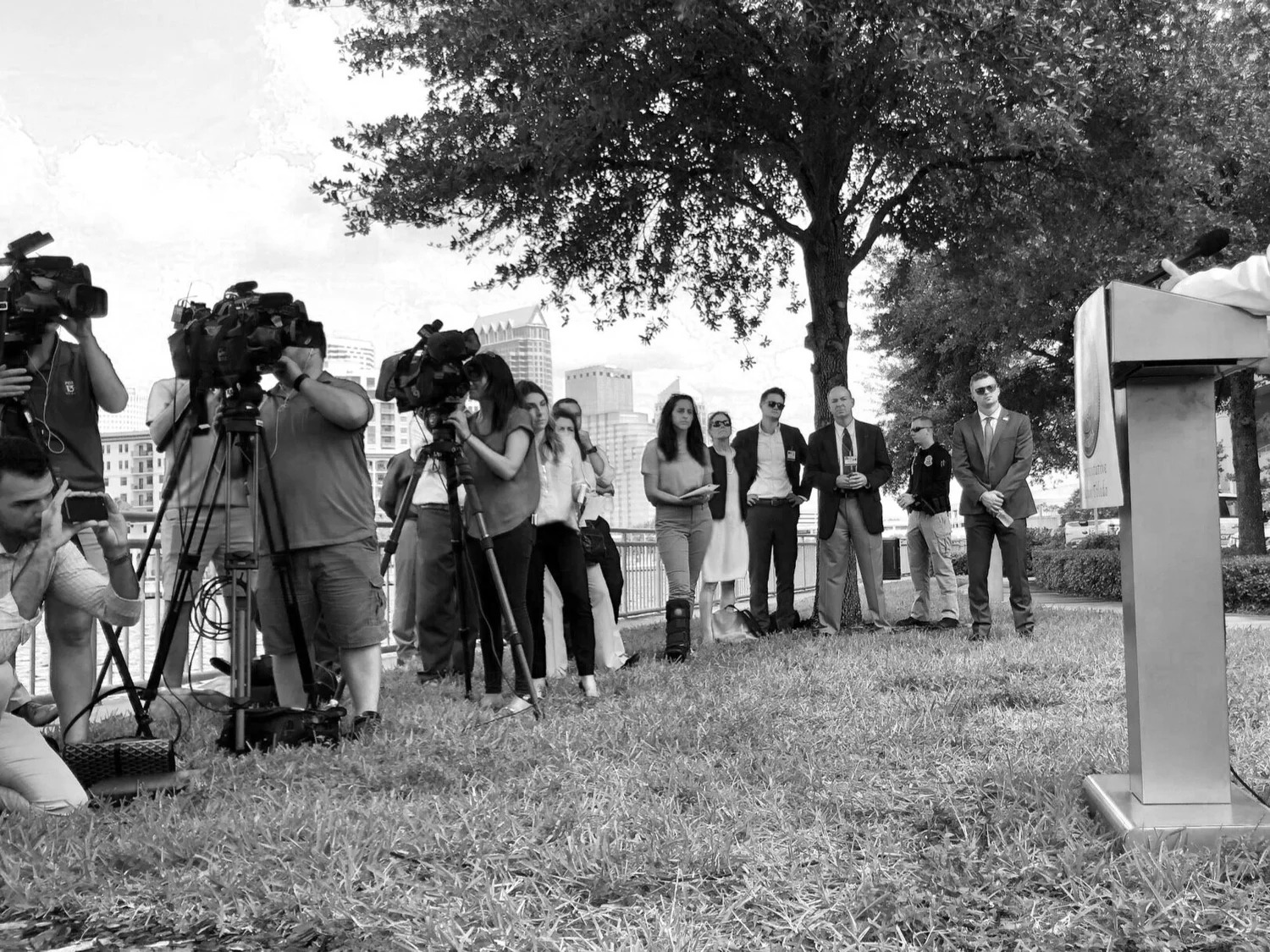
The firm's event work extends from choosing a venue to credentials, security, press kits and the geometry of a press conference. Media training covers message, tone, posture, facial expression and the strange difficulty of looking like yourself once a red camera light appears. A 2024 partnership with Tampa's 1887 Creative adds graphic design, brand identity, websites and social creative. Catalyst also lists video and photography inside its own team.
The distinction is not that no competitor offers these things. Plenty do. It is that Catalyst frames each service through the receiving end. A speech is not complete because the speaker likes it. A social post is not effective because it was approved. A press conference is not successful because there were chairs. The communication must survive contact with reporters, viewers, officials and people who have no obligation to care.
The rare price tag in public ink
Private agencies do not usually publish rates, and Catalyst does not post a menu. A Tampa Bay Water procurement document offers a more revealing glimpse. In 2022, the regional utility selected Catalyst alongside Dialogue Public Relations and B2 Communications for as-needed strategic-communications support. Catalyst's contract carried a ceiling of $135,000 a year and as much as $945,000 across a three-year base term and two possible two-year renewals.
Public contract anatomy / Tampa Bay Water
Maximum potential value across seven years - not a disclosed bill, guaranteed spend or company revenue.
The document also explains why a public agency hires a firm like this. Tampa Bay Water wanted flexible help for newsletters, public meetings, ribbon cuttings, emergency outreach, water-quality messaging, conservation campaigns, writing and research without permanently expanding staff. That is the business model in unusually plain language: clients rent a bench of specialized judgment when the need is uneven, urgent or too political for improvisation.
The $945,000 was a maximum contract value, not a report of what Catalyst received. That distinction matters. So does the competition. Dialogue and B2 were selected too. In this market, relationships may open a door, but procurement still compares qualifications, workload, experience and fees. Catalyst is an alternative to other Florida PR firms, an internal communications hire, or the executive who believes the interview can be handled without rehearsal.
The first thing to fail is usually the premise
There is a limit to the newsroom-insider advantage. Relationships can earn a hearing; they cannot manufacture public interest forever. The approach weakens when a client withholds facts, confuses repetition with relevance, expects earned coverage on command or needs deep reach in a market where the team has no network. It also fails when the underlying act is less interesting than the announcement written around it.
Crisis work makes the limit sharper. Communications can reduce confusion, establish a credible spokesperson and stop speculation from occupying an information vacuum. It cannot repair conduct that continues, substitute for operational change or make contradictory facts agree. The first failure is often not the statement. It is the belief that the statement is the event.
The copyable newsroom test
- Why would someone outside the organization care today?
- What is new, specific, visual or consequential?
- Which claim can a skeptical reporter verify quickly?
- Who can answer the difficult second question on camera?
- If the company name vanished, would the story still be interesting?
That five-question test is the useful part a reader can steal. It costs nothing and it catches expensive mistakes early. Start with the audience's problem. Replace adjectives with evidence. Put the strongest verifiable fact first. Prepare for the question after the approved answer. If there is no honest reason to care, improve the act before polishing the announcement.
A local advantage tries a longer road
By 2025, Catalyst had been voted Best PR Firm by readers in Tampa Magazine's Best of the City program. The award is local and reader-voted, which is exactly why it fits: Catalyst's moat is not proprietary software or a patented technique. It is accumulated familiarity - with producers, public bodies, Florida communities and the tempo of a working newsroom.
Its latest chapter tests whether that familiarity can travel. New senior hires have brought experience from Tampa, West Palm Beach, Miami, municipal government, politics and national consumer brands. South Florida offers more clients and more newsrooms, but expansion creates the classic service-business puzzle. A firm wins because senior people know the terrain; growth demands that more terrain be known without thinning out the senior attention.
Catalyst's answer so far is to recruit people who already carry a map. It is a costly way to build a team and a sensible way to sell judgment. The firm does not promise a machine that turns announcements into headlines. Its more credible promise is human: before the pitch reaches the reporter with 146 unread messages, somebody who remembers that inbox has already asked whether the story deserves to survive.