A building can spend a surprisingly long time existing as a question. There is an address, perhaps a seller, perhaps a persuasive sketch. There are also rules about what can fit, assumptions about what people will pay, and a spreadsheet whose optimism deserves a second opinion. Joe Bromovsky has made the space between the address and the answer his business.
As CEO and co-founder of Algoma, he works on early real estate feasibility: the investigation that helps a developer decide whether to pursue a site. It is an unglamorous place to look for a housing story. Nobody cuts a ribbon on a well-rejected parcel. Yet a decision to walk away can preserve the time and money needed to pursue a better one.
Bromovsky brings a civil engineer’s background to that problem, along with experience in construction technology, a Harvard MBA and a CFA charter. The combination gives his work a particular shape. The physical possibility of a building and the financial case for building it have to survive the same conversation.
A civil engineer crosses the Atlantic
Bromovsky, whose formal biographies use Josef, grew up in the United Kingdom and began his career there. He has described an early interest in the physical world and an ambition to start a construction technology company. His father’s entrepreneurial ventures supplied one example of what that might look like. Large construction and engineering employers supplied a different education: repeated exposure to problems that were difficult to change from within.
At AECOM, he worked in a technology group developing new tools and identifying outside technology that could be introduced across the business. That experience connects directly to his eventual company. He had worked on construction projects, then on the systems intended to make those projects more productive. Founding a company meant taking responsibility for a proposed improvement himself.
He moved to the United States to study. Harvard Business School identifies him with its MBA class of 2023. By then, the interest in entrepreneurship had acquired a name: Algoma Homes. His path had brought him from engineering into business education while keeping the built environment firmly in view.
Before the platform, a timber proposition
In Harvard’s 2023 New Venture Competition listings, Algoma Homes appeared with a specific proposition: net-zero multifamily housing using mass timber and offsite manufacturing. That description is an instructive starting point. Before Algoma’s current emphasis on development intelligence, its public identity was already tied to the practical question of delivering housing through a more repeatable process.
The early HAX description adds detail. Algoma was presented as a digital architect and engineer, combining mass timber with standardized building components. Automated feasibility studies, architectural and engineering design, and connections to contractors and suppliers were parts of that proposition. The ambition extended from understanding a site toward helping a project get delivered.
There is a family resemblance between that early idea and the present platform. Standardized components ask which parts of a building can be reused. Feasibility software asks which parts of the investigation can be repeated without starting from an empty desk. Both put pressure on the habit of treating every project as an entirely fresh administrative adventure.
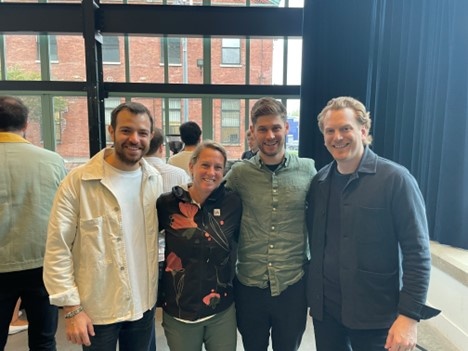
By September 2023, Bromovsky and his co-founders were circulating in New York’s climate and building community. A Climate Week photograph places him beside Seyfihan Usarer, Kyle MertensMeyer and Harvard’s Lynn Schenk. It captures an early stage of the company’s public life: three founders bringing a building proposition into rooms where people were discussing how to change the built world.
The expensive stretch before yes
Algoma’s May 2025 financing announcement described a familiar mess. Zoning information lived in PDFs. Spreadsheets, emails and preliminary financial models had to be assembled into a decision. Specialists supplied different pieces. A developer could spend weeks working out whether an opportunity deserved further work, while the opportunity itself refused to wait politely.
The company announced $2.3 million in seed funding, led by Zacua Ventures, with SOSV, Iron Prairie Ventures, DOMiNO Ventures, Compose VC and angel investors participating. Its stated plans were to expand engineering, improve the product suite and develop its web platform. The financing supported a business organized around getting those early questions into one workflow.
Led by Zacua Ventures, with five named institutional participants including the lead investor.
The initial customer focus was small and mid-sized developers, including teams working on infill, mixed-use and housing projects. That choice matters. A large institution may have people devoted to individual pieces of analysis. A smaller team still has to answer the questions. The calendar does not grant an extension for having fewer desks.
For Bromovsky, the attraction is the decision those pieces support. A parcel’s permitted capacity, plausible rents and construction assumptions belong together. A generous building envelope means little if the economics fail. A promising financial model is equally vulnerable if the physical site cannot accommodate the scheme. The job is to discover the disagreement early.
Give the question a shape
Algoma’s current public platform shows how the company approaches that job. Users can search for sites, inspect map layers, study capacity, review market information and export material for a team. The company advertises coverage across all 50 states and early feasibility in under 60 seconds. Those are company claims about its product, rather than a stopwatch result for every possible property.
Among the visible capabilities are GIS overlays for flood zones and wetlands, generated layouts, rent comparisons and renderings. The interface also presents a conversational agent for querying a site and changing assumptions. A developer can approach the work through an address and a question, then examine the consequences in a more concrete form.
- 01Find the parcelStart with a place.
- 02Read the constraintsRules, boundaries, ground.
- 03Test a possibilityCapacity, market, costs.
- 04Decide what comes nextInvestigate, revise or pass.
This diagram describes the questions involved; it is not a measured product benchmark.
The usefulness of that arrangement is easy to understand without confusing a preliminary output with a completed building. Moving an assumption should make its effects easier to examine. A drawing gives a number a shape. A market comparison gives a revenue assumption some company. A map layer can make a complication visible before it becomes an expensive surprise.
Keep a person in the loop
By April 2026, Algoma’s development included an associated services operation as well as self-serve software. Its founders described a path from early screening toward professional project work. Bromovsky’s team combined engineering, architecture and business experience; his co-founders brought design practice and operations backgrounds to the company.
In discussing the product that spring, he emphasized the outcome a homebuilder wanted and the continuing involvement of people. His formulation was compact: “Homebuilders want outcomes, not just tools.” It is a useful sentence for someone selling software. The customer’s destination is a viable project. The tool has to earn its place along the way.
“Homebuilders want outcomes, not just tools.”
Joe Bromovsky · April 2026
That perspective also keeps the story attached to physical work. Early analysis is one stage in a sequence involving people who design, assess and deliver projects. The company’s service component makes that connection explicit. The address enters a platform, but the project eventually has to leave it.
The timber thread is still there
The earlier building ambition remains visible in a specific project. In January 2026, the Georgia Forestry Foundation identified Algoma as the lead of the team for 1500 Waters, a proposed four-story, 18,000-square-foot residential building in Savannah’s Live Oak neighborhood. ACE Real Estate and Aspect Structural Engineering were also on the team.
The project featured in the Georgia Mass Timber Accelerator’s first cohort. The foundation described the proposed use of regionally sourced Southern Yellow Pine and reported $75,000 awarded across the cohort’s three projects. That total belongs to the cohort; it should not be mistaken for a personal award or a grant entirely to Algoma.
For Bromovsky’s story, the interest lies in the continuity. The founder whose early venture description involved timber housing now leads a company associated with both software and a timber project team. The work still reaches toward the same stubborn destination: a place where people might actually live.
A useful answer, sooner
Ask Bromovsky what he enjoys about the work and his answer returns to customers. He has described working on real projects and hearing how the team affects decisions as the rewarding part of the job. That gives the technical story a human scale. An analysis becomes useful when someone can do something with it.
His ambition is to help more housing reach construction by reducing the friction before it. The route he has chosen involves the patient details that sit beneath that ambition: a site, a constraint, an assumption, a revision. There is room for an informed refusal in that sequence. A developer who discovers a problem early has a chance to spend the next month elsewhere.
Bromovsky began with an interest in the built world. His company now asks people to look harder at the world before building on it. Sometimes the answer will justify the next drawing. Sometimes it will close the file. Either way, there is something rather civilized about getting the answer before falling in love with the rendering.