A vacant site has a peculiar talent for generating paperwork. Before there is a front door, there can be a zoning interpretation, a cost estimate, a sketch, a revised sketch and a spreadsheet whose optimism depends on which tab is open. Josef Bromovsky has built a company around this interval between seeing a piece of land and knowing whether it deserves a building.
The Algoma CEO and co-founder began as a civil engineer. His work now concerns an earlier kind of structure: the information that holds a development decision together. Can a site accommodate the proposed homes? What will they cost? Will the financial model survive contact with the design? These questions arrive before the construction crew, and they have a habit of bringing invoices.
Bromovsky’s proposition is to make that first investigation quicker and more accessible. The human story behind it runs through construction firms, a technology team, Harvard Business School, an unexpected student venture and a conversation that turned into a customer. The recurring problem is the price of waiting for an answer.
An engineer learns to read the paperwork
Bromovsky grew up in the United Kingdom and began his career there in civil engineering. He later worked in AECOM’s technology group, developing and evaluating technology for construction delivery. He had entered an industry that makes physical things and found a substantial opportunity in improving how its people work.
His qualifications eventually crossed three professional languages. Civil engineering deals with the constraints of the built world. A Harvard Business School MBA, completed with the class of 2023, added business training. The CFA designation added a formal finance credential. In development, the conversation passes between these disciplines constantly: a promising design still needs a workable set of numbers.
That combination helps explain the problem he chose. A beautiful building can be difficult to finance. A plausible financial model can conceal an impossible site assumption. Moving a project forward requires those judgments to meet. Algoma’s work occupies the space where an engineer’s calculation and a developer’s decision must agree.
“zoning codes are buried in PDFs”
Josef Bromovsky, May 2025
Before buildings, a different supply chain
There is a small surprise in Bromovsky’s Harvard years. In the 2022 New Venture Competition, he appeared on the team for AGRIBUY alongside Sofia Altuna, Luis F Gutierrez and Seyfihan Usarer. Their proposal was a digital marketplace linking farmers directly with restaurants, aiming to improve farmers’ returns, widen restaurants’ choice and reduce waste.
The entry places Bromovsky and Usarer together before Algoma. It also adds a useful complication to the polished biography that starts with an industry problem and proceeds neatly to a company. Here was another problem, another proposed business and another set of people trying to make a fragmented system work better.
AGRIBUY’s ambition concerned the journey from farm to restaurant. Algoma’s concerns the journey from site to development proposal. They are separate ventures, and the student entry stands on its own. Still, the earlier experiment belongs in the story. Entrepreneurship had already become something Bromovsky was doing, alongside the engineering career he brought to business school.
The conversation that became a customer
During their second MBA year, Bromovsky and Usarer attended the Harvard Real Estate Symposium. They were there to meet people in the industry. In Usarer’s account, an encounter with someone working for a real estate development firm in Savannah led to further conversations and an introduction to a developer.
That developer became an early significant customer and an investor. It is an unusually concrete example of what founders mean when they talk about building a network. An acquaintance at an event became a route to someone willing both to buy the work and to back the business.
Algoma’s founding group combined Bromovsky with Usarer and Kyle MertensMeyer. Usarer brought strategy and operations experience, including McKinsey; MertensMeyer brought architecture and product experience. Their backgrounds gave the company several ways to examine the same development problem. By February 2024, Bromovsky and Usarer were listed among the founders taking part in an urbantech event at Columbia’s architecture school, bringing their work into another room of people concerned with how cities get built.
A smaller developer at the center
Algoma chose a particular customer: small and mid-sized real estate developers. Its May 2025 funding announcement described teams working on urban infill, mixed-use development, affordable housing and workforce housing. Those projects require consequential decisions even when the business making them has a modest staff.
Bromovsky has described the attraction of serving developers directly. They bear the consequences when a project takes longer or costs more. Giving them earlier access to useful analysis puts the tool close to the decision and close to the person responsible for acting on it.
The starting point is an address. Algoma brings together zoning research, market information, capacity calculations, early design and financial modeling. The appeal is partly organizational. Information that would otherwise arrive through different conversations can be considered within a shared workflow. A change in one assumption becomes easier to examine alongside the others.
The question behind the address
- What is allowed?Zoning and site constraints
- What could fit?Capacity and early design
- Could it work?Market, costs and financial model
A conceptual map of Algoma’s feasibility workflow.
A quick decision to stop can be useful too. A site that cannot support the intended project still consumes attention while the team investigates it. The case for earlier analysis includes the work a developer can choose to abandon before spending further. In that setting, speed has a practical meaning: fewer resources committed to an unanswered question.
Wood, software and a real address
There is a physical thread running through Algoma’s software story. Its early work involved mass timber and repeatable building components, with automation intended to make design and engineering more efficient. The company participated in Harvard’s Climate Circle and was selected for the NYC Mass Timber Studio and Georgia Mass Timber Accelerator programs.
In Savannah, Algoma leads the team for 1500 Waters, a planned four-story residential building in the Live Oak neighborhood. The project is described as 18,000 square feet, with ACE Real Estate and Aspect Structural Engineering on the team. Its proposed use of regionally sourced Southern Yellow Pine connects the design to a specific material and regional supply chain.
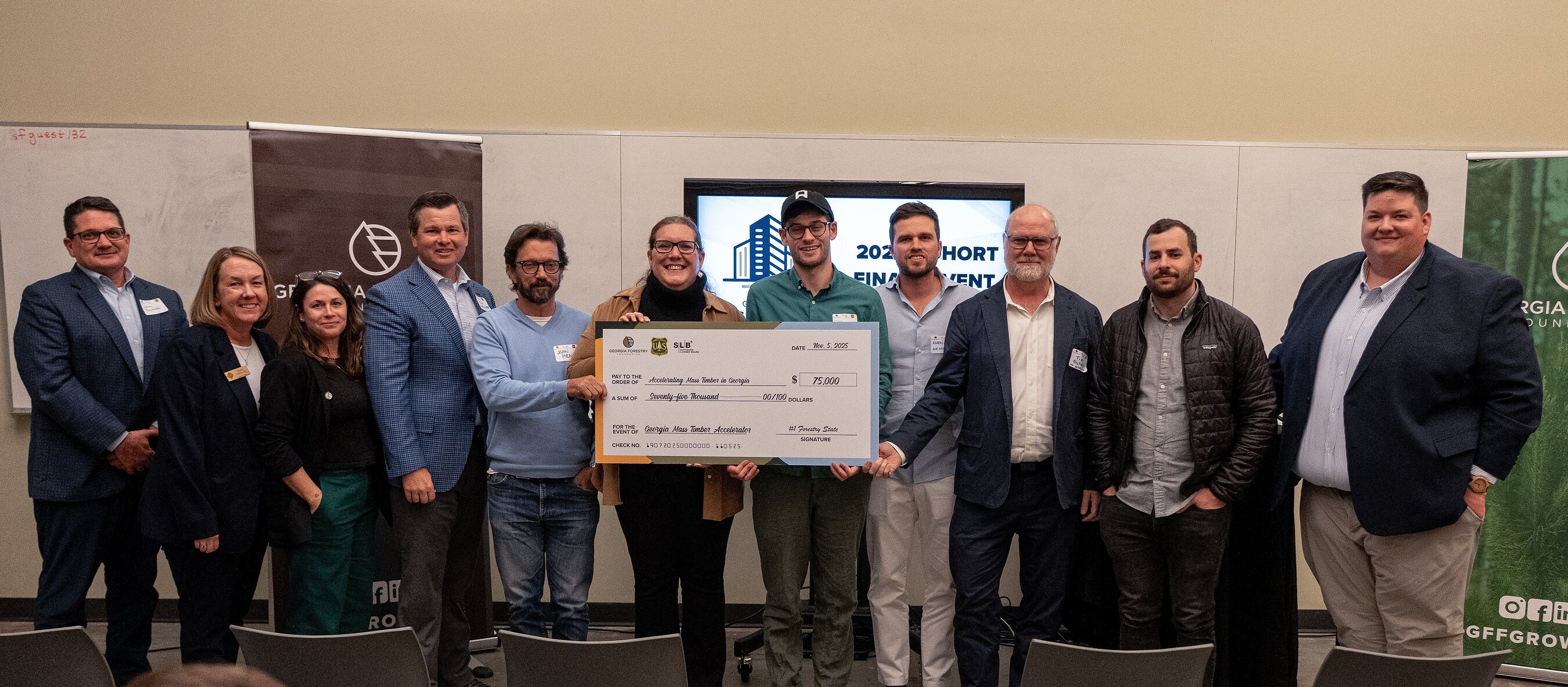
The distinction between a planned building and a completed one matters. Here, the work described is the development of a mass timber project, supported by an accelerator offering funding and technical assistance. It gives the software discussion an address, collaborators and a set of decisions that eventually have to be resolved in timber, drawings and construction.
A seed round, and the work after it
On May 15, 2025, Algoma announced $2.3 million in seed funding. Zacua Ventures led the round, with SOSV, Iron Prairie Ventures, DOMiNO Ventures, Compose VC and angel investors participating. The stated uses were engineering hires, a broader product suite and continued work on the web platform.
May 15, 2025
There was a close fit between the investor group and the industry Bromovsky was serving. Several backers worked in construction and the built environment. For a company selling into a specialized workflow, that familiarity matters: the discussion can begin with the problem the customer already recognizes.
Customers were describing practical benefits. Advenir Development’s Scott Weathers reported that work which had taken weeks could be done in a day. ACE Real Estate’s Amerigo Contini emphasized time saved and the ability to reuse a foundation while adapting each project. These are customer accounts, tied to their own experience, rather than a stopwatch for every future site.
By 2027, the founders’ stated ambition was a more integrated web platform, with expansion across asset types and, eventually, international markets. Those were plans. The immediate work remained specific: making the next version useful enough for developers to rely on when deciding which opportunities to pursue.
Learning to commit without certainty
Bromovsky’s current work is devoted to making decisions better informed. Starting the company required him to accept a decision that could never be fully informed. In discussing entrepreneurship, he has pointed to his father’s ventures as an inspiration and described commitment as something that helps other people engage with a founder’s idea.
“it’s impossible to have perfect information”
Josef Bromovsky, June 2025
That is a useful tension to carry into a business concerned with feasibility. Better information can narrow uncertainty, but someone still has to act. Algoma can assemble a picture of a site; the developer must decide whether to take the next step. Bromovsky faced his own version when he left the established-company setting for a venture of his own.
His career has moved from civil engineering to technology and then to the early judgments that precede construction. The throughline is tangible: making it easier to determine what can be built and whether the effort makes sense. For all the software involved, the question remains pleasingly ordinary. Is this worth building? Bromovsky has chosen to work on the long, expensive pause before the answer.