John Kouten interviewed with Joe Boyd in 1989. He did not get the job. Decades later, remembering Boyd, Kouten added a detail that gave the unsuccessful interview an unexpectedly long afterlife: Boyd had remained a friendly contact. He kept answering the telephone. An agency founder’s career usually arrives in public as a sequence of appointments and announcements. Here was something smaller, and rather more revealing: the applicant who could still get through.
There is a particular generosity in that. A recruiting conversation has an obvious purpose while a position is open. Afterward, the person on the other end becomes easy to forget. Keeping the acquaintance alive takes a different attitude toward professional life. The door may have closed on one job, but the conversation continued. Kouten’s memory allows us to begin with an interaction rather than an executive title.
Calep Allan Boyd III, known as Joe, co-founded MCS in 1985. He died on December 24, 2024. Between those dates lies the history of an agency and the working lives that passed through it. Boyd’s story becomes more interesting when the employees and applicants enter the frame. A founder establishes a business; the people around him discover what being part of that business actually feels like.
A newsroom before an agency
Before MCS, Boyd worked at the Lakeland Ledger in Florida, reporting on crime and the courts. He also taught journalism at the University of Florida, where he had earned his undergraduate degree. His professional route therefore included both making journalism and helping other people learn to make it. Writing, questioning, explaining: these were already working activities before agency ownership appeared on his résumé.
In 1980, he moved to Greensboro, North Carolina, to become assistant director of public relations in Ciba-Geigy’s agricultural division. A later appointment took him to the company’s pharmaceutical division in Summit, New Jersey, as public relations director. Then came the decision to co-found MCS. Five years separated the Greensboro move and the agency’s establishment. The chronology is compact; the changes of responsibility were substantial.
A reporter answers to an editor and a reader. A corporate communicator works inside an organisation with its own decisions and constraints. A founder must also concern himself with the people doing the work and the business that supports them. Boyd occupied each of those positions. There is no need to make the transitions seem inevitable. Their interest lies in the range of professional obligations they brought into one career.
- NewsroomCrime and court reporting at the Lakeland Ledger
- 1980Ciba-Geigy role in Greensboro
- 1985Co-founds MCS
- 2017CEO when Harrison becomes president
The business at human scale
The agency did not need an enormous staff to appear in the industry’s directories. A contemporary listing recorded sixteen full-time employees in 2013 and seventeen in 2014. Boyd was CEO; Eliot Harrison was executive vice president. Those figures give the business a useful human scale. Seventeen colleagues are people whose names can fit around a meeting table, even when their calendars are considerably harder to accommodate.
There is an earlier snapshot, too. A New Jersey business ranking using 1998 billings placed MCS fifth on its list of public relations firms, with $3.98 million in billings and Boyd named as senior executive. The entry located the agency in Summit and recorded its founding year as 1985. It is a spare little record: a name, a place, a number, and the person responsible. It gives the later office photograph a history beyond the photograph itself.
The distinction between those records is useful. Billings describe one measure of business activity in a particular year. Employee counts describe the size of a workforce in another. Neither tells us what it felt like to work there, and the figures should not be stitched together into a growth story they cannot support. They offer separate glimpses of an agency that had a life well before the succession announcement.
For a reader meeting Boyd through this retrospective, those glimpses provide proportion. The company was an operating concern with staff and commercial obligations, as well as a place people remembered warmly. Founding it involved taking responsibility for both. The recollections of opportunity acquire more substance when they are set inside an actual workplace, with its own address, payroll, clients, and succession to consider.
That scale matters to the way we read a founder’s reputation. In a small organisation, access to the person in charge can be part of ordinary working life. It also makes a founder’s habits especially visible. Decisions about whom to hire, how to respond to a question, and whether to take a call become encounters between people who may work together again tomorrow.
One account of an MCS interview captures Boyd welcoming a candidate’s doubts about the industry. Her reservations did not end the conversation. He saw a use for an unconventional perspective. It is a compact example of the difference between asking applicants to sound agreeable and allowing them to reveal how they think. A good interview occasionally becomes more useful at precisely the moment it becomes less polished.
“He gave me an opportunity and I will always be grateful.”
Christopher Vancheri, remembering his first PR job
An advertisement from 2016 offers another view of the business, this time one MCS chose to put into print. Boyd appears above a photograph of the office entrance. The words beside him place creativity, service, and results together. The design presents a person and a place before the reader has finished considering the sales pitch. Even public relations must sometimes allow the office door to do a little public relations.
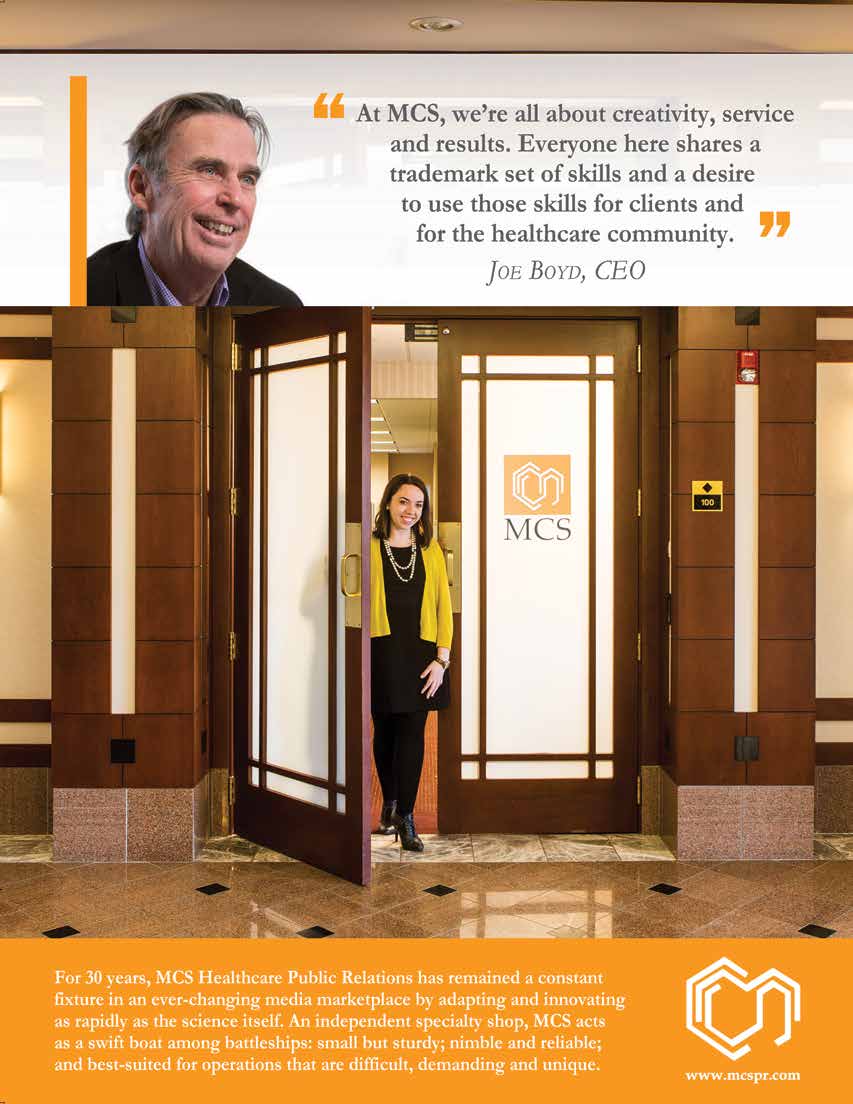
An advertisement is a statement of intention. It tells us how a business wished to introduce itself. The useful question is what happens when that chosen description sits beside the memories of people who were there. In Boyd’s case, the emphasis on service finds an echo in recollections of access and opportunity. The public promise and the personal memory belong beside each other, with neither asked to stand in for the whole story.
Thirteen years before the title
On May 3, 2017, MCS announced that Harrison would become agency president. He had joined in 2004 and served as executive vice president. His new responsibilities included long-range business planning, the agency’s people and resources, and the delivery of its work. There were thirteen years of experience inside MCS behind the change of title. A succession announcement can fit in a paragraph; preparation has a habit of requiring a longer calendar.
Boyd’s accompanying remarks described the quality of the working relationship he wanted MCS to have with clients. He valued Harrison’s wish to be involved closely in their daily operations. He also praised creativity and the ability to encourage improvement in other people. These are practical expectations: understand the assignment from inside the client’s working day, and help colleagues do better work.
Harrison is Boyd’s eldest son. That family connection is part of the account, alongside the years spent at the agency before his appointment. Both facts deserve their place. The working chronology gives the relationship professional context, while the family connection gives it another dimension. Readers can hold the two together without reducing thirteen years of employment to a single line on a family tree.
From Harrison joining in 2004 to his appointment as president in 2017.
What the colleagues kept
After Boyd’s death, former colleagues recalled starting their careers at MCS. Christopher Vancheri remembered receiving his first opportunity in public relations. Tracy Furey remembered both learning and enjoying the experience. Kathleen Tobin Schoff recalled mentorship and a family atmosphere. Their accounts concern different careers, but they meet around the experience of being allowed to begin, learn, and belong.
Those memories make a useful companion to the formal milestones. Appointments explain who held responsibility. Recollections help explain how responsibility was experienced by the people around them. Neither account replaces the other. A company needs decisions, deadlines, and a plan for the next piece of work. The people carrying those responsibilities also remember whether the working day contained some pleasure.
Another colleague, Matthew Foster, remembered an evening at Boyd’s home, with dinner, stories, and classical music. It is a modest detail beside a company’s founding date, which is precisely why it deserves room. There is a person outside the professional biography. A guest remembers what it was like to spend an evening with him, without needing an announcement or a business result to explain why the occasion mattered.
Boyd’s lasting presence in these accounts comes through ordinary verbs: giving, learning, listening, answering. They are the activities that disappear when a career is compressed too far. Looking closely restores some of the people and occasions around the job titles. The founder becomes visible through the relationships that continued after the meeting, after the assignment, or after someone moved on.
Kouten’s unsuccessful interview returns to mind. There is no dramatic reversal to add; the account is memorable without one. The applicant did not become an employee. He remained someone Boyd would talk to. For a business built around communication, that is a satisfying detail to keep: long after the interview had served its immediate purpose, there was still a person willing to pick up.