There is a peculiar ritual at the entrance to modern work. Employers ask young people for experience. Young people ask where to get it. The answer is often an internship with limited seats, a long application, and a manager who is already too busy to manage. Jodi McPherson has spent enough time inside education and employment systems to recognize a circular argument when she sees one. Her response is Work Simplr, a Denver company that turns real business projects into short, paid assignments for vetted college talent.
The proposition sounds almost suspiciously practical. A company brings a backlog item: research, data cleaning, product testing, campus outreach, or another piece of work that keeps sliding to next Tuesday. Work Simplr helps define the brief with AI, divides the job into tasks, matches it with student operators, manages the workflow, checks the quality, and delivers the result. The company buys an outcome. The student leaves with earnings and a piece of evidence.
Evidence is the center of McPherson's argument. A course can teach a skill. A résumé can name it. A finished project can be inspected. It gives an early-career worker the deliciously concrete sentence that so many job applications demand: here is what I did.
The user-research trick was to become the user
McPherson's instinct for learning by doing predates the startup. In 2004, Pearson asked her to build accounting software. There was one inconvenience: she did not know accounting. So she enrolled in three accounting classes. She sat among 19-year-olds, took notes, did homework, and bombed quizzes. A product executive had quietly become her own field study.
She noticed that an idea could feel perfectly clear in the classroom and then dissolve by the time a student reached home. The difficulty was not simply the content. It was the gap between explanation and independent practice. That observation informed the product work, but the method is the more durable lesson. McPherson did not stand outside the experience with a clipboard. She occupied it.
Her career had already crossed educational publishing at McGraw-Hill and would extend through senior product, user-experience, career-readiness, and student-success work at Pearson. Company materials now summarize that history as more than 30 years in edtech. The long tenure matters because Work Simplr did not begin with a stranger's suspicion about how education meets employment. It began with an insider's fatigue.
A second act built around first chances
On December 13, 2019, McPherson paused. What she expected to be a short break from corporate life became a 15-month sabbatical. She later renamed it with characteristic cheer: a “soul-batical.” On June 30, 2021, she launched UPSKLS, the venture that evolved into Work Simplr. She was 51 and, by her own account, did not have a polished five-year plan.
She tells the story through golf. The founder has to take the swing before knowing whether it will be elegant, useful, or find the neighboring fairway. McPherson even gave her founder manuscript the title Tee'd Off. It is an apt frame for someone who writes with affection about underdogs, invokes Moneyball, and has little interest in waiting until permission arrives embossed.
The company began with a moral concern and an operational one. Capable students were stuck outside the gates of meaningful experience, especially those without the right network or the ability to accept unpaid work. Meanwhile, employers had consequential tasks piling up, yet no appetite for extra headcount or the administrative theater of hiring. McPherson's answer was to make the project, rather than the permanent role, the unit of access.
This depends on a less glamorous craft than matchmaking: scope. Vague work is expensive. The worker does not know where to begin, the manager discovers six interpretations of “done,” and everyone meets again on Thursday to discuss alignment. Work Simplr makes definition part of the product. Its current SprintWork model uses AI to help transform a rough need into a structured workflow, then relies on human execution and quality checks.
The case study that fits on a scoreboard
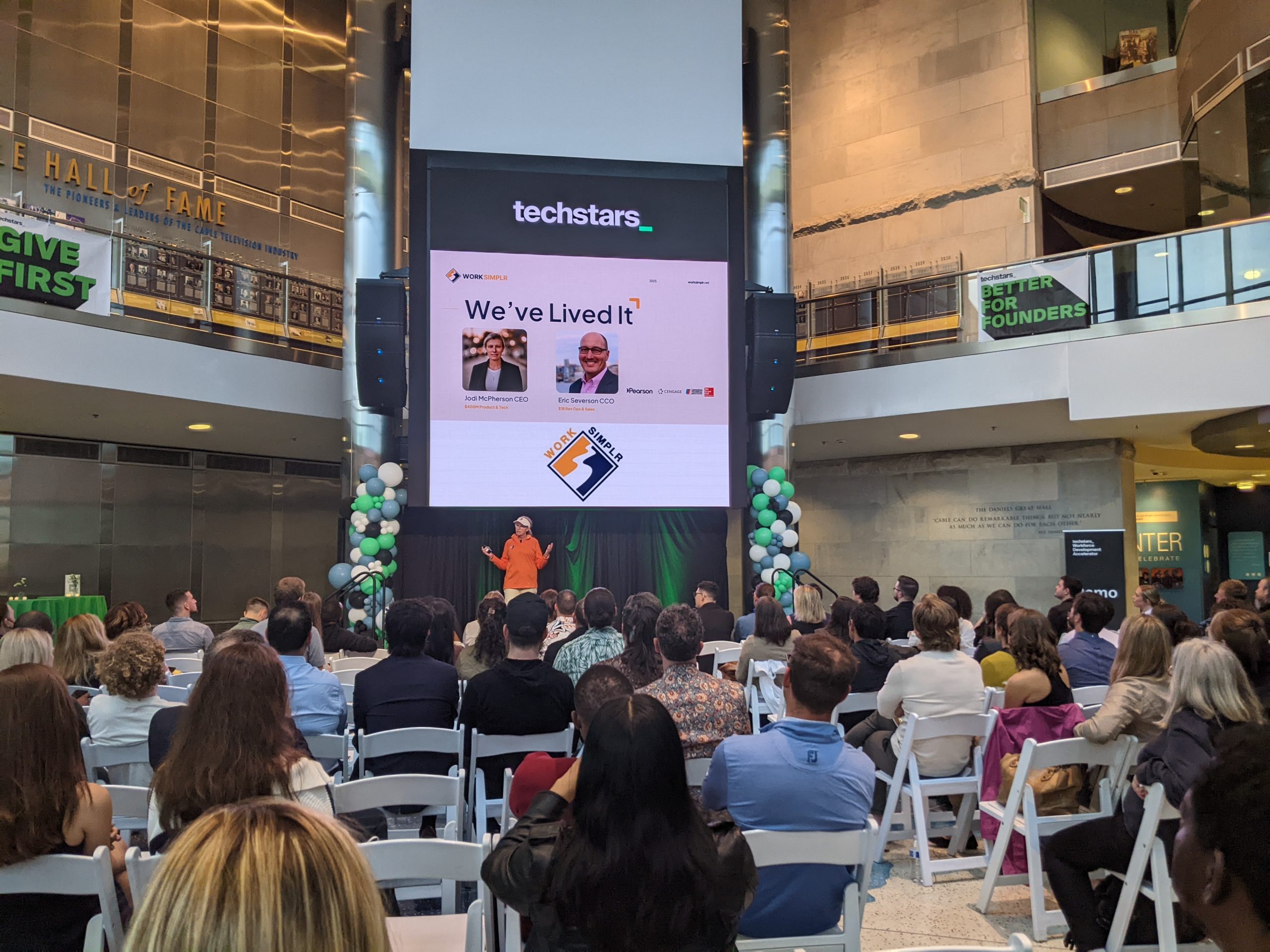
At Techstars Workforce Development Demo Day in June 2025, McPherson described the kind of assignment that makes the model easy to see. U.S. News & World Report needed a large amount of information for its university rankings work. Work Simplr recruited and trained 62 students. Together, they collected nearly 200,000 pieces of information in four weeks, accurately, according to McPherson's pitch.
The numbers are theatrical enough for a demo-day screen, but the revealing word is trained. A crowd is not a workforce merely because it has accepted invitations to the same spreadsheet. Large distributed projects need protocols, supervision, checkpoints, and a standard for error. McPherson's product sensibility appears here again: the interface between a person and a task must be designed.
The company later described itself as an AI-powered project delivery platform rather than a staffing agency. The distinction is commercial, but it also protects the learning experience. A student handed a hazy brief and abandoned to improvise may acquire a heroic anecdote. A student working inside a thoughtful process can acquire repeatable judgment.
The apprenticeship after automation
AI complicates the first rung. Entry-level knowledge work once contained a great deal of repetition: compiling data, reformatting documents, preparing basic reports. Those chores were rarely beloved, but they taught the geography of an organization. As software absorbs more of the mechanics, young workers can lose both the drudgery and the informal apprenticeship hidden inside it.
McPherson's view is that the work is transforming, not simply vanishing. Students need to practice judgment, iteration, and AI orchestration earlier. Employers, in turn, need infrastructure that lets emerging talent contribute without pretending the old apprenticeship will reappear untouched. Work Simplr places AI at the scoping and acceleration layer while keeping people in execution and verification.
This is why McPherson resists treating only formal internships as legitimate experience. A part-time job, freelance gig, campus role, research position, co-op, or well-designed project can teach someone to show up, take feedback, solve an unfamiliar problem, and finish on a deadline. The label is less important than the consequential work inside it.
Curiosity over noise
Her public voice is direct, green-clovered, and fond of a useful provocation. She writes about equal parts optimism, caffeine, and stubbornness. She takes an annual week to read, walk, and reset. She has described her mother as the original person who believed in her and traced three values back to that influence: create opportunity, open doors, give people a shot.
Those values risk becoming a handsome poster unless the operating model can carry them. Work Simplr's challenge is to make access reliable at the same moment it makes delivery reliable. Students must be paid and supported. Clients must receive accurate work. AI must reduce friction without laundering errors. Scale must not make the experience anonymous.
An accelerator lap, then another
Work Simplr's path has included several institutions built to question a founder's assumptions in public. The company entered the ASU+GSV Elite 200 in 2022 and reached an ASU+GSV Shark Tank final in 2023. It joined the Butler Accelerator for Education and Workforce Innovation, powered by Gener8tor, in late 2024. In spring 2025 came the Techstars Workforce Development Accelerator in Denver, followed by participation in a Google cohort focused on artificial intelligence.
Accelerators are compressed exercises in translation. A founder must explain an unruly system to investors, customers, advisers, and other founders, usually before the coffee has achieved its full diplomatic effect. McPherson credited Gener8tor's investor meetings with validating the company's pitch and creating useful follow-up conversations. The more visible consequence came at the Techstars demo day, where a room could grasp Work Simplr through one project and three numbers: 62 students, almost 200,000 data points, four weeks.
That evolution is visible in the company's language. The early story emphasized a student-centered freelance marketplace. The current pitch emphasizes project delivery: define the work, arrange the people and software around it, verify the result, ship. Students remain central, but the customer no longer has to become a part-time workforce coordinator. McPherson has moved the operational burden inside the product.
McPherson appears energized by exactly this sort of knot. Former colleagues describe a curious product leader who connects people and builds user-centered systems. Her own favorite shorthand is “curiosity over noise,” a small phrase with the discipline of a filter. The labor market produces abundant noise: credentials, titles, applications, promises, panic about automation. Curiosity asks a calmer question. What did the person actually do?
The answer Work Simplr wants to manufacture is visible and paid. A research file. A tested product. A clean dataset. A finished sprint. For the employer, one task leaves the backlog. For the student, one line of possibility becomes a story with a beginning, middle, and delivered end. And for a founder who began this chapter at 51, every first chance contains a quiet argument for second acts too.