Enterprise software likes to begin at the beginning. A request is opened. A supplier is found. A contract is negotiated. Somebody signs. The dashboard turns green. Yet the signature is only the ceremonial middle of the story. After it come the obligations, price adjustments, insurance certificates, service levels, renewals and small promises with expensive consequences. Jesal Mehta built Aavenir around that afterlife.
It is an appropriately unfashionable obsession for a founder whose career has been spent in the plumbing of large organizations. Mehta has worked as a systems analyst, software engineer, implementation manager, operations leader and product general manager. His route ran through Tata Consultancy Services, Novell, Nextance and Revitas before Apttus gave him a larger canvas. Each job brought him closer to the place where software meets policy and policy meets the people who must somehow get the work done.
A contract, in this world, is not a handsome stack of paper waiting for a fountain pen. It is a compressed operating system. It contains permissions, deadlines, prices, protections and chores. Leave it in a repository and it becomes a well-organized secret. Connect it to a workflow and it can tell the business what to do next.
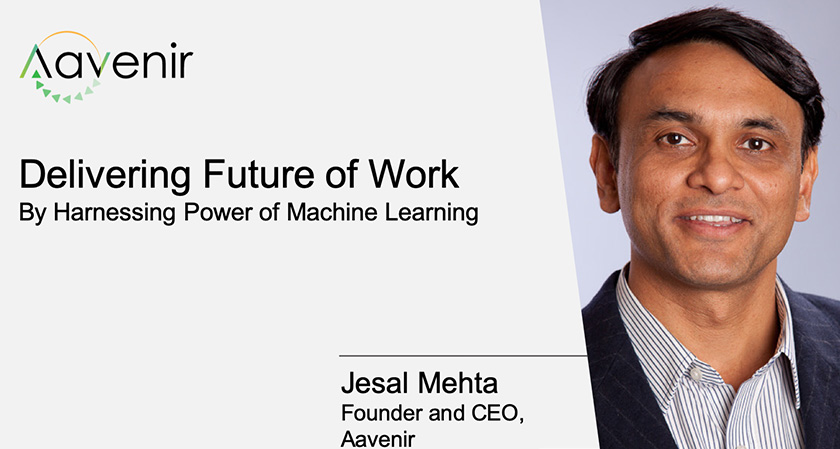
The long apprenticeship
Mehta began at TCS in 1992 and spent the next stretch of his career moving between code, implementation and operations. That range matters. Enterprise products can be immaculate in a demonstration and unruly in a deployment. Someone who has lived on both sides learns to distrust the elegant answer that ignores migration, integration or the person staring at a Monday-morning queue.
He also learned across geographies. After roughly a decade in Silicon Valley, the Gujarat native returned to India. At Apttus, he led India operations as the quote-to-cash company expanded. In 2016, he helped open a Bengaluru research and development center, the second Indian site after Ahmedabad. By the following year, the operation had grown to 450 employees across three cities, supporting sales engineering, professional services, engineering and product development.
That is a specific kind of founder training. It is not the romantic apprenticeship of a napkin sketch and a garage. It is hiring plans, delivery ownership, partner models and several hundred opportunities for a process to be misunderstood. In 2017, Apttus promoted Mehta into a global role managing its core contract lifecycle management product. The operator was now responsible for the thing itself.
Begins a long enterprise-software career at Tata Consultancy Services.
Moves into offshore-operations leadership at the company later known as Revitas.
Joins Apttus and starts scaling its India operation.
Takes global responsibility for Apttus contract lifecycle management.
Founds Aavenir around AI-enabled source-to-pay work on ServiceNow.
Raises a $6 million Series A led by Accel.
In 2019, he founded Aavenir. The company chose a narrow architecture with wide implications: build source-to-pay applications natively on ServiceNow. Instead of introducing another island, Aavenir would meet enterprises on a platform many already used for workflows, identity and approvals. Contract management, sourcing, vendor onboarding, obligation management and accounts payable could share the same institutional bloodstream.
We started this company with three core values; customer success, innovation, and joy - joy for our employees and joy for our customers.Jesal Mehta, 2019
A little joy in the procurement queue
Joy is the odd word in that sentence, which makes it the useful one. Procurement systems are more commonly associated with compliance, control and waiting for Gary to approve something. Mehta noticed the strange split between the software people tolerated at work and the software they enjoyed at home. A procurement professional could buy something on Amazon with clean context and recommendations, then return to an office terminal that seemed a decade older.
His phrase for the repair was “consumerizing the work experience.” It did not mean turning a contract into entertainment. It meant treating clarity as a serious feature. Give the user guidance. Bring the relevant clause forward. Make an approval understandable. Reduce the number of systems a person must visit simply to discover what the business already knows.
Aavenir's early products applied machine learning to two stubborn forms of disorder: invoices arriving in thousands of vendor-specific formats and contracts full of unstructured language. In a 2019 interview, Mehta described one customer dealing with 16,500 vendors and 400,000 invoices a year. The point was not the splendor of an algorithm. It was the absurdity of asking an accounts team to decipher all of that by hand.
The company launched with three differentiators in Mehta's telling: ServiceNow, user experience and AI. He has since sharpened that last word into a sequence. Begin by helping people find contracts. Then identify metadata, clauses and obligations. Once those foundations are dependable, move into redlining, deviation analysis and automated review. A chatbot can sit alongside the process, but it does not replace the process.
This is less theatrical than declaring that artificial intelligence will reinvent legal work by Thursday. It is also more credible. Search is frequent. Extraction is measurable. Review carries consequences. The order respects both utility and risk.
The ownership trap
The hardest problems are often organizational rather than computational. Procurement optimizes for speed and savings. Legal optimizes for risk and compliance. Put contract lifecycle management entirely inside one department and the other may become a queue, an obstacle or a quiet escape route. Mehta has written that this procurement-versus-legal framing creates a ceiling on value.
A manufacturer can build a smooth procurement flow only to watch agreements stall in legal review. Legal can build an admirable policy fortress while employees route around it because business must continue. The software is then blamed for faithfully expressing a governance problem nobody settled.
Aavenir's answer is shared workflow: common data, visible decision rights and connections to governance, risk and compliance. Supplier performance can shape the clauses used in the next contract. Contractual obligations can become assigned work after signing. The agreement stops being departmental property and becomes operational infrastructure.
Great tech happens when people listen, that's Aavenir's way.Jesal Mehta
Capital for the unglamorous middle
In March 2022, Aavenir announced a $6 million Series A led by Accel, with ScOp Ventures participating. The round brought reported total funding to $8 million. Mehta said the money would support new products, a larger source-to-pay footprint and a stronger sales team. He also emphasized the practical advantage of the ServiceNow relationship: certified applications, faster implementation and a lower total cost of ownership.
Funding did not change the central premise. The company kept working in the unglamorous middle where a supplier response becomes an award, a contract becomes an obligation and an invoice becomes a payment. In 2025, Mehta described AI-powered contract intelligence as a way to make buried obligations visible and turn procurement teams into more strategic partners. In May 2026, Aavenir announced agents for scoring supplier responses, recommending awards and managing post-signature obligations.
The word “agent” can carry a great deal of costume jewelry. Here, the jobs are concrete. Compare bids. Explain why one supplier ranks above another. Extract commitments from several related documents. Remove duplicates. Generate instructions for an owner. Validate the evidence that a task is complete. Each action has a before, an after and somebody who cares about the result.
The marathon, appropriately
At an entrepreneurship conclave, Mehta once gave a talk titled “The marathon mindset.” The title fits the résumé. More than three decades separate his start at TCS from Aavenir's latest generation of AI agents. Twenty-plus years of that journey have touched contract management. When a podcast host mentioned the length of his experience, Mehta joked that it made him feel old, then used the history to explain just how far the category had moved: a contract repository once counted as advanced.
His public comments suggest an operator who likes novelty but distrusts novelty without adoption. At Aavenir, employees were encouraged to lead new initiatives without fear of failure and ask a daily question: “Did we do something new?” The second half of the idea mattered as much as the first. If the experiment failed, had the team learned something? Innovation was not a permission slip for noise. It was a demand for evidence.
There is also patience in choosing contract software as a life's subject. Its dramas are quiet. A renewal date passes. A discount is not applied. A supplier promise lacks an owner. A clause nobody can find would have answered the argument. These are small moments until thousands of them begin to resemble strategy.
Mehta's aspiration for Aavenir is contained in its name, taken from the French word for future. Yet his version of the future is strikingly grounded. It looks like fewer disconnected systems, a contract that can explain itself, and an obligation arriving in the right person's queue before it becomes a surprise. The paperwork does not disappear. It learns how to participate.