An automotive seat is an excellent place to hide a complicated business. Sit down, adjust the backrest, complain about the traffic. Somewhere beneath that entirely reasonable routine are foam formulations, metal structures, sewn covers, purchasing decisions and a factory schedule. Jerome Dorlack has spent his career moving among the departments responsible for making such things work. In January 2024, he became president and chief executive officer of Adient, the automotive seating supplier based in Plymouth, Michigan.
The interesting part of that promotion is the route. Dorlack had already been Adient’s purchasing chief, led its Americas business and served as chief financial officer. Before that came powertrain products, electrical distribution systems and years across engineering, quality and operations. Read his career sideways, across functions rather than upward through titles, and it becomes a study in industrial education. Each job supplies another way of looking at the same object.
A designer sees a surface. A purchasing executive sees the material and the supplier. An operations leader sees the sequence required to make it. A finance chief asks what remains after everyone has been paid. Dorlack’s résumé passes through all those rooms. The seat, obligingly, stays in the middle. It is a useful vantage point for understanding an executive whose public story is closely tied to the work itself.
He earned both an engineering bachelor’s degree and an MBA at the University of Toledo. The pairing suits the career that followed: technical training alongside the language of business. His early professional years included 17 years at ZF/TRW Automotive, with assignments spanning engineering, commercial work, quality, operations and purchasing. That is a lengthy acquaintance with the places where an elegant plan can become an expensive practical problem.
Purchasing, powertrains, then the Americas
By 2013, Dorlack was vice president of global purchasing, supplier development and logistics at ZF, a position he held until 2015. He then became executive vice president of global procurement, serving until 2016. Those titles put supplier relationships and the movement of materials near the center of his career. Procurement is easily mistaken for a prolonged argument over price. The inclusion of supplier development and logistics suggests how much else belongs in the conversation.
In 2016, he moved to Delphi, where he became vice president of powertrain systems and general manager of global powertrain products. From 2017 to 2018, he served as a senior vice president at Aptiv, heading electrical distribution systems and South American operations. The assignments expanded his responsibilities across products and geography. They also preceded his arrival at a company concerned with one of the few vehicle components every passenger gets to judge personally.
Dorlack joined Adient in 2018 as vice president and chief purchasing officer. In 2019, he took charge of the Americas as executive vice president. The progression mattered: he went from buying for the business to running a region of it. In 2022, Adient named him executive vice president and CFO. Four years after joining, he had held responsibilities touching the supplier base, the operating business and its financial accounts.
- 2018Purchasing
- 2019Americas
- 2022Finance
- 2024CEO
Year each role began. A career measured in changing responsibilities.
An inside succession, with work attached
Adient announced the succession in November 2023. Doug Del Grosso would retire at the end of December; Dorlack would become president, CEO and a board member. Mark Oswald would take over the finance role. Del Grosso specifically pointed to Dorlack’s record leading the Americas and serving as CFO. The appointment carried a straightforward logic: the next leader already knew several versions of the company.
Dorlack’s response emphasized continuity. He thanked Del Grosso and talked about building on the existing business and its customer relationships. There was no promise to abolish the ordinary laws of manufacturing. Seats would still have to be engineered, produced and delivered. The appeal of an internal successor, in this case, lay in familiarity with those obligations and with the people already carrying them out.
The scale makes that familiarity consequential. In 2026, Adient described a business with more than 65,000 employees, operations in 29 countries and approximately 200 manufacturing and assembly plants. Those are company figures, rather than personal accomplishments. They describe the reach of the job Dorlack inherited: a decision made in an executive meeting has to survive translation into many factories, customer programs and local circumstances.
The small engineering of a large business
On his first quarterly earnings call as CEO, in February 2024, Dorlack discussed growing complexity inside the vehicle cabin. He described customer interest in reclining seats, longer seat rails and sound integrated into seats, alongside changing safety requirements. A passenger may experience these as pleasant additions. A supplier has to find a repeatable way to manufacture and assemble them. Luxury, viewed from the factory, comes with a work instruction.
He also described modular assembly: building backframe and cushion pan modules within Adient’s existing manufacturing network to improve labor, freight and inventory efficiency. The discussion connected product engineering with logistics and production. It is precisely the sort of problem that crosses the functional boundaries in his career. A better seat matters commercially when the company can also make and deliver it at an acceptable cost.
A concrete example arrived in February 2026 with the announcement of Sculpted Soft Trim. The technology uses an automated forming process to reduce sewing in seat covers and other interior parts. In one child seat anchor application, Adient said a single pattern could replace as many as twelve individual patterns and sew lines. The claim concerned that application, rather than every seat. Its attraction is easy to understand: fewer pieces to coordinate, with more freedom over shape.
The people developing such products deserve their own names. Adient’s announcement featured Mike Maddelein, its Americas engineering vice president, explaining the manufacturing advantages. Dorlack leads the company in which that work takes place; the engineering belongs to teams. Keeping that distinction clear makes the story more interesting. A chief executive’s task includes creating the commercial and operating conditions in which somebody else’s technical achievement can become a product.
and sew lines
trim pattern
Sculpted Soft Trim example for a rear-seat child seat anchor location, announced February 2026. Results depend on the application.
Foam, footprints and what can be controlled
In April 2026, Adient bought a foam production plant in Romulus, Michigan, from Woodbridge. The deal included the building, land, equipment, inventory and associated assets. Existing employees would join Adient, and the UAW collective bargaining agreement would remain. The acquisition is an unusually tangible chapter in a corporate story: a particular factory, making a particular part of the seat, becoming part of the company’s production network.
The environmental work has a similarly practical side. Adient’s sustainable product design approach brings together material choices, engineering analysis and efforts to reduce complexity and waste. A dedicated team in Trenčín, Slovakia, supports its product carbon footprint tool. Applying that analysis early in development allows environmental effects to enter the conversation while product decisions are still being made. Sustainability becomes a design consideration with numbers attached, rather than a paragraph added after the tooling is ordered.
Dorlack’s public language repeatedly returns to execution. In May 2026, he described his teams as “focused on what we control.” The accompanying quarterly results showed why that distinction matters: adjusted EBITDA was $223 million, down $10 million from a year earlier, with customer production inefficiencies and volume and mix among the pressures. It was a reminder that experience provides ways to respond to uncertainty, rather than an exemption from it.
By the third quarter, reported in August, adjusted EBITDA was $225 million, essentially flat against the prior year. GAAP net income was $25 million. These are different measures and should remain separate. Together they offer a more useful view than a single congratulatory number: Dorlack’s operating agenda is being tested in actual quarterly results, where production difficulties, costs and customer decisions keep showing up in the arithmetic.
“Our teams remained focused on what we control”
Jerome Dorlack · May 2026 results statement, excerpt
A birthday cake in Chongqing
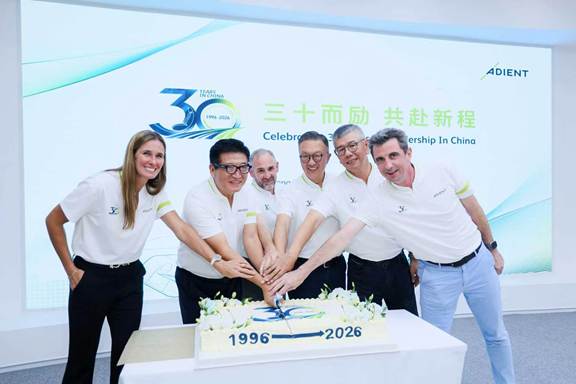
On September 22, 2026, Dorlack joined colleagues at Adient’s China Tech Center in Chongqing to mark 30 years of the company’s business in China. The photographs contain the expected anniversary ingredients: matching shirts, a group gathering and a cake. Industrial diplomacy occasionally comes with icing. Alongside the celebration was a substantial operating presence: 39 manufacturing facilities, three global tech centers and seating supplied to more than 40 domestic and international automakers.
In his remarks, Dorlack credited generations of employees and the trust of customers and partners. His optimism concerned the people, technology access, manufacturing network and customer focus already in place. The setting offers a helpful correction to the solitary CEO portrait. A business operating across borders is sustained by relationships that began before the current leader arrived and will need attention long after the anniversary photographs have been filed.
The next seat at the table
His stated leadership priorities also extend to conduct. In the opening message to Adient’s ethics policy, Dorlack singles out the principle “We respect and empower our people, always acting with integrity.” He treats everyday decisions and professional standards as part of the company’s competitive position. It is a public commitment that gives employees and customers something concrete against which to judge leadership.
The management team is changing again. In September 2026, Adient announced that board member Peter Carlin would join as vice president of finance on October 1 and become CFO on November 16, succeeding Oswald. As of October 21, that CFO handover is still ahead. Dorlack welcomed the planned appointment while acknowledging both executives’ contributions. The former finance chief is now responsible for another finance succession.
That is the continuing shape of his story: acquiring another perspective, then finding someone else to carry a part of the work. The engineering graduate became a purchasing executive, a regional leader, a CFO and finally CEO. His current challenge is to make those accumulated perspectives useful together. For the passenger, the desired result remains wonderfully modest. The seat should be comfortable, arrive with the car and give nobody a reason to think about all this.
Follow the work
Explore the company, Dorlack’s professional profile and the developments discussed here.
- Jerome Dorlack on LinkedIn
- Adient: company and products
- Official executive biography
- The CEO succession announcement
- Sculpted Soft Trim, explained
- The Romulus foam plant acquisition
- Adient’s China anniversary
- Third-quarter 2026 results
- The planned CFO handover
- Watch: Adient’s official YouTube channel
- Adient on LinkedIn
- Adient on X
- Adient on Facebook