A small boat has a way of making its occupants honest. There is limited room for luggage, less for vanity, and a rather immediate penalty for pretending the weather agrees with you. In 2014, Jeremy Warren and Phil Kirk sailed around Britain in an open Wayfarer dinghy called Hafren. The previous record was 76 days. They returned in less than half that time.
Two years later, Warren was helping launch another compact piece of equipment with ambitions beyond its dimensions. Oxford Nanoimaging, now ONI, was selling a microscope that could sit on a desktop and detect individual fluorescent molecules. A professor and a PhD student supplied the invention. Warren brought experience of getting scientific instruments out into the world.
The boat and the microscope belong in the same life story. Both invite a tempting mistake: admire the smallness and overlook the work that makes it useful. Warren’s public career offers a more interesting subject than a collection of titles. It follows the practical business of making equipment, building a company around it, and deciding what success should leave behind.
A chemical engineer takes the long route
Warren’s preparation began well away from an Oxford optics bench. He studied Chemical Engineering at the University of Birmingham, then worked in production management at Unilever. He qualified as a chartered engineer. He subsequently established a chemicals manufacturing business in Belgium and earned an MBA at INSEAD. Strategy consultancy with Booz Allen followed.
That sequence gives his later career a useful context. Production management asks whether something can be made consistently. A manufacturing business adds the question of whether customers will pay for it. Business school and consultancy introduce another vocabulary: markets, plans, value. Scientific instrumentation brings those questions into unusually close contact. A device must perform in an experiment and survive life as a product.
There is a considerable distance between demonstrating an idea and delivering an instrument. The customer gets the instrument, the instructions, the support arrangements and whatever happens when something goes wrong. Warren’s career moved toward businesses occupying that distance. By 2005, according to his published biography from 2011, he had joined NanoSight as CEO.
Making a business out of seeing particles
NanoSight had been founded by Bob Carr and John Knowles in 2003. Carr’s technology made nanoparticles suspended in liquid visible and measurable. Its nanoparticle tracking analysis followed individual particles, using their movement to build information about their size. The commercial opportunity lay in giving researchers a practical way to examine materials that were inconveniently small.
Warren became the executive explaining that opportunity. In a 2012 interview, he described a business approaching 500 installed systems worldwide. Its customers included industrial companies and universities. An ASTM standard guide had given users a framework for good practice with the technique. That mattered because an instrument’s usefulness depends partly on confidence in the measurements it produces.
The same year, NanoSight received a Queen’s Award for Enterprise for International Trade. Warren discussed direct sales teams in France and Germany, and additional sales and technical support staff in North America. These are quieter details than a product launch. They also explain how an instrument becomes an international business: someone has to answer the questions after the demonstration.
For a company selling measurement equipment, the customer relationship does not end at the invoice. A laboratory must learn the technique, interpret its output and know where to turn when results puzzle it. The growth described during Warren’s NanoSight years included that surrounding machinery of sales and support. The apparatus on the bench was only the most visible part.
The exit had a next chapter
In September 2013, NanoSight was acquired by Malvern Instruments, part of Spectris. Spectris’s annual accounts put the total consideration at £16.4 million, or £14.6 million net of acquired cash. The transaction placed NanoSight’s particle-tracking technology alongside an established range of measurement instruments.
Warren’s account of the sale was unusually concerned with what came next. He described a process lasting about a year, spent working out where the company’s value lay and where it belonged. He stayed on as general manager. His discussion of the acquisition included opportunities for employees within a larger organisation, alongside opportunities for products and markets.
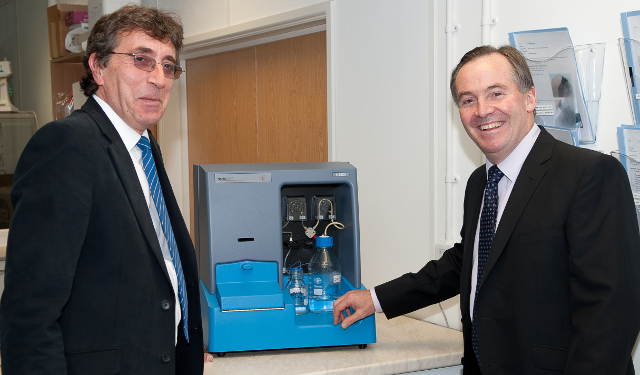
There is a revealing companion to that account in Warren’s testimonial about working with Qi3. He acknowledged that people immersed in developing a technology can struggle to assess it objectively. He welcomed outside questioning of NanoSight’s planning and market knowledge. The resulting models, he said, were built inside NanoSight with guidance, giving the team shared ownership of them.
That is an executive admitting the usefulness of being challenged. It suggests a working method rather than a personality slogan: ask someone who understands the technology to test the commercial assumptions. A company can be very knowledgeable about its instrument and still need help deciding which opportunities deserve its time.
A microscope that needed less real estate
When ONI emerged from Oxford in 2016, Warren joined Achillefs Kapanidis and Bo Jing as a co-founder and initial CEO. Kapanidis led the biological physics research group behind the technology; Jing was his PhD student and a co-inventor. The company existed to commercialise their Nanoimager.
The launch announced £1.2 million in seed funding from Oxford Sciences Innovation, Oxford Technology Management and Oxford-based investors Barnaby Martin and George Robinson. The instrument was described as roughly 30 times smaller than existing super-resolution microscopes, with the footprint of a desktop computer. Its compactness had an intended consequence: more researchers could have access to the technique.
“With Oxford Nanoimaging, we aim to democratise the use of super-resolution microscopy.”Jeremy Warren, 2016
Warren’s language attached the engineering to a customer. Researchers without a laboratory full of specialist physics equipment, or the budget to acquire it, were the audience. He anticipated that 90 per cent of second-year sales would be outside the UK. That was a forecast at launch, an expression of the exporting business he hoped to build.
In his technical explanation, he emphasised an optical design assembled from the bottom up, with components machined into place rather than screwed onto a breadboard. The ambition was to remove alignment difficulties. The useful question was whether someone could buy the capability without also taking responsibility for constructing a microscope.
A compact instrument for single-molecule imaging.
Dimensions describe the launch-era Nanoimager.
ONI’s launch also had a commercial head start. Warren described a finished product, an established team and orders already in place. Academic development had preceded incorporation. For the person responsible for running the business, that changed the starting problem: customers and delivery were immediate concerns, rather than distant rewards for a successful prototype.
The other compact machine
Hafren provides a different view of Warren’s relationship with equipment. The plan began after a conversation with Kirk at Thornbury Sailing Club’s Christmas dinner in 2011. Preparation took two and a half years. Both were engineers. They modified the boat, simplified controls, tested equipment and practised recovering from a capsize.
They also enlisted experienced advisers for weather and navigation. This was a small vessel backed by a wider network of judgement. The record attempt depended on practical preparation and favourable conditions; the crew’s account gives both their due. Warren’s recollection of night sailing included feeling vulnerable and humbled. The sea had declined to sign a testimonial.
In a voyage dispatch under his own name, Warren returned to a modest number: 3.5 knots. It had appeared in their trials and again after the first leg from Weymouth to Dale in Wales. That passage covered 250 miles over 67 hours, including three nights. A small average speed, sustained, carried them a long way.
The dispatch included the less glamorous work of progress. When the wind dropped near Milford Haven, they paddled and caught a channel buoy. A lifeboat passed on its way to another vessel. Kirk described their limited space changing function between kitchen, chart table and toilet. Whenever one person moved, the other had to compensate.
Those details keep the achievement human. A record is a clean figure at the end of an untidy journey. The journey itself consists of meals, forecasts, tired decisions, local help and equipment that must earn its place. Warren’s engineering life had acquired a distinctly damp field test.
The people left standing
In a local interview in 2021, Warren described laboratory-instrument businesses as “the picks and shovels of the nanotechnology gold rush”. The metaphor gives the customer the discovery and the instrument maker the enabling work. It is a sensible division of labour, with fewer speeches required.
The same interview recorded a more personal measure of achievement: the young people he had encouraged and trained, many of whom had gone on to fulfilling careers. After retiring from work that May, he joined Aust Parish Council. His interests included the local environment, future flood defences and the power-station site. Council minutes recorded his resignation in February 2026.
The scale had changed again, from international customers to local questions. Throughout the story, instruments, colleagues and collaborators occupy the foreground. Warren’s career is best understood through that company: the inventors beside him, the researchers using the equipment, the staff finding their next roles, the friend sharing a small boat. Making something smaller can widen the circle around it.
Follow the instruments and the voyage
- ONI - microscopes and imaging
- Jeremy Warren on LinkedIn
- nanoTherics - Warren’s professional biography
- The NanoSight conversation, 2012
- Warren on the Malvern acquisition
- ONI’s May 2016 launch
- The Nanoimager’s engineering and early orders
- The RNLI’s Hafren voyage feature
- Warren’s dispatch: 3.5 knots
- The Littleton interview, June 2021
- Warren on outside scrutiny at NanoSight
- Spectris’s 2013 acquisition accounts
- Aust Parish Council’s February 2026 minutes
- Watch: Warren explains nanomaterials (4:18)
- Watch: Warren demonstrates the LM20 (5:06)