Bo Jing’s microscope had an unusual competitor: the ease of a television prop. In Star Trek, a sample could go on a table and a computer could be asked to look closer, all the way down to individual molecules. Jing remembered the appeal of that simplicity. Anyone who has negotiated with a temperamental piece of laboratory equipment can appreciate the fantasy. The spaceship was optional. The absence of a lengthy setup procedure was rather more attractive.
At Oxford, he helped turn part of that wish into an instrument. The Nanoimager brought single-molecule imaging into a compact box suitable for a laboratory bench. ONI, the company he co-founded in 2016, grew around it. Its founding problem was physical: how much machinery, space and specialist knowledge should a researcher need before being allowed a closer look?
A detour beside the chapel
Jing’s route to that question crossed several borders. Born in China and raised in Germany, he studied mathematics, biology and physics at ETH Zurich. The subjects placed him near several ways of thinking about a problem: abstractly, experimentally and through the behavior of living systems. Oxford would give those interests a particular object to work on.
His future wife, Anastasia, also helped determine the destination. They met in Germany in 2012, when she was an intern and a Keble physics undergraduate. She encouraged him to apply for doctoral study at Oxford. He chose Keble and later recalled staying, without permission, in her room beside the college chapel. It is a pleasingly domestic detail in a career usually described through nanometers and funding rounds.
He began his DPhil studies in 2013. The path into company building was less planned. A doctoral project supplies plenty of reasons to worry about the next experiment; it does not necessarily announce that a payroll will eventually join the list.
The microscope came before the business
Jing’s own early description of the work makes the sequence clear. He was enjoying the construction challenge before he was considering a market. He recalled that “creating this microscope was a fun challenge.” Only afterward did the team recognize that the instrument could be useful to other researchers and decide that a spinout was a way to make it available.
He worked in the laboratory of Achillefs Kapanidis, a professor of biological physics. Kapanidis, Robert Crawford and Jing contributed to the optical assembly behind the compact instrument. That shared development matters. An instrument is an arrangement of interdependent decisions, and the account of its making has room for the professor, the researcher and the student who did the detailed building.
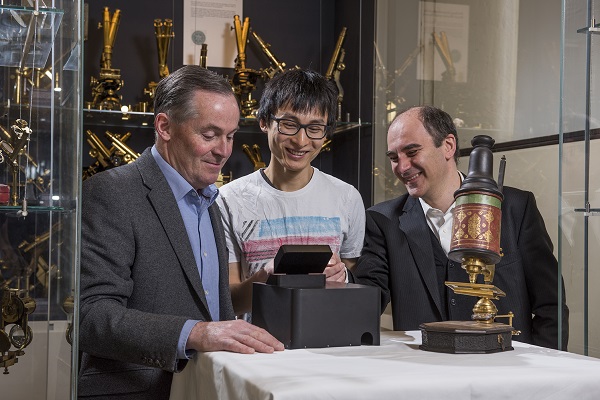
The Nanoimager arrived after a wider scientific advance. Super-resolution techniques had already broken through the conventional limits of light microscopy; their inventors received the 2014 Nobel Prize in Chemistry. The opportunity for Jing and his colleagues was to make demanding imaging methods available in a more manageable instrument. They were working on the distance between a technique existing and someone being able to use it.
A laboratory is a place, too
Laboratory space makes an unglamorous but persuasive design brief. Every instrument has to live somewhere. Its footprint competes with samples, computers and everything else a researcher needs within reach. A small device can change what is practical before anyone has taken a single image.
The Nanoimager was described as roughly shoebox-sized, about 30 times smaller than the alternatives in Oxford’s account, and able to work without specialist infrastructure. Its optical system could distinguish objects separated by around 20 nanometers. Lasers and fluorescence made individual molecules visible; software helped assemble the observations into images.
by the Nanoimager
without a special room
Resolution describes how close two objects can be while remaining distinguishable. A compact footprint answers a different question: where can the instrument go?
Those features explain why the product belongs in Jing’s personal story. His interest lay in building a tool that opened an experimental possibility to someone else. The box and the image were linked. Improving one while leaving the other forbiddingly awkward would have left much of the original problem intact.
Ease of use also changes who must be present when something happens. An instrument that demands fewer adjustments allows attention to move toward the sample and the question. For a builder, that means surrendering a little of the pleasure of being the only person who understands the machinery. The successful tool becomes useful in other hands.
When other people start asking questions
ONI’s formation in 2016 gave the microscope a route beyond the university. The early team included Jeremy Warren, identified as CEO in the launch announcement, alongside co-founders Jing and Kapanidis. Jing subsequently led the company as CEO until 2023. The origin is collaborative even when the later title makes a convenient shorthand.
Early investment supplied more than money. Jing described Oxford Sciences Innovation introducing advisers, potential colleagues, investors and customers. Dave Norwood, a Keble alumnus and early backer, became someone Jing explicitly credited with seeing promise in the team. The college connection continued into the company’s recruitment, with other Keble graduates joining ONI.
Then came the questions a customer asks. Professor Rizal Hariadi described speaking directly with Jing about the Nanoimager’s performance requirements, sample preparation and experimental protocols. His account emphasized Jing’s technical knowledge and the stability of the instrument. A researcher considering a purchase was getting answers from someone who understood the experiment as well as the equipment.
One student user, Franky Djutanta, praised the straightforward acquisition process and the small amount of experimental setup. The benefit he described was time: more room for scientific ideas, future papers and life outside the laboratory. For all the elegance of the optics, that is an unusually comprehensible product review.
“creating this microscope was a fun challenge”
Bo Jing, reflecting on the Nanoimager’s beginnings, 2017
As the company expanded, the work also drew in people with different experience. Tyler Ralston joined as chief technology officer in 2021. By the following year, ONI’s executive team included operations, commercial and growth leaders. The instrument still mattered; an organization now had to deliver it repeatedly and support the people using it.
The numbers leave the bench
Recognition arrived in several forms. ONI received an Institute of Physics Business Start-up Award in 2018. In May 2019, Jing and Kapanidis jointly received the BBSRC Innovator of the Year award at London’s Science Museum, winning both the commercial impact category and the overall prize. The award recognized the journey from research into use.
Capital followed the same expanding scale. A £1.2 million seed round in 2016 was followed by £3 million in 2017 and a $25 million Series A in 2018. In January 2022, ONI announced a $75 million Series B led by ARCH Venture Partners and Casdin Capital. The money would support commercial and research teams, consumables and software.
The installation figures supplied a useful companion to the financing. ONI reported more than 120 instruments placed and over 650 scientists reached, with more than 110 publications from its customers’ work. A financing round measures confidence and resources. A working instrument in another laboratory begins to measure the original idea against everyday use.
The company also developed CODI, its software for working with and sharing imaging data, and introduced consumable workflows. The object on the bench was becoming part of a longer process. Researchers needed to acquire images, analyze them and exchange results. Access had acquired a software problem alongside its optical one.
A sheet of paper enters the picture
In February 2023, ONI announced that Paul Scagnetti would succeed Jing as CEO, effective February 27. The announcement initially described a continuing product-development contribution from Jing. An investor’s later account recorded his employment ending in March and his directorship ending in May. His chapter running the company had closed.
A later public biography introduced another interest: Foldscope. It described the paper microscope company as his next adventure, without specifying a formal job title. The connection is revealing because Foldscope approaches access through a very different set of constraints.
Manu Prakash and Jim Cybulski invented Foldscope at Stanford. Its original design aimed for less than a dollar in parts, using folded paper to support precise optical arrangements. It serves a different purpose from ONI’s instrument. The family resemblance lies in asking what a microscope must cost, demand and occupy before someone can start exploring.
Foldscope’s community lets users share observations, and its educational audience extends well beyond professional laboratories. A leaf, a fabric fiber or a small organism can become the beginning of an investigation. The machinery required for that encounter can be astonishingly modest.
Seen along that line, Jing’s work has a consistent practical interest: the encounter between a curious person and an instrument they can actually use. At Oxford, the answer involved bringing precise molecular imaging onto a bench. Paper microscopes offer another answer for another audience. There is room for both, and for the stubborn, enjoyable work of making the next look possible.
Keep looking
More from Jing’s work and the people around it.
Bo Jing on LinkedIn ↗A portrait at Keble ↗Jing’s early account in The Keble Review (page 21) ↗ONI’s instruments and imaging ↗ONI’s January 2022 announcement ↗Jing’s 100 Coaches biography ↗How Foldscope began ↗