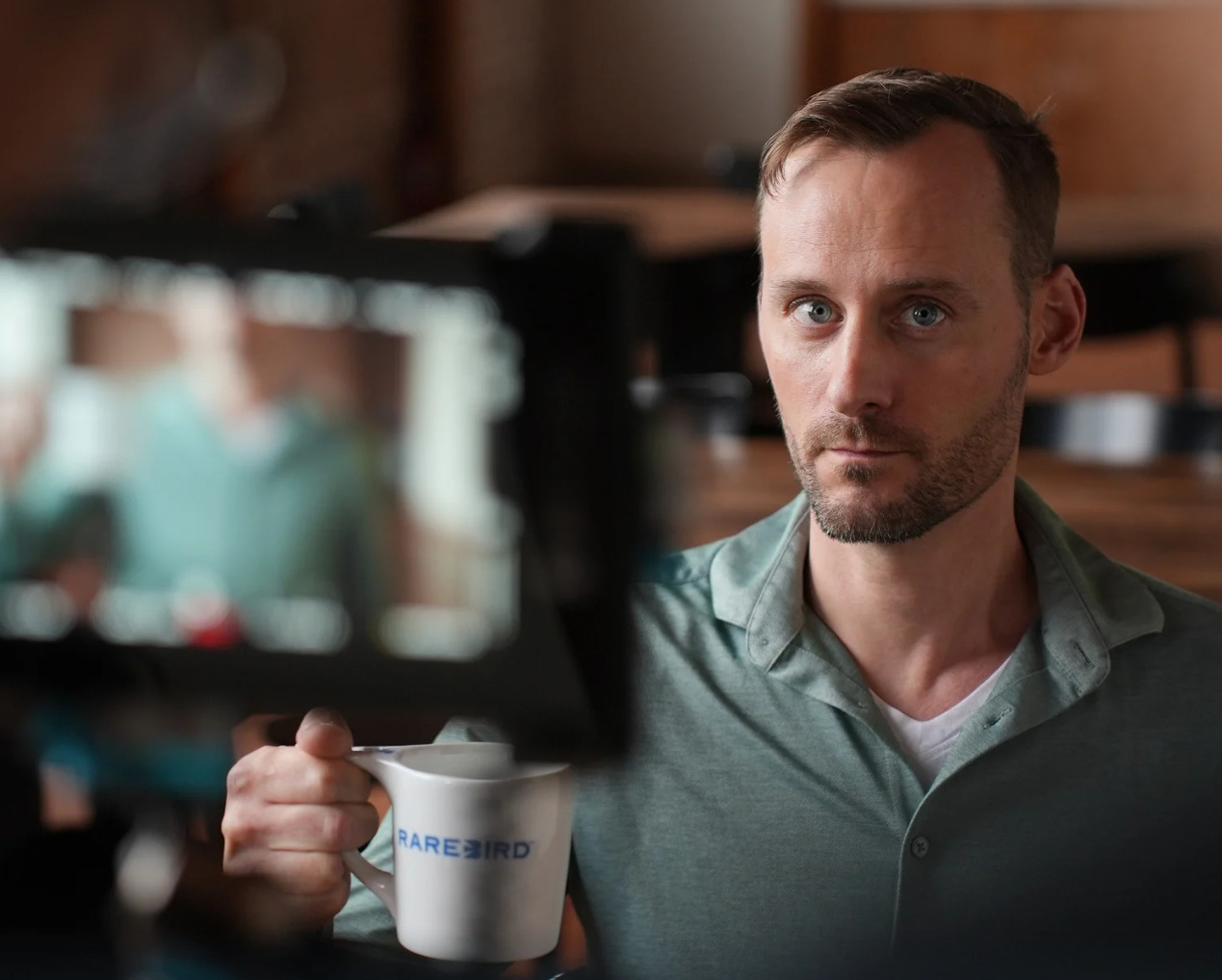
He spent a career engineering molecules. Then he built a coffee company around the one your body makes after the caffeine is gone.
Jeffrey Dietrich sells coffee, but that undersells it. What he actually sells is a molecule called paraxanthine, dropped into decaffeinated Colombian arabica. When you drink an ordinary cup, your liver spends the next hour converting roughly 80 percent of the caffeine into paraxanthine anyway. Dietrich's idea was blunt: skip the caffeine, skip the jitters and the 3 a.m. ceiling-staring, and hand you the metabolite directly.
Rarebird, the company he founded in 2020, is the only outfit with patents on the process. It won the Specialty Coffee Association's Best New Product award, pulled in two NSF research grants, and earned a place in the Y Combinator portfolio. Not bad for a product built to solve one man's shrinking tolerance for his own favorite drink.
Most founders start with a market. Dietrich started with a metabolic pathway.
The reasoning is almost stubbornly logical. Caffeine has a wildly variable half-life - anywhere from three to eight hours depending on your genes - which is why the same afternoon espresso leaves one person calm and another one wired past midnight. Certain genetic profiles also make people prone to caffeine-triggered anxiety. Paraxanthine sidesteps both problems.
Research suggests it binds adenosine receptors far more potently than caffeine while clearing the body faster. It carries GRAS safety status and, unlike its parent compound, has shown anxiety-reducing rather than anxiety-inducing effects. Dietrich, who reads the literature the way most founders read a pitch deck, saw a product hiding in plain sight.
POTENCY AT ADENOSINE RECEPTORS (relative)
HALF-LIFE (hours, shorter = clears faster)
Dietrich drank coffee happily through his undergraduate years at Rice, where he studied bioengineering, with no complaints at all. Then, gradually, the drink turned on him. One cup a day became his ceiling. Decaf, the obvious fix, left him flat and unsatisfied - all the ritual, none of the point.
So he did what a trained scientist does when a product fails him: he went looking for the mechanism. He read into how the body actually processes caffeine, and kept landing on the same downstream molecule. Paraxanthine wasn't obscure to pharmacologists, but nobody had bothered to put it in a bag of beans and sell it. That gap became Rarebird.
The name is a small joke that rewards attention. A genuinely better cup of coffee is a rare bird. So is a stimulant that lifts you without extracting a toll. He pairs the compound with specialty-grade Colombian arabica, decaffeinated, so the thing in your mug still tastes like coffee and not like a supplement pretending to be one.
Rarebird is not Dietrich's first company, and the through-line matters. He earned his PhD in bioengineering at UC Berkeley in Jay Keasling's lab, one of the field's landmark groups for building new biomanufacturing technologies - the science of coaxing microbes into making molecules that used to come from oil refineries.
In 2011 he co-founded Lygos and served as its CTO for close to a decade. The company's mission was to replace petroleum-derived industrial chemicals with bio-based alternatives. It went through Y Combinator in early 2016, raised more than $40 million in equity and another $10 million in federal awards, and put Dietrich squarely in the world of turning laboratory chemistry into shippable product.
Look at both companies side by side and the pattern is obvious. Lygos made bio-based chemicals. Rarebird makes a bio-based coffee molecule. Same instinct, wildly different aisle of the store.
BS in Bioengineering.
PhD in Bioengineering, Jay Keasling lab.
Co-founds Lygos; serves as CTO for nearly a decade.
Lygos joins Y Combinator (W16); raises $40M+ equity, $10M federal.
Founds Rarebird with co-founder AD Andracchio; joins YC.
Rarebird ships (Feb), launches subscriptions (Aug), wins SCA Best New Product.
Granted second U.S. patent covering paraxanthine coffee.
Secures $1M NSF-linked grant to expand e-commerce, B2B, and R&D.
"I want you to walk into every Starbucks and have this coffee."
On the ambition"If you're going to have PX coffee, you need to work with Rarebird."
On the patent moat"I started with no negative side effects. But over time I had to cut down to one cup a day."
On the problem"The energy wasn't sustainable."
On why he startedTwo U.S. patents - 11,872,232 and 12,178,820 - cover paraxanthine coffee and its production methods. The goal, in Dietrich's words, is to make Rarebird the mandatory partner for anyone building with PX.
Roughly 75% of Rarebird customers drink it in the afternoon - the exact window most people quit caffeinated coffee. That's not an accident; it's the use case he designed for.
Two NSF research grants, including $1M in 2025, plus backing from Y Combinator and AgFunder. A functional beverage funded like a science project - because it started as one.
The small facts that make the big story stick.
Dietrich wants paraxanthine coffee to stop being a curiosity and become a staple - on every shelf, in every chain, the default choice for people who love coffee but resent what it does to their sleep.