Jeff White arrived at the New Brunswick Innovation Foundation with a curious piece of management advice: “Everybody has to sweep the floors.” A broom is an unfashionable accessory in venture capital. It carries no promise of a spectacular exit, and nobody has ever mistaken one for a pitch deck. That was rather the point. White wanted people throughout a team to feel that their work mattered, wherever they sat in its hierarchy.
When he became NBIF’s chief executive in 2018, he had already worked in the financial engine rooms of technology companies and coached youth sports. The two occupations shared something useful: results depended on people doing work that would rarely earn individual applause. His language about leadership came from the court as readily as the boardroom.
By 2026, the coach had hired a coach of his own. He had recognised that helping portfolio companies was consuming time he needed for the future of NBIF. His account of that adjustment gives this career its most interesting turn. An executive experienced in building businesses was learning to leave more of the building to other people.
A captain before the capital
White studied at St. Francis Xavier University from 1986 to 1990. His professional profile lists him as captain of the men’s varsity basketball team and a Macpherson House alumnus. The combination is pleasingly practical: an accounting education, a team to organise, and a residence whose name still merits space on a business profile decades later.
He earned a business administration degree focused on accounting, followed by chartered-accountancy training. Those choices supplied the technical foundation for a career involving financing, acquisitions and company operations. Basketball supplied a different kind of responsibility. A captain has a title, certainly, but the score still belongs to everyone.
It would be too neat to treat a university team as the explanation for an entire working life. White himself, however, kept returning to coaching when describing his responsibilities. The connection rests in the way he talks about the job: helping people develop, deciding how they fit together, and accepting that a leader’s performance depends on theirs.
His base is Saint John, while NBIF operates from Fredericton. That distinction places him within the province’s network of people and organisations rather than simply at the address of its investment foundation. The work has carried him across company finance, mentoring and governance, with New Brunswick remaining central to the story.
Varsity team captain
by Salesforce
as chief executive
“Everybody has to sweep the floors.”
Jeff White, 2018
The work behind the acquisition announcement
White’s finance career included chief financial officer roles at Radian6, Q1 Labs and Genesys Laboratories Canada. These were operating jobs inside technology businesses, where an ambitious product also required financing and organisational discipline. His experience covered public and private offerings, mergers and acquisitions, and growth strategies.
Radian6 offers a concrete glimpse of that world. Founded in 2006, it built technology to monitor and analyse conversations across social networks, blogs and online communities. Salesforce completed its acquisition on May 2, 2011. At the time, Radian6 had more than 2,400 customers, including Dell, PepsiCo and UPS. A New Brunswick business had become useful to companies with very large footprints.
White’s part in the transaction appears in a recommendation from Michael Dunleavy, the outside lawyer who worked on the acquisition. Dunleavy described four months of close collaboration and White’s involvement across a complex process. Radian6 co-founder Marcel LeBrun likewise described him as a business partner whose contribution extended beyond the finance function.
An acquisition announcement compresses years of company building into a date. White’s career sits in the material that compression leaves out: raising money, establishing processes, working through negotiations, and helping an organisation become capable of handling growth. That experience would later make his conversations with founders less abstract. He had held responsibilities inside businesses facing those demands.
East Valley, and the habit of helping early
Before NBIF, White was co-founder and chief operating officer of East Valley Ventures. Creative Destruction Lab’s biography describes more than six years there, investing in and mentoring information and communications technology startups in the Maritimes. This moved his work closer to founders who were still deciding what their businesses could become.
East Valley’s network included Gerry Pond and people with experience building earlier New Brunswick technology companies. A 2016 account described Pond and White at the centre of a group whose members invested in startups and brought operating experience with them. Money travelled alongside introductions and practical assistance. The arrangement depended on people continuing to participate after a cheque had cleared.
In 2018, White also served as interim chief financial officer of Canada’s Ocean Supercluster. The organisation was then establishing its operating framework, agreements and relationships with industry. It was another occasion to assemble the machinery around an ambitious idea before the machinery could be taken for granted.
His mentoring work also connects him to CDL-Atlantic, where he is listed as an associate in the Prime stream. At the University of New Brunswick, the Fraser Student Venture Fund’s 2023 report names him on its investment committee. There, experienced members review student recommendations and provide feedback. Financial judgement becomes something to practise and pass on.
An appointment with a wider brief
NBIF announced White’s appointment on October 4, 2018, with his start scheduled for October 29. Chair Cathy Simpson welcomed someone who knew innovation, commercialisation and growth strategies. He was succeeding Calvin Milbury and taking responsibility for an organisation supporting both early-stage companies and applied research.
White’s early priorities included generating more businesses from work at New Brunswick’s academic institutions. He also wanted expertise that complemented his own background in information technology. The ambition required collaboration with people who understood different industries, rather than assuming that one executive’s experience could answer every question.
That original brief helps explain why his story cannot be reduced to picking investments. He was interested in the journey between an idea and a working business: who understood the problem, who could help develop it, and which organisations needed to cooperate. The foundation gave him a place to work on those connections across a province.
The responsibilities subsequently changed. NBIF’s 2024 impact report described the realignment of its applied-research portfolio to ResearchNB and a stronger emphasis on support involving accelerators and incubators. White’s present role centres on investment strategy and relationships among founders, investors, government and industry. The continuity is company building; the organisational tools have evolved.
The coach takes his own advice
In a leadership interview published in May 2026, White put a number on the problem in his calendar: “I was 75 per cent in the business and 25 per cent on it.” Portfolio-company work was absorbing most of his attention. He wanted more room to consider where NBIF itself should go.
He began one-to-one coaching with Marilyn Orr of Vision Coaching. Together they worked on priorities, protected time for strategic thinking and ways to give colleagues meaningful responsibility. The account described a change in how clearly he communicated direction, as well as in how he organised his day.
The detail that matters is his willingness to bring coaching to his leadership team while recognising the limits of his own role. A chief executive can mentor, but also holds authority over the people receiving that advice. White acknowledged that distinction. An independent coach could offer a different relationship.
This episode makes his earlier sports language more interesting. Coaching requires attention to people; leading an investment organisation also requires decisions about where that attention goes. The person who tries to help with every immediate problem may leave too little time to prepare for the next set. White’s adjustment was to make responsibility more widely held.
A New Brunswick address, a larger market
White’s argument for venture capital is closely tied to geography. He wants companies to compete beyond New Brunswick while creating value within it. Selling into national and international markets brings revenue into the province. Growing teams give developers, engineers and business professionals another reason to build their careers there.
In April 2026, he reported that more than $30 million in investment capital had flowed into eight New Brunswick companies over the preceding fiscal year, compared with $15 million in 2025. Those figures describe company funding across investors. They are neither White’s personal investment total nor a claim that NBIF supplied all the money.
He also described NBIF investment as typically attracting four dollars from other investors for each dollar it contributes. That is an account of its usual investment pattern, rather than a promise attached to any individual startup. His wider argument includes the ability to reinvest financial returns in another generation of companies.
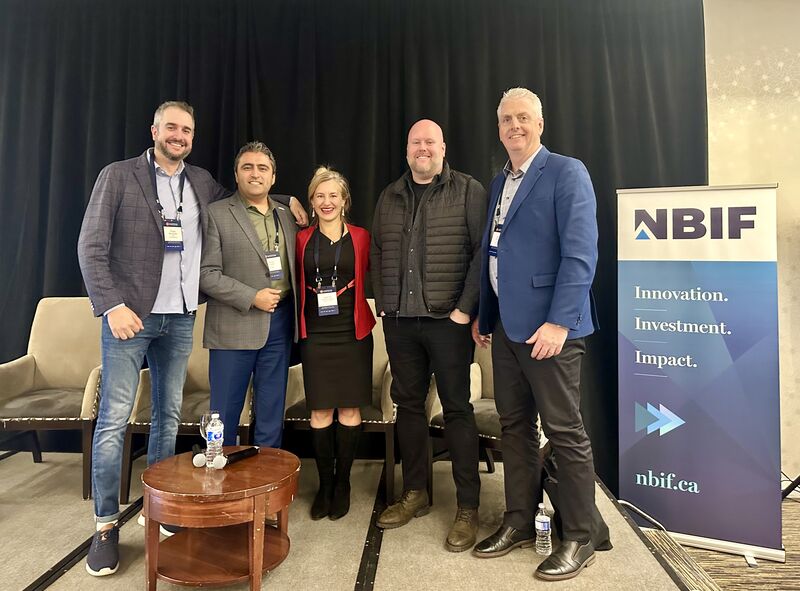
At the 2024 InnovateNB gathering, he joined a discussion about artificial intelligence and technology adoption with Amir Akbari, Jeanne Charbonneau, Brian Dunphy and Yves Boudreau. He also discussed fundraising with Propel’s Kathryn Lockhart. The photograph captures a useful part of his working life: standing among people with different businesses, responsibilities and experience.
Making space at the national table
White’s provincial work now intersects with the Canadian Venture Capital & Private Equity Association. He is listed on its board and government relations committee. In May 2026, he co-chaired Invest Canada in Halifax with Stephen Denton, helping bring a national investment gathering to Atlantic Canada.
After the event, White highlighted a panel he moderated with Craig McLellan, Patrick Spence, Cato Pastoll and Ali Abou Daya Daye. Its subject was what it takes to keep companies Canadian. The conversation extends a question already present in his New Brunswick work: how can a business grow into larger markets while retaining meaningful roots at home?
In a June 2026 essay, he organised the requirements for scaling around capital, customers and capabilities. He supported changes to New Brunswick’s Small Business Investor Tax Credit and said NBIF had contributed input to their development. The emphasis was on the conditions around founders, including access to investment and the ability to hire and pursue larger markets.
There is an appealing modesty to the broom in his first piece of advice. It gives everyone a job and nobody an exemption. His more recent experience adds a complication: somebody must also stop sweeping long enough to decide what the team needs next. Jeff White’s work has come to include both duties, and the judgement required to move between them.