At sixteen, Jeff Smulyan managed to mislay the front page. More precisely, he lost the photograph intended for it. Working as a copy boy at the Indianapolis Times, he had a job that involved carrying things to people who needed them immediately. One morning, the picture slipped behind a filing cabinet. The newspaper went ahead with a substitute. His editor, Irving Leibowitz, summoned him. Smulyan, who admired the editor, remembered the dressing-down decades later.
There are grander ways to begin a business career. This one had the advantage of introducing consequences early. Before the radio stations, the baseball team and the broadcasting awards, there was a teenager discovering that enthusiasm did not get a photograph into print. Someone still had to deliver it.
Smulyan would eventually write rules for his company. Two deserve a place beside that filing cabinet: “Never get smug” and “Admit your mistakes.” They are unusually useful instructions for someone whose career has supplied ample opportunities to do both.
A radio in the pocket, California on the horizon
Born in Indianapolis in 1947, Smulyan grew up with baseball arriving through a transistor radio. Music and games could follow a boy around; a signal from another city could make that city feel close. He remembers listening to Indianapolis’s WIFE and Chicago’s WLS. Arriving at the University of Southern California in 1965, he encountered Los Angeles radio just as KHJ was establishing its new sound.
He studied history and telecommunications, then earned a law degree. The training gave him a practical route into an industry he already liked. He served as note and comment editor of the Southern California Law Review and worked at ABC while studying law. His family also supplied examples of working for oneself: his father and both grandfathers were entrepreneurs.
California was an attractive place to stay. His father had another proposal: return to Indianapolis and run a small station while preparing to start a company. In 1973, Smulyan came home. WNTS became an early classroom in programming, costs and the awkward distance between having an idea and having a viable audience.
David Letterman hosted its midday talk show. Letterman had a plan of his own, telling Smulyan he would do the job for a year before trying Hollywood. Their connection survived the departure. Years later, the radio executive and the comedian would be partners in a venture with considerably more expensive uniforms.
The audience that had to be invented
Smulyan began assembling Emmis in 1979; Emmis Broadcasting was established in 1980. A small FM station in Shelbyville became WENS in Indianapolis, reaching the air in its new form in 1981 after regulatory delays. A good response to its adult contemporary programming gave the young company room to buy again.
The expanding station list took him into Minneapolis, St. Louis, Los Angeles and New York. Each acquisition presented a concrete question: what could this station offer that people would choose to hear? The company’s later portfolio included Power 106, Hot 97, KSHE and Q101. Those call letters represented distinct tastes and cities, rather than one interchangeable national audience.
His sports programming proposal was also one his managers initially rejected. Smulyan wanted an entire station devoted to sports. The vote went against him. Then programming executive Rick Cummings returned with a compromise: the team still doubted the idea, but would try it.
On July 1, 1987, New York’s country station WHN became WFAN. Sports would occupy the whole day. There would be room for the argument after the score, the call after the argument, and another argument before tomorrow’s game. The space between games had become the product.
The beginning was expensive and discouraging. WFAN struggled to attract listeners. In a later account, Smulyan explained that the original approach had been too national; New York needed a station that sounded like New York. That was a programming problem requiring changes, rather than a slogan requiring more repetition.
Emmis acquired WNBC and moved WFAN to its 660 AM frequency. Don Imus came into the lineup. Mike Francesa and Chris Russo’s pairing became another essential part of the station’s identity. Smulyan’s idea needed the right signal and the right voices before it became a business people wanted to copy.
“The line between a genius and an idiot is very fine.”
Jeff Smulyan
It is tempting to tell the WFAN story backward, with the eventual success making the launch look inevitable. Smulyan resists that convenience. His recollections include dissenting colleagues, mounting losses and the possibility of giving up. The useful part of the story is how much had to change after the supposedly decisive decision to go ahead.
Seattle, with a bill attached
In 1989, Smulyan led the group that bought the Seattle Mariners. Letterman was among the investors. Smulyan loved baseball, liked Seattle and had already demonstrated that he could make people pay attention. A struggling team offered a chance to apply those skills somewhere the audience could actually buy a seat.
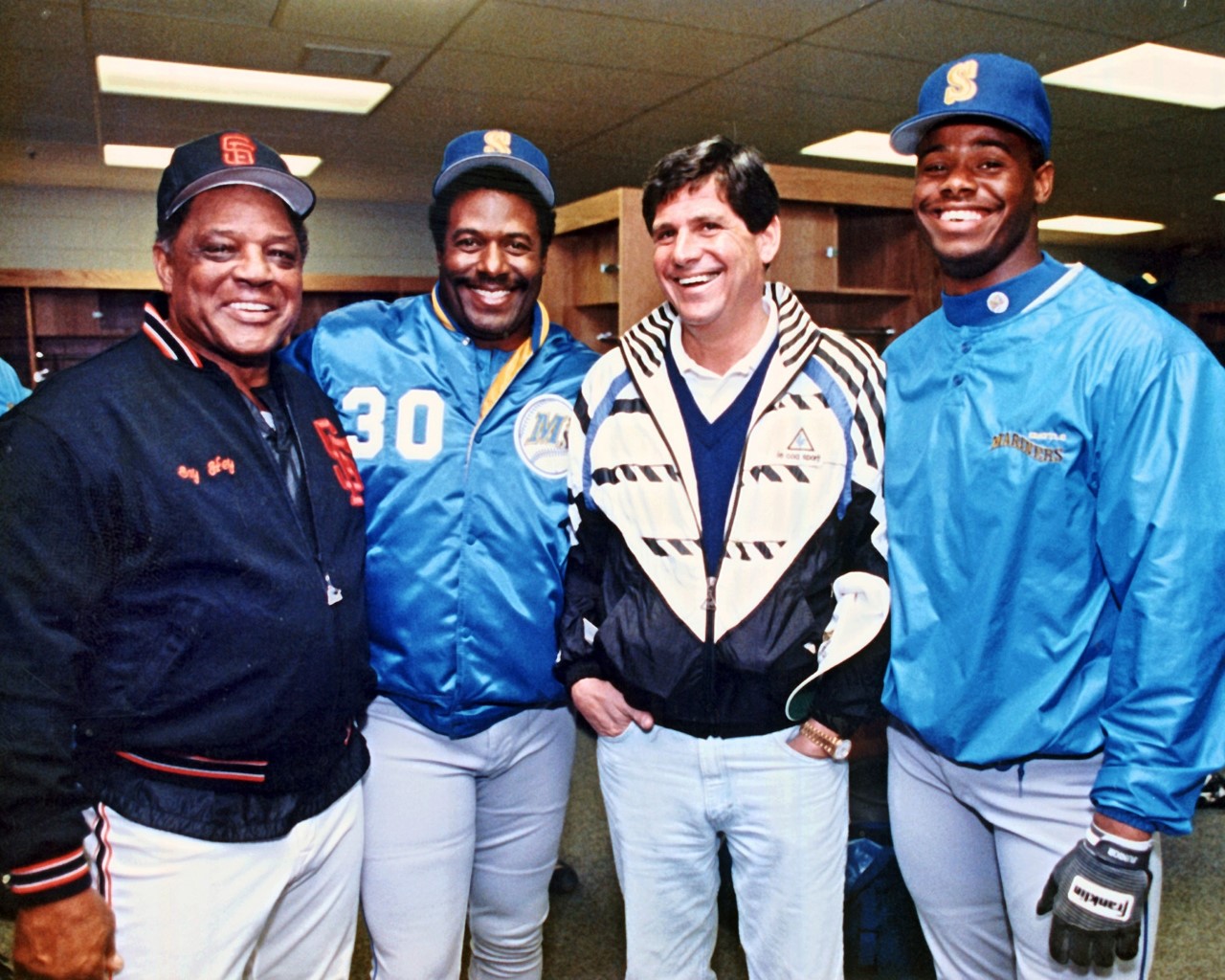
His wit made a good first impression. When Seattle columnist Art Thiel asked about the negotiating reputation of the seller, George Argyros, Smulyan answered, “George owes me a beer.” It was a small joke with a large purchase behind it.
The marketing had energy: funny television commercials, ballpark videos, promotions and the Mariners Moose. Ken Griffey Jr. gave the team a young star; the arrival of his father made the outfield a family occasion. In 1991, Seattle finally posted its first winning season. The club drew more than two million spectators.
But winning more games and making better advertisements did not settle the finances. Smulyan put the team up for sale in 1991. The possibility of a move to Florida became part of a bitter argument over the franchise’s future. A Nintendo-backed group purchased the Mariners in 1992, keeping them in Seattle.
The episode complicates an otherwise agreeable picture of the accessible owner with a ready joke. For Seattle, ownership involved the security of a team’s place in the city. For Smulyan, it also involved losses he could not keep absorbing. The baseball venture tested the limits of a broadcaster’s marketing skills and financial resources.
His memoir gives the WFAN and Mariners experiences opposite directions: idiot to genius, then genius to idiot. It is an economical way to arrange a career, provided one is willing to put both chapters in the same book.
Eleven commandments, no throne required
Smulyan’s management philosophy has a surprisingly modest origin. He recalls writing the first ten Emmis commandments on a napkin at a managers’ meeting. The additional instruction to acknowledge mistakes followed the baseball experience. A company rulebook had acquired an amendment at considerable expense.
The principles make room for flexibility, rational decisions, confidence and enjoyment. They also insist on integrity and giving employees a share in the enterprise. Smulyan describes a company where colleagues have a say and a stake. Disagreement over WFAN belongs in that account: the people around him could tell the founder that his cherished idea looked foolish.
“Never get smug”
“Admit your mistakes”
Give employees a voice and a stake.
Working with performers made that philosophy practical. Letterman, Imus and Griffey brought different abilities and temperaments. Their names make entertaining company in a memoir, but the management problem persists at every level: people need enough direction to succeed and enough freedom to contribute something of their own.
Emmis’s place on Fortune’s list of 100 Best Companies to Work For gave that approach recognition beyond broadcasting. In 2022, Smulyan entered the Radio Hall of Fame. His company had also expanded well beyond its first medium, operating television stations and publishing city and regional magazines. Indianapolis Monthly, Texas Monthly and Los Angeles magazine belonged to its history.
The broadcaster learns to sell quiet
A career spent attracting ears eventually led Smulyan into a business that makes conversations less distracting. In March 2020, Emmis acquired Lencore’s sound masking business. Its technology adds unobtrusive background sound to commercial spaces, helping provide speech privacy. The executive whose early product was a reason to turn the radio up now owned a reason to overhear less.
There was a business argument behind the pleasing irony. Smulyan described the acquisition as a way to apply Emmis’s sales and marketing experience in another market. The company was seeking businesses with better growth prospects as it reduced its traditional media holdings.
Digonex brought a different application: dynamic pricing for attractions, performing arts and other industries. It had joined the Emmis portfolio in 2014. Its systems recommend prices using data, with clients able to review and adjust those recommendations. In September 2025, Emmis president Patrick Walsh became Digonex’s chief executive, another step in the company’s shift toward technology businesses.
In June 2023, Emmis led Anzu’s $48 million Series B round. Anzu places advertising inside video games. The total was the funding round’s size, rather than Smulyan’s personal investment. For a former radio operator, the attraction was recognizable: an audience spends time somewhere, and advertisers want a way to reach it.
Still listening, still in Indianapolis
The move away from radio has had exceptions. In January 2025, Emmis launched La Exitosa on New York’s 98.7 FM and 1190 AM, mixing English and Spanish adult contemporary hits. The company had been trying to sell its remaining New York stations. A review of the market persuaded Smulyan that a bilingual format offered an opportunity worth pursuing.
It is a familiar sequence in his life: examine an asset, question its current use, try a different audience. A new format can be a reasonable decision even while selling stations is the larger strategy. The launch leaves room for the broadcaster inside the investor.
By March 2026, Smulyan was discussing that long career with Nate Feltman in an extended interview: the Indianapolis beginnings, the station purchases, international expansion, baseball and the consequences of disruption. He was still explaining the decisions, including the ones that made uncomfortable chapters.
Indianapolis remains home. The first months after returning from California were difficult to reconcile with what he had imagined. Over time, he became attached to staying. His civic work and years on boards sit alongside the commercial career; his USC connection has continued through service on its board of trustees.
Smulyan’s story gives a lost newspaper photograph a respectable place beside a radio breakthrough and a baseball purchase. Each involved people waiting for him to get something right. The teenager found the picture. The broadcaster found the audience. The owner found the limits. At Emmis, the instruction to admit mistakes remains in print.
Keep the conversation going
Career, company and conversations in his own voice.
- Smulyan at Emmis · The company’s commandments
- Jeff Smulyan on LinkedIn · Emmis on X · Emmis on Facebook
- Watch: Off the Record, March 2026
- Listen: The Sound Off Podcast · The newspaper anecdote and Get Indiana interview
- SportsJam: radio, baseball and the memoir · A Seattle view of his Mariners years
- Radio Hall of Fame · The author’s publisher page
- Indiana University’s broadcast history profile · The early Emmis years
- The Lencore acquisition · Digonex’s approach · Walsh’s 2025 appointment
- Anzu’s funding round · La Exitosa’s launch