In 2008, Edward K. Christian placed an advertisement with a rather awkward admission. Saga Communications wanted to grow, but it had a problem. The company needed managers. Before he would commit money to another radio station, Christian wanted someone capable of running it. The deal could wait. A good search might take months.
The advertisement reversed the usual glamour of expansion. Here was a public company whose founder was asking about the person who would show up after the papers were signed. Christian had watched consolidation reduce the pool of general managers. He also thought people had become less willing to uproot their lives for a job. Buying a station first would leave the business waiting for its leadership.
He called that prospect unfair to the station. It is an unusual way to talk about an acquisition, as though the building and its transmitter deserved a decent introduction. But his reasoning was practical. Local management sat at the center of the business he had constructed. Without it, another purchase would leave a hole exactly where he wanted a relationship. The advertisement made the missing person more important than the next announcement.
“At radio stations, your assets go home every night.”
Edward K. Christian · 2002
The microphone was switched off
Christian traced his fascination with radio to kindergarten. Each morning, a child stood at a dead microphone and told classmates what breakfast had been. When his turn arrived, he grabbed the stand and performed. An audience of children and a microphone with no electricity were apparently sufficient equipment.
Later, he listened to Detroit radio serials and to distant stations on a tube radio in his bedroom. Before he could drive, he found his way to work at Detroit FM stations. When he began looking for paid summer work, he made audition tapes at home, recording music by holding a microphone up to the radio. The method required enthusiasm considerably more than fidelity.
Interviews in Alma and Houghton Lake went nowhere. On the return trip to Detroit, he stopped at WMIC in St. Helen, talked with the afternoon disc jockey and met the owner. A week later, the station offered him a job. He accepted before asking his parents. His mother lent him her car. At sixteen, he was doing middays on a 500-watt daytime station for $52 a week. The executive career began with a boy who needed a lift.
Christian’s teenage midday job at WMIC, a 500-watt daytime station.
Learning to buy what he could run
His working life moved through several parts of radio. Christian graduated from Wayne State University in 1966 with a degree in mass communications and joined WCAR-AM-FM in Detroit as an account executive. He earned a management master's degree at Central Michigan University. In 1971, he bought WCER-AM-FM in Charlotte, Michigan.
By 1974 he was managing WNIC in Detroit. Josephson Communications later bought the station, and Christian stayed. Marvin Josephson wanted a radio division; Christian helped build it. That relationship eventually presented him with an opportunity larger than his first station purchase.
In 1986, Christian raised $38.5 million to buy Josephson International's radio division. The resulting company, Saga Communications, began with three AM stations and five FM stations. Six years later, it became publicly traded. The distance between a summer microphone and a stock-market listing was considerable, but both jobs depended on getting people to listen.
Christian connected the name Saga to his Icelandic heritage and to an ongoing adventure. The word suited a company assembled from local properties, each with its own audience and history. It also suited a founder whose career had kept changing responsibilities while staying within the same medium.
- 1958Detroit control boards
- 1971First station purchase
- 1986Saga founded
- 1992Public listing
A budget that came from the station
The details of Christian's management mattered as much as the vocabulary. In 2002, he described a budget process that began with individual department heads. Each prepared a plan, reviewed it with the general manager and signed off. The manager then brought the combined budget to Christian and his colleagues.
The book included an analysis of competing media, retail trends, housing starts and new stores. Those subjects placed the station inside the economy around it. Someone had to understand what was happening beyond the studio before proposing what should happen inside it.
Christian said he waited until the manager sat down in front of him before looking at the book. Preparing it was part of the manager's job, and using it through the year was part of the responsibility. Local authority came with a written plan and a conversation about performance.
He also favored common equipment vendors and backup systems. Individual station character could coexist with shared purchasing and reliable machinery. A transmitter failure did not become more charming because the playlist was locally chosen. His version of autonomy required both judgment and maintenance. The person at the station had room to act, and the company expected that person to know the business.
Christian’s budgeting process, described in 2002.
When the audience had its own opinion
Local attachment could complicate management decisions. In Milwaukee in 2015, WKLH's decision not to renew morning co-host Carole Caine's contract provoked an outcry. She had been at the station for twenty-nine years. Christian spoke about the reaction while declining to discuss personnel details.
He described Saga stations as individually shaped and said a Virginia country station's nine hours of weekend bluegrass would remain because the programming was part of its community. The same philosophy made Milwaukee's response understandable. Familiar voices were part of what listeners thought they owned.
Christian acknowledged that the morning-show change had not happened as anticipated. The station's broader adjustments included research and a rebalanced music library, but listeners could hardly be expected to experience their morning routine as a corporate analysis.
The episode exposed a difficulty inside his own premise. A station that becomes part of local life invites local judgment. Affection brings expectations, and a long relationship can make a programming decision feel personal. His hope was to earn listeners' trust again. Belonging carried a cost: the audience could answer back, loudly, when a familiar part of its day disappeared.
The sales pitch had to earn its airtime
Christian explained radio's commercial logic in a 2012 interview: compelling programming attracted listeners, and good advertising could then help a merchant reach them. Creative copy mattered. If the campaign produced results, the advertiser had a reason to return. The chain started with what came out of the speaker.
His arguments about community were tied to that chain. A station needed to become a habitual destination, recognizable enough that listeners felt a connection to it. The advertiser was buying access to attention that the station had already earned.
The same interview made clear that protecting a station's character did not eliminate difficult decisions. Christian described asking staff for a five percent pay reduction during the downturn, then restoring most of it by the time of the interview. He stressed communication with employees and preserving the experience listeners valued. This was a business with bills, even when its founder talked about magic.
Years later, sales manager Christie Matthews described Christian, Chris Forgy and her general manager Trey Stafford as people who believed in her and gave her access to training. Her account puts a working person into the management philosophy. Support meant the chance to learn the job and carry it out, rather than merely hearing that local people mattered.
Twenty-three thousand chances to get it right
In his 2021 letter to shareholders, Christian reported more than 23,000 speculative advertising spots produced across Saga during the year. These proposed commercials addressed individual clients' businesses. The figure gives his talk about ideas a tangible size: thousands of attempts to turn a merchant's problem into something a listener might hear.
Local direct advertising accounted for approximately half of total net revenue that year, compared with 46 percent in 2019 and 47 percent in 2020. Total 2021 revenue was $108.3 million. Christian set those figures beside his belief in public interest, convenience and necessity as a professional responsibility.
That juxtaposition was characteristic. A shareholder letter could make room for station history, advertising craft and operating results. He wanted investors to see the link between community connections and revenue. His invitation to visit Saga stations and talk with staff brought the argument down to a place and the people working there. A company could be described in numbers; he still wanted it to be encountered in person.
Bars use a 0-100% scale. Historical figures from Christian’s 2021 shareholder letter.
A national job, a local habit
Christian's responsibilities extended beyond Saga. He chaired the Radio Music Licensing Committee, whose work included negotiating music licensing rates for radio. He served on the National Association of Broadcasters board and had been president of the Associated Press Broadcast Advisory Council and chairman of the Arbitron radio advisory council.
In 2009, he received NAB's National Radio Award. The recognition specifically connected his national leadership to stations' local roots and public service. The previous year, he had been named a recipient of the Ward L. Quaal Pioneer Award. His career brought him into the industry's collective work as well as its daily competition.
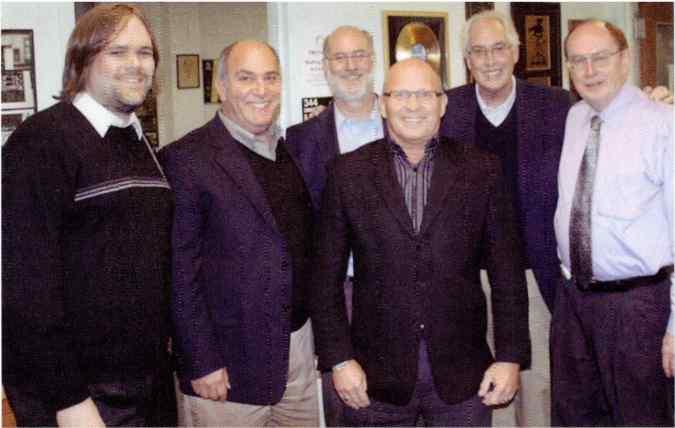
Teaching supplied another connection. Christian served as an adjunct professor at Central Michigan University. A photograph published in January 2012 shows him visiting the university with Saga colleagues, including Warren Lada and Chris Forgy. The company and the classroom occupied the same frame.
He also served as an honorary consul for Iceland, a role that gave his heritage a public expression beyond the company name. His life included support for theater, and his family's memorial choices included Florida Studio Theatre. The broadcaster's interests reached past the dial, even though radio remained the organizing thread.
What kept playing
Christian died on August 19, 2022, aged seventy-eight. He had led Saga from its founding in 1986. At the time of the company's announcement, its holdings included 79 FM stations, 35 AM stations and 80 translators across 27 markets. The translators were additional signals, a distinct category from the AM and FM stations.
Warren Lada became interim chief executive. Chris Forgy took over as president and CEO in December 2022, becoming the second person to hold that job in Saga's history. Forgy described a company whose people already understood how to behave and whose work continued: serve communities, make local content, produce commercials, train employees and deliver value to shareholders.
That succession gives the 2008 advertisement a second meaning. Christian had been concerned with the person who would run a station after a purchase. Eventually, the same question applied to the company itself. His successor's account emphasized habits that remained in place when the founder was gone.
A teenage job had paid $52 a week. The company that followed reached twenty-seven markets. Between those figures was a repeated act of attention: to the manager, the merchant, the familiar voice and the listener who noticed when it changed. Christian's business of belonging depended on people continuing to care what was on the radio.
79FM stations
35AM stations
80Translators
Across 27 U.S. markets. Translators are counted separately from AM and FM stations.
Along the dial
- Saga Communications
- Explore Saga’s company profile
- Christian on finding managers before buying stations
- His first-person account of getting into radio
- Radio Business Report interview · February 2002
- Radio Ink interview · January 2012
- WKLH and the Milwaukee audience · July 2015
- 2021 shareholder letter
- NAB’s 2009 award announcement
- The 2022 company announcement
- Chris Forgy on carrying the work forward
- RMLC’s December 2025 leadership update