Before Jeff Cross built software that maps the hidden relationships inside enormous codebases, he learned to make websites from his mother. She worked as an intranet webmaster and, when Cross was about 12, taught him and his siblings how to build pages in Microsoft FrontPage. It was a modest beginning, domestic and slightly beige, in the manner of most late-1990s computing. It also gave him a durable instinct: complicated systems become approachable when someone makes their structure visible.
He moved from FrontPage to Dreamweaver, GeoCities and Flash. His first professional identity was closer to web designer than software engineer. There were layouts to compose, images to adjust and interactions to choreograph. Code arrived as a way to make the design do more. ActionScript led toward object-oriented programming; JavaScript widened the field. By his twenties he was working at an agency built around Flash, just as the web was preparing one of its periodic acts of creative destruction.
Cross kept moving. He helped create Deployd, an open-source toolkit for building real-time APIs, in the young Node.js era. The project joined visual product thinking with backend machinery. It was also an early rehearsal for a pattern that would define his later work: remove repetitive setup, expose a comprehensible model, then let developers concentrate on the particular thing they came to build.
01 / The apprenticeshipScale, learned from the inside
Google gave the pattern a much larger stage. Cross became one of the early core contributors to Angular and eventually tech lead of the Angular Mobile team. He worked on Angular 2’s HTTP module and AngularFire2, contributed to RxJS 5 and spent his days amid a framework whose choices would flow into thousands of engineering teams. “Scale” in that setting was not a decorative word in a pitch deck. A seemingly local choice could affect documentation, testing, build performance and the working habits of developers far beyond the room.
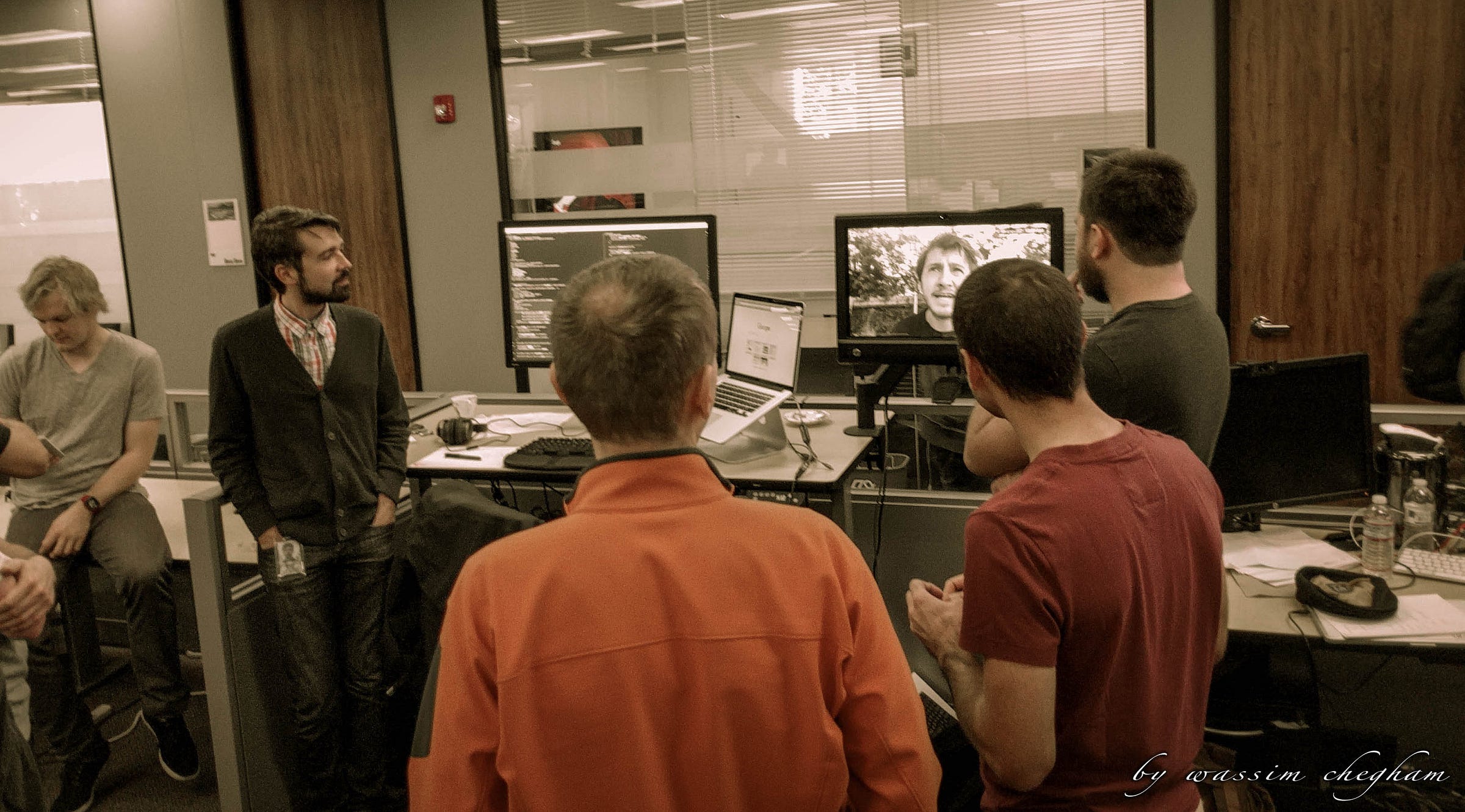
The group had room for jokes. Cross’s running list of honors includes “Best Beard on Angular Team” and “Funniest Member of Angular Team.” A 2015 ng-conf presentation on the Benchpress performance tool included an eighties montage and physical comedy. Away from the computer, he once described himself as doing whatever his children told him to do, usually playing music or making gadgets. The humor matters because developer infrastructure can become solemn very quickly. Cross’s version left the human fingerprints on it.
“We think about monorepos in a way that's like every company has at least one monorepo, like one primary repo where the magic happens.”Jeff Cross, discussing how Nx sees modern codebases
02 / The useful detourConsulting before category
In 2016, Cross and fellow Angular engineer Victor Savkin left Google and founded the company then called Nrwl. The spelling looked like a password; it was pronounced “narwhal.” They did not begin by announcing a universal theory of software organization. They began as Angular consultants, working with banks, airlines and other enterprises whose applications were large, valuable and difficult to change.
This was less glamorous than the startup fable and more useful. Consulting paid for attention. Inside client codebases, the founders saw the same friction recur. Teams duplicated libraries because sharing was awkward. Dependencies were real but poorly understood. A small change could set off broad, expensive CI work. Architectural standards lived in presentations and the memories of senior engineers. The repository structure and the company structure had drifted into a complicated relationship.
How a recurring complaint became a system
repeat the same pain
and dependencies
runs again
The project graph is the hinge: it turns a codebase from a pile of folders into a model that tools and people can reason about.
Work with Capital One helped push the pair toward a product. Nx first appeared as an extension to the Angular CLI, carrying ideas they knew from Google into environments without Google’s internal machinery. Put multiple projects in one workspace. Draw the dependency graph. Establish boundaries. Determine what a change actually affects. Cache work that has already been done. Give the team a common language for a system too large to fit in any one person’s head.
Cross and Savkin also wrote Essential Angular, a compact book intended for developers who had passed the tutorial stage and needed the framework’s mental model. That phrase, mental model, is the quiet thread through Cross’s career. A useful tool does not merely perform a task. It improves the user’s picture of the task.
03 / The graph becomes a companyOpen source, then a business around time
Nx expanded beyond Angular into React, Node and a wide plugin ecosystem. The center of gravity shifted from one framework toward the mechanics of large-scale software work: project graphs, code generation, task orchestration, remote caching and distributed CI. The local tool remained open source. Nx Cloud sold the coordinated computing around it.
The business proposition is almost comically plain: waiting costs money. If a system knows which projects changed and which tasks can be reused, it can avoid unnecessary builds and tests. If work must run, it can be spread across machines. The saved minutes accumulate across engineers, branches and days until developer experience becomes an economic line item.
Nx’s funding followed the product rather than preceding it. The company announced an $8.6 million seed round in 2022, co-led by Nexus Venture Partners and Andreessen Horowitz, with GitHub co-founder Tom Preston-Werner among the angel investors. A $16 million Series A followed in 2023. Cross had made the transition from engineer to CEO, a change he has described without romantic fog. Enterprise sales involved positioning, patience and the discovery that a technically evident benefit does not sell itself.
The same pragmatism appeared when Nx took stewardship of Lerna, an established JavaScript monorepo tool. Cross did not describe it as a vanquished competitor. The aim was to care for an existing community and keep the project working, while offering an easier path for anyone who later wanted more of Nx. Open source ecosystems remember how maintainers behave when the fashionable attention moves elsewhere.
A codebase is never only code. It is a record of who depends on whom, which decisions became rules and how long everyone waits to learn whether a change worked.
04 / Beyond one repositoryThe context problem gets larger
The monorepo label has been both a ladder and a fence. It helped developers understand Nx, then encouraged some to mistake the tool for an Angular-specific filing cabinet. Cross’s broader definition is organizational. Most companies have a primary repository where much of the important work happens, plus satellites connected through packages, APIs and operational dependencies. Large companies may have hundreds of substantial monorepos and thousands of other repositories. They have no intention of merging them all, nor should they.
Artificial intelligence makes this old context problem newly urgent. Coding agents can produce changes quickly, but speed without a map merely arrives at the wrong destination sooner. An agent needs to know which repository owns an API, which consumers rely on it, what tests matter and what architectural rules the organization expects. Cross argues that AI is a tailwind for Nx because more output increases the value of automated validation and usable context.
That logic now reaches into Polygraph, an Nx product designed to give agents visibility across repository boundaries and memory across sessions. The idea is not to pretend a fragmented estate is secretly one giant repository. It is to build a graph across the seams so that a change in one place carries its consequences into view. The container was never the deepest idea. The connection was.
There is an appealing continuity to the ambition. The child using FrontPage needed the web to become visible. The designer needed behavior to meet form. The Angular engineer needed a framework developers could reason about. The consultant needed to understand why large teams stumbled over shared code. The CEO now wants humans and agents to see relationships that corporate history has scattered across thousands of repositories.
Cross works from Gilbert, Arizona, while Nx describes itself as globally distributed across the United States, Canada, the United Kingdom and Europe. The geography suits the product. Modern software teams are rarely gathered around one monitor, as the Angular group was in 2016. Their work still needs a shared room. Nx’s bet is that the room can be a graph: explicit enough for a machine, useful enough for a new engineer and flexible enough for the organization that will inevitably change around it.