A payment terminal is an odd monument. Nobody crosses a city to admire one. Its audience wants a transaction approved, a receipt if necessary, and permission to leave. Jean-Jacques Poutrel helped build a business around this modest encounter between a customer, a merchant and a bank. Co-founding Ingenico with Michel Malhouitre in 1980, he placed his working life inside a moment that most of us would prefer to pass without incident.
Start with the counter rather than the balance sheet. A card is a promise that needs machinery around it: something to read it, something to communicate with the payment network, something the merchant can actually operate. Ingenico occupied that useful middle. Poutrel's story is interesting because he arrived there through other useful middles, with little apparent concern for the career ladder a respectable biography might have ordered for him.
Born in Paris in 1934, he began his career in advertising and regarded himself as self-taught. By 1962 he was designing, producing and installing commercial freezers. Before helping merchants take money, he helped them keep stock cold. The connection is practical rather than glamorous: a business needs equipment that performs a job, day after day, while its owner gets on with selling things.
Four employees, then a hundred machines
His move into electronics preceded Ingenico. From 1968 he developed equipment for hotels. By the time the payment company began, he had experience with the unromantic systems that keep a service business running. His fellow founder brought a complementary discipline. Malhouitre was trained in digital electronics design and development and would serve as Ingenico's technical director until 2000. The partnership deserves its place beside the founder's name.
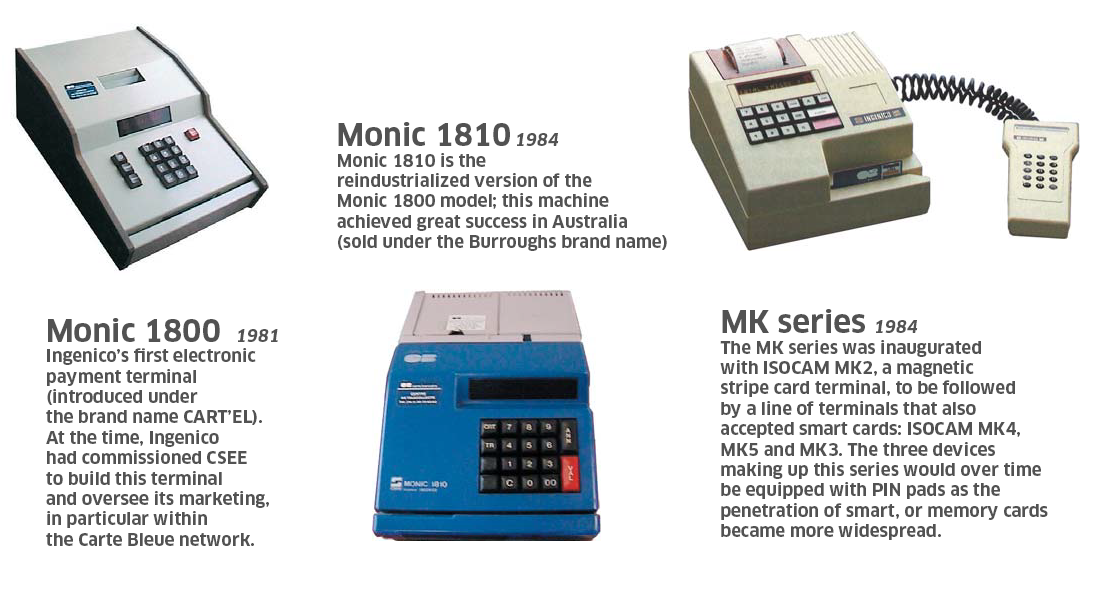
Ingenico started with four employees and capital of 500,000 French francs. An automated hotel billing system helped lead the pair toward a terminal that could read a magnetic stripe and send information through an integrated modem. In 1982 the CART'EL became a design suitable for industrial production. Carte Bleue ordered a hundred. That number reflected the small company's production capacity, an unusually sensible limit on a founding legend.
Then came the problem every appealing prototype eventually encounters: making enough of them. A partnership with CSEE put manufacturing and distribution behind Ingenico's design. The resulting Monic 1800 had a metal body framed by wooden sides. It belonged to an age when financial technology could have looked quite at home beside a well-made radio. An Australian opportunity followed in 1983 through Burroughs, with a redesigned model for that market.
Twenty times the profit, no magic formula
By 1984 Ingenico had a terminal combining magnetic-stripe and chip-card reading. It floated on the Paris stock exchange in 1985 and opened its first Australian subsidiary in 1987. These dates describe distinct kinds of progress: a product adapting to cards, a company gaining access to public capital, and a French operation establishing a permanent presence abroad. Poutrel had to manage all three clocks.
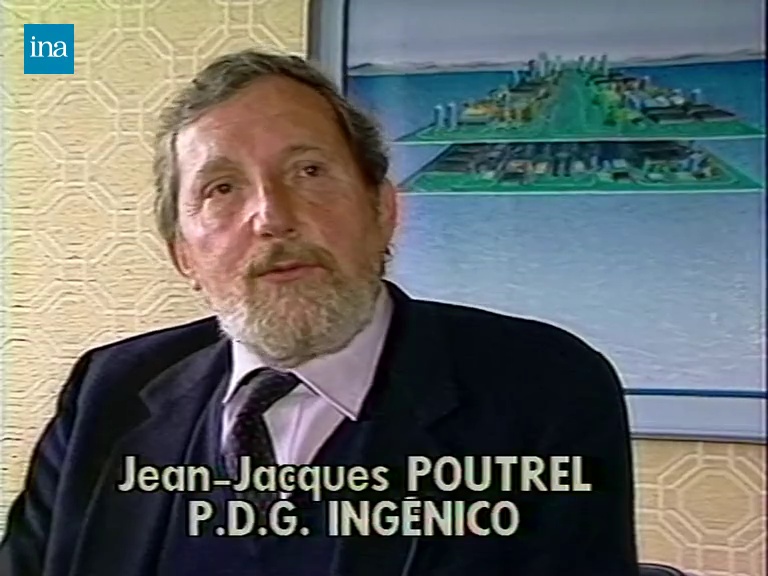
In May 1988 a television camera caught him explaining the business. Ingenico had come first in L'Entreprise's Top 100 competition for the second consecutive time. Over four years, profits had multiplied by twenty and employee numbers had tripled; overseas business represented twenty percent of activity. The machines were finding their way into hypermarkets, petrol stations and railway stations. Electronic payment was becoming part of the furniture.
Poutrel's explanation began with a disarmingly plain phrase: “Je crois qu'il y a pas de secret à proprement parler” - roughly, he did not think there was a secret as such. He described concentrating on the company's own work rather than on competitors. A television interviewer could reasonably hope for a dazzling formula. Here was the chief executive offering a working method, while the arithmetic behind him did the dazzling.
A passport for the little box
Growth did not follow a straight line from that television appearance. During the early 1990s, weak conditions in France and Europe put pressure on the business. Ingenico increasingly looked abroad. International sales rose from sixteen percent of revenue in 1992 to thirty-four percent in 1993, then exceeded half in 1994. A company whose name sounded comfortably French was learning to earn its living in many languages.
Its approach to North America offers a revealing detail. Rather than begin by confronting the established American suppliers directly, Ingenico moved into Mexico and Canada. In 1994, two Mexican contracts covered twelve thousand terminals. The route was less theatrical than a grand American debut. It also gave the company a foothold. For a payment business, being present where a merchant actually trades matters more than a stirring declaration of arrival.
Acquisitions expanded the company's reach and capabilities: Innovatron Data Systems and Germany's Epos in 1996, terminal activities from De La Rue and Bull in 1999, then IVI Checkmate in 2001. Secure Internet payments joined the work at the counter. The sequence makes the scale of Poutrel's job clearer. He was overseeing a business that had to assemble people, software, distribution and local knowledge, as well as assemble a machine.
The share price has a different conversation
An April 2000 interview shows a more argumentative Poutrel. Technology shares were falling and Ingenico's valuation had dropped sharply from its recent peak. He challenged the market's reaction and pointed to growth in the underlying business. A founder speaking to investors occupies an awkward position: the share price is public, immediate and emphatic, while the work that might justify it arrives on a slower timetable.
He was particularly concrete about software. If payment-security requirements changed, installed terminals could need updates; some competing equipment might need replacement. Poutrel saw a commercial opportunity in servicing the existing base. This was a view of the terminal as something with a working life after the initial sale. The little box on the counter could generate further work because banks and merchants would continue to need it to function.
He also described joint research and technology agreements with Gemplus, the smart-card company associated with Marc Lassus. Different countries and manufacturers had different standards. Cards and readers had to cooperate despite those differences. Poutrel could speak vigorously about the stock market, but the operating problem underneath his answer was familiar: getting several pieces of technology, and several interested institutions, to agree long enough for somebody to pay.
Cards and readers had to cooperate despite those differences.
An everyday purchase, an international engineering problem
A founder leaves, and a company continues
The end of his executive tenure was difficult. In the first half of 2003, Ingenico's revenue fell 27.6 percent to €160 million. Even allowing for exchange rates, sales were down nineteen percent. Jean-Marie Descarpentries succeeded him. Poutrel resigned as chairman, chief executive and director on 17 July 2003. A retrospective owes this period the same attention it gives the early growth figures. Both belong to the career.
Retirement from executive management did not end his connection with Ingenico. He returned to its board in April 2005. By 2009 he was serving on its strategic committee and its remuneration and nominations committee; his other listed directorship included Atlantic Radio System. These are quieter entries than a stock-market flotation. They show his working relationship with the company changing form after more than two decades at its head.
By 2010, Ingenico was also describing the services around its machines: processing transactions, managing terminal estates and giving retailers access to information through an online portal. A device at a checkout could be the visible part of a much wider arrangement. This helps explain why an equipment company had to keep changing its skills as payments evolved. The merchant still wanted the sale completed, but the machinery behind that outcome kept acquiring new responsibilities.
That same account discussed payment at restaurant tables using Bluetooth terminals and the deployment of contactless equipment. Think of the distance from the early countertop models: a waiter could bring the terminal to the diner. The basic commercial encounter remained recognisable, while the device moved around it. Poutrel had spent his executive years in an industry where a useful product could require repeated reinvention, even when the customer's request sounded exactly the same.
The business carried on expanding after his departure from management. In a 2010 interview, Ingenico described more than fifteen million terminals deployed in 125 countries. That scale belonged to the continuing work of many teams and later leaders. Poutrel's contribution was at the beginning and through the long period of building that followed. Keeping those periods separate gives him a more credible place in the company's history.
The curiosity behind the counter
One account of the early experiments places Poutrel and his son Nicolas with integrated circuits and a soldering iron in a former bathroom converted to business use. It is a pleasingly cramped setting for a company destined to take up space on so many counters. The scene also offers a reasonable way to picture his curiosity: close enough to a device to see whether the thing would work.
Colleagues and family remembered an energetic reader of computing manuals, a demanding character who also enjoyed sailing and cooking. There was an old sofa in the Puteaux headquarters that he resisted replacing. None of these details explains a corporate result by itself. Together they interrupt the smooth outline of a business portrait. A founder can approve another international move and still consider the existing sofa perfectly adequate.
Poutrel died on 24 May 2013. His family subsequently discussed a foundation bearing his name to support innovation and entrepreneurship. Ten years later, they published a remembrance asking those who had known him to think of him. The public business story stretches across countries and decades; the family notice brings it back to a person. Between those scales sits his familiar product, waiting quietly for the next customer to put a card in.
Further reading & viewing
- Ingenico: the company today
- Watch Poutrel in the 1988 television report
- Read his April 2000 interview (French)
- Explore Ingenico’s early machines
- A portrait of Poutrel and his family’s foundation plans (French)
- Ingenico’s international expansion
- The 2003 leadership change (French)
- The family’s 2023 remembrance (French)