Thirty euros is an awkward sum on which to build a music-business legend. It buys a modest evening out. In June 2005, it was what Denis Ladegaillerie’s first Believe contract brought in, after six months of prospecting. The occasion was the Fête de la Musique. The partner was Virgin Mega. For an enterprise intended to open the record business to more artists, the opening receipts were decidedly intimate.
That figure has survived in his telling because it makes the distance visible. Believe reported €988.8 million in revenue for 2024. Between the small first deal and the annual accounts lies a career spent asking who gets to participate in music, what they need to reach listeners, and who should control the machinery that helps them do it. The lawyer who became a music executive has kept returning to the terms of entry.
A lawyer among the MP3s
Ladegaillerie was born in Limoges in 1969. His education took him through French business and political studies and a law master’s at Duke University. He passed the New York Bar in 1997 and joined Shearman & Sterling, where he practiced business law until 2000. The route offered a perfectly respectable future. Respectability, however, does not always provide enough interesting questions.
Vivendi did. He joined its finance department in 2000, working on a portfolio of internet businesses, then took responsibility for strategy and finance in its American digital activities. His work included eMusic, MP3.com, mobile media and Rollingstone.com. These were businesses trying to discover what the internet would do to entertainment while the internet was enthusiastically changing the question.
MP3.com was especially instructive. Here were independent artists putting music online and finding an audience without first winning admission to the established label system. The experience gave him something more useful than a prediction about declining CD sales: a view of musicians already behaving differently. He could see demand, creators and a possible route between them. The business still had to be made to work.
Three founders and the rubbish
In Paris, Ladegaillerie met Arnaud Chiaramonti, whose background included marketing at Sony Music France. Chiaramonti understood artist development; Ladegaillerie brought the financial perspective. Nicolas Laclias, a friend of Chiaramonti’s who worked in real estate and loved music, became the third co-founder. Believe began in 2005, initially in Ladegaillerie’s apartment.
The domestic setting suits his account of the change. Corporate life had supplied colleagues, defined responsibilities and a certain consistency among the people across the table. Starting a company brought bank accounts, recruitment advertisements, unfamiliar problems and the rubbish that still needed taking out. A founder’s job description can be admirably brief: whatever has not yet been done.
He financed the business without taking a salary for its first three years. In his recollection, the uncertainty lasted well beyond the first promising signs. The €30 contract was followed by €100,000 in revenue twelve months later. Those are different measures, but together they suggest the scale of the beginning. His romantic attraction to entrepreneurship had acquired a substantial amount of administration.
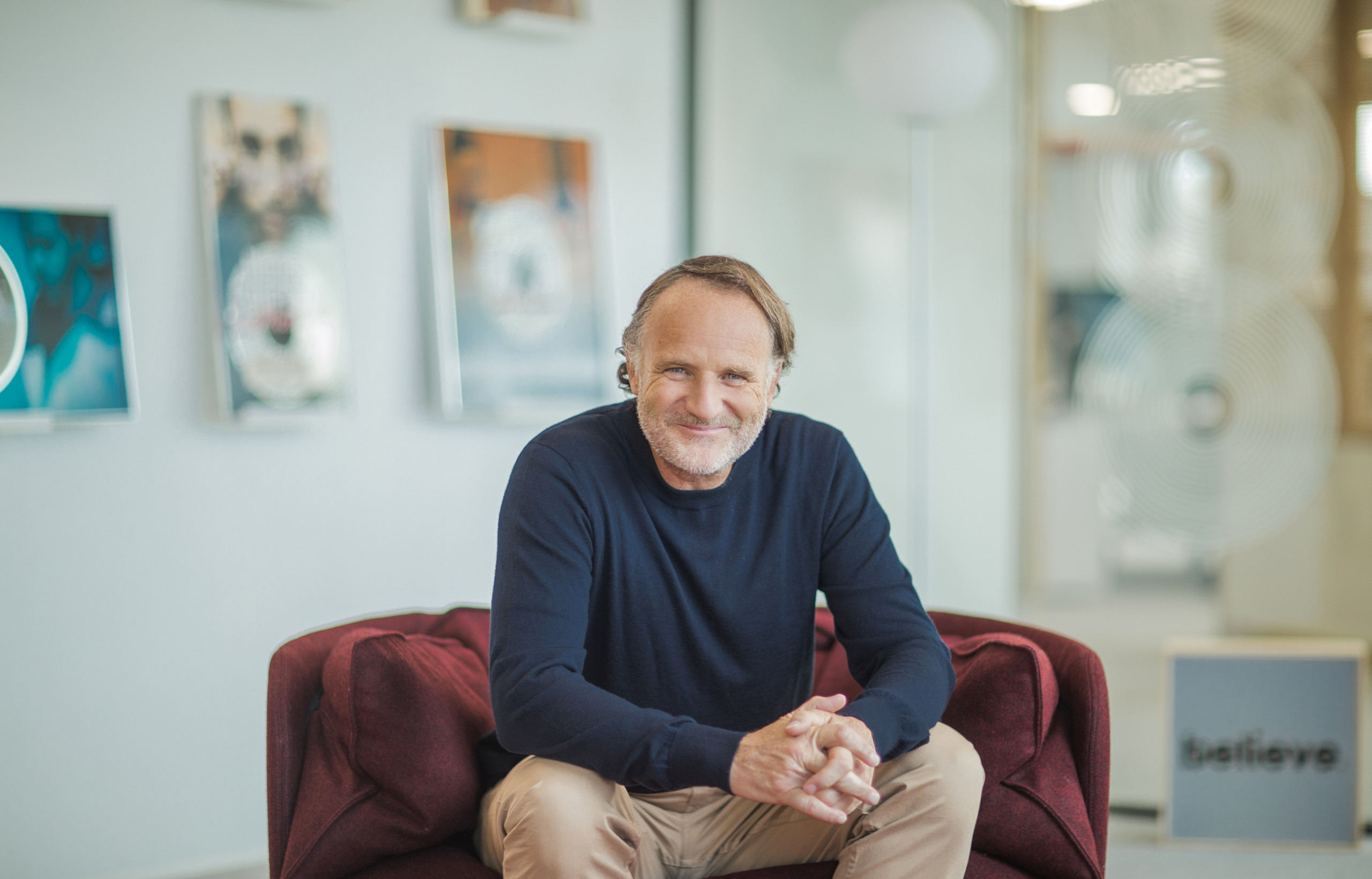
An audience needs a way in
The founding idea was to help independent musicians reach the digital market and develop there. It required paying attention to artists whose prospects did not fit a conventional record-company calculation. It also required a willingness to treat digital listening as a business to build, even when established habits made it appear an unwelcome interruption.
Ladegaillerie’s approach gives local knowledge a central role. In a 2021 interview, he described building teams on the ground to follow and encourage local artists. The internet could carry a recording across borders; understanding the people making and listening to it still involved geography. A global delivery system and a locally informed relationship could occupy the same company.
He used Jul to explain the change. The French rapper’s audience developed through digital channels, including YouTube. That offered an alternative to the older journey through physical retail and mass-media promotion. The practical questions became how to understand an audience, grow it and earn revenue from it. A video platform could be a place where a career began, rather than simply somewhere to advertise one already underway.
Different careers needed different amounts of help. A self-releasing musician might want distribution tools. An established artist could need financing for an album or video, promotion and advice. Treating every musician as if they had the same resources and ambitions would be a peculiar way to serve a business whose entire product is difference.
“Recommendation algorithms are the new marketing.”
Denis Ladegaillerie, in a public LinkedIn post
His sentence has the economy of someone who has sat through too many meetings about promotion. It also reveals what interests him: the mechanism by which attention moves. In an earlier podcast conversation, he described the change from persuading an industry intermediary to understanding an algorithm. The creative work remained personal; the route by which listeners encountered it had acquired another set of rules.
On Génération Do It Yourself in 2020, he talked about the appeal of an entrepreneurial adventure and the importance of respect and collective work. That is a useful accompaniment to the algorithms. His account leaves room for both the technical explanation of distribution and the people expected to make it succeed. A musician may experience the platform through software, but a company still chooses how to treat the musician.
Buying the missing pieces
Believe’s acquisition of TuneCore in 2015 extended its relationship with self-releasing artists. Instead of requiring every musician to enter a traditional label arrangement, TuneCore offered an automated route to digital distribution. The acquisition put a different kind of customer relationship inside the same group: one capable of serving people who wanted to handle much of their own career.
The purchases also followed the music. Musicast, acquired in 2015, added distribution experience in urban music. Naïve followed in 2016. In 2023, Believe bought Sentric, the music publishing platform. That widened the work from distributing recordings to services connected with songwriting rights and publishing. The pieces help explain why Ladegaillerie’s company became harder to describe with a single familiar music-industry noun.
In interviews, he has repeatedly returned to flexibility, transparency and the service an artist actually needs. Those principles have operational consequences. A distribution customer and an artist receiving a substantial investment cannot sensibly be offered identical economics. His financial training is useful here. An appealing promise has to survive the contract, the cost of delivering it and the next release.
The bell, and the way back
Believe listed on Euronext Paris in June 2021, raising €300 million. Ladegaillerie presented the event as a means of financing development. His public message thanked investors, artists, labels, teams and partners. Behind the ceremonial bell was a specific agenda: invest in the technology platform and make acquisitions. The company had entered the market for capital as well as the market for music.
The relationship with public ownership did not last. In 2024, Ladegaillerie joined EQT and TCV in a consortium to acquire control. Warner Music Group explored a competing offer and ultimately declined to make a firm bid. The following year brought a further buyout and compulsory acquisition of the remaining shares. Believe was delisted on August 5, 2025.
By July 2025, the consortium’s vehicle, Upbeat BidCo, held 98.67% of the capital. The squeeze-out price was €17.20 a share. These were consequential changes in who owned the company, rather than alterations to the founding date on its stationery. Ladegaillerie remained at the center of the business, now alongside financial partners in a private structure.
+12.3% year on year. Historical reported revenue; bars start at zero.
The financial results supplied a useful distinction. Revenue grew 12.3% in 2024, while group adjusted EBITDA reached €67.1 million. Adjusted EBITDA is a profitability measure, with its own adjustments; it should not be mistaken for net income. Believe reported €0.6 million of net income that year. Scale and the money left at the end of the accounts deserve separate lines.
The work after the upload
By September 2025, Ladegaillerie was describing Believe as “middle-first.” His argument concerned the artists and revenue beyond the top of the charts. Serving that population shaped the tools, deals and level of support the business needed to provide. He was choosing where to concentrate the organization’s attention, and making a claim about an opportunity its competitors could also see.
“But access does not mean success.”
Denis Ladegaillerie, September 2025
The phrase explains the next problem. Digital distribution opened a door; a sustainable career demands repeated reasons for listeners to return. Ladegaillerie outlined priorities including artist services, deeper label support, publishing, closer platform relationships and better skills for staff. His ambition had moved further along the musician’s working life, from getting a recording into circulation to helping build what follows.
On October 19, 2026, Believe expanded Romain Vivien’s remit as Global Head of Music to include direct leadership of its three main regions and strategic partnerships. The change sits within its plan through 2030. Ladegaillerie praised leaders who had grown inside the company alongside new arrivals. It is a different management problem from the apartment years: keeping decisions close to artists while coordinating an international organization.
The October 2026 Amsterdam Dance Event program put Ladegaillerie and Vivien together for a discussion about Believe’s development and its plans. The pairing was apt. The founder supplies the original argument; the music executive helps turn it into decisions across markets. More than two decades into the business, the story increasingly depends on the people around Ladegaillerie and the responsibilities they can carry.
The early €30 makes a pleasing opening anecdote. The lasting interest is in the work it led to. A founder can remember the first contract for decades; the artist needs help with the next one. Twenty-one years after starting Believe, Ladegaillerie has organized his next chapter around that continuing obligation.
Follow the conversation
Explore Believe and its company history. Follow Denis on LinkedIn and X.
- Watch: Le Tech Show with Vincent Klingbeil
- Listen: Génération Do It Yourself, episode 135
- Listen: The French Tech Journal on the IPO and digital music
- Read: the September 2025 conversation about Believe’s next phase
- Read: The Good Life’s interview and photographs
- Read: Believe’s October 2026 leadership announcement