A fence is a wonderfully literal object. It tells you where the trouble should come from. For most of modern security, the geometry was mercifully flat: gates, doors, locks, cameras, guards. Then consumer drones put a third dimension within reach of anyone with a credit card and an afternoon. Jaz Banga looked up and saw an architectural problem. The perimeter had acquired a ceiling, but nobody had installed the ceiling.
Banga's company, Airspace Defense, began in 2015 with co-founders Noah Moore and Earl Stirling. The early pitch sounded like a prop from a Saturday matinee: a drone that could chase another drone, fire a Kevlar net, entangle the target, and carry it away. Yet the comic-book silhouette concealed sober constraints. Knocking an aircraft out of the sky can turn it into a falling hazard. Electronic jamming comes with complications of its own. In crowded places, stopping the intruder is only half the job. The landing matters.
You are going from a 2-D security problem, which was fences and gates and doors and locks, to now a 3D problem.Jaz Banga
This is the useful way into Banga's story. It is not simply a tale about an interceptor with a net. It is about a founder who has spent more than two decades making invisible networks legible. First the network was broadband. Then it was municipal Wi-Fi. Later it became intellectual property, with ideas mapped into claims. Finally, it became low-altitude airspace, where the urgent questions were no longer only where an aircraft was, but what it was, who controlled it, and whether it belonged there.
Chapter oneThe city as a laboratory
Banga is British-Canadian and moved to Silicon Valley in 2000. His official biography places him first in high-speed broadband infrastructure at @Home. After the attacks of September 11, 2001, he founded UnwireNow, aimed at resilient wireless networks for critical infrastructure and municipal agencies. The stated purpose was practical: improve emergency response and coordination when reliable communication mattered most.
In 2005 came Feeva Technology. Its software brought addressability to next-generation IP networks, associating a device with useful context on a network. Feeva's technology was licensed by Cisco and Juniper Networks and helped power early municipal Wi-Fi deployments, including Google's San Francisco network. An older biography still takes evident delight in Union Square's free connection. By 2010, Feeva had been selected for Microsoft's invitation-only BizSpark One program.
The technology changed, but the recurring interest was already visible: a network becomes more useful when it can distinguish one participant from another. That premise can support advertising, public connectivity, or emergency services. Years later, with propellers involved, it would become a question of safety.
The recurring system
The labels changed across Banga's companies. The underlying sequence kept returning.
Chapter twoIdeas need scaffolding
Between wireless networks and airspace, Banga founded ProximityWare and co-founded Connected Patents. The latter treated patents less like ceremonial certificates and more like an operating system for a young company. His biography says the firm helped venture-backed startups file more than 500 patents. Banga served as an intellectual-property architect behind portfolios linked to acquisitions including Qwiki by Yahoo and Podz by Spotify.
His own count grew as well. Public profiles once described 55 patents; Airspace's current biography says more than 60, spanning broadband networking, wireless identification, and autonomous artificial-intelligence guidance. The numbers matter, but the more revealing point is continuity. Patent work rewards an exacting habit: describe the system, separate its parts, anticipate edge cases, and define what is genuinely new. That is useful preparation for a field where hardware, software, physics, policy, and public safety arrive in one untidy bundle.
Chapter threeThe hundred-prototype answer
Banga had tinkered with drones since his early Valley years. He has described them as both fascinating and troubling: easy to fly, broadly useful, and capable of crossing boundaries that were designed for people on foot. Airspace was a natural extension of the hobby, sharpened by concerns about privacy and security.
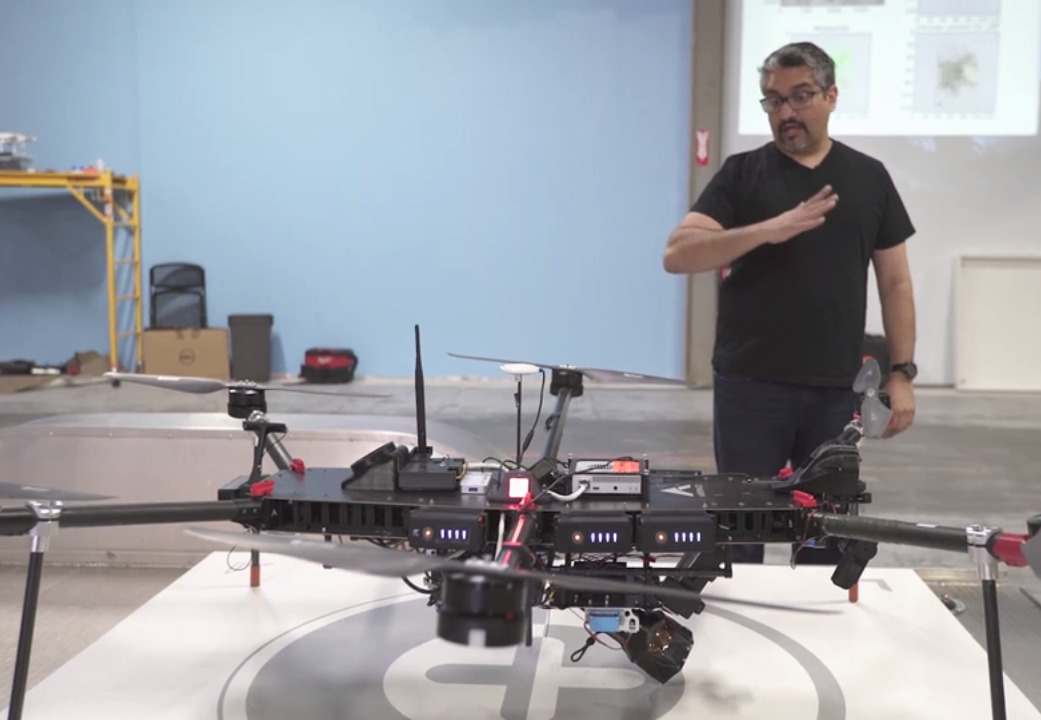
The Interceptor did not spring fully formed from a sketch. Banga has said the team worked through at least 100 prototypes before arriving at capture. Purpose-built hardware and software had to detect a target, predict its bearing, close at speed, deploy a net, and manage what happened after contact. Computer vision met aerodynamics; the final flourish was woven from Kevlar.
One interception, three jobs
Conceptual view: detection starts the process; identity supplies context; a controlled response closes the loop.
The company also worked on Remote ID, commonly explained as a license plate for drones. Banga's public biography credits the Airspace team with pioneering the technology in 2016. A patent issued in 2020 describes optical and radio-frequency methods for identifying low-altitude aircraft. In FAA committee discussions that same year, Banga pushed the identity question one step further: knowing the aircraft was not enough. What about the person, or autonomous system, controlling it?
That question reveals his preferred unit of thought. The drone is an object; airspace security is a system. Radar, radio-frequency sensing, visual classification, operator identity, flight behavior, regulation, and human judgment all contribute partial truths. The practical job is to fuse them quickly enough to make a better decision.
I think that gut instinct doesn't get enough credit. I think it's the culmination of all your experiences into a binary decision. It's what AI machines strive to do.Jaz Banga
Chapter fourThe inventor in the policy room
Emerging technologies do not wait politely for their rulebooks. Banga entered the FAA's Drone Advisory Committee in 2016 and served through 2024. Meeting records show him asking how non-cooperative data from radar, radio-frequency systems, and other sensors might enter unmanned traffic-management systems. He also pressed the operator-identity issue. These were not abstract seminar questions. Airspace customers were already putting sensors around facilities and discovering that technical capability and legal authority do not always advance at the same speed.
He also held a seat on RTCA's Policy Board, another bridge between aviation technology and standards. In this part of his career, Banga operated less like the mythic lone inventor and more like a translator: from the workshop to the committee table, from a sensor return to a policy category, from what a machine can do to what an institution should permit.
Feeva takes shape
Network identity and addressable services meet early municipal Wi-Fi.
Airspace is founded
Banga, Noah Moore and Earl Stirling bring machine vision and autonomous flight to drone security.
A seat at the FAA table
Banga advises on drone integration, security, traffic management and identity.
The Interceptor enters a national collection
Banga and Moore deliver the aircraft to the Smithsonian National Air and Space Museum.
Beyond the Fence
At RSAC, Banga moderates a discussion connecting aerial threats with enterprise security.
Chapter fiveA machine becomes an artifact
In March 2024, after nearly ten years of development, Banga and Moore delivered an Airspace Interceptor to the Smithsonian National Air and Space Museum. Airspace describes it as the first fully autonomous, AI-powered interceptor drone funded by the U.S. Army. Museum collections are patient places. They turn prototypes into evidence that a generation had a particular problem and chose a particular answer.
For Banga, the accession also rhymed with a stated ambition. Asked what motivated him, he said he liked solving hard problems. He hoped that at 70 he could look back and say he had brought real change to a sector or contributed to improving an issue. The line is less chest-beating than bookkeeping: what will the work add up to?
There are lighter clues to the person doing that bookkeeping. An older self-profile calls him a passionate photographer, surfer, Audi enthusiast, and supporter of music-industry charities. A podcast conversation reaches back to a child taking apart toys and forward to an adult who values giving himself time to reflect. Its most cinematic description has him as someone inclined to run toward an explosion. Curiosity, in this telling, does not stand at a safe distance.
By 2025, Airspace had supported San Francisco Fleet Week for a sixth year. In March 2026, Banga moderated an RSAC session on aerial threats with aviation and security leaders. The vocabulary had expanded from interceptors to trusted drone-security programs, but the old geometry remained. The sky is increasingly a workplace, a delivery route, a camera angle, an emergency corridor, and occasionally a problem. It needs rules that can recognize legitimate use without pretending misuse will vanish.
Banga's career offers a compact lesson for builders: earlier work is rarely discarded if one learns to recognize its shape. Municipal Wi-Fi taught questions about devices and identity. Patent strategy taught decomposition and defensibility. Drones gave those instincts altitude. Policy work forced them into a shared language. The thread is not the hardware. It is the determination to make a network explain who is inside it.
A conventional fence ends at the top rail. Banga's version begins there.