Jared Peterson grew up on a farm near Weldon, Saskatchewan. He went on to found a project-management company in Saskatoon. Somewhere along that route, the question of what Saskatchewan engineers could do next acquired a rather ambitious destination: the Moon. It is a large change of scenery for a career rooted in getting practical work done. Yet the connection becomes easier to follow when you look at the people involved, rather than the distance between the places.
Peterson is the founder and CEO of Peter Lucas, the industrial project firm he established in 2011. His work brings together engineering, entrepreneurship, and the business of assembling teams. His public introduction on LinkedIn is disarmingly brief: “I build teams, businesses, and opportunities.” There are worse ways to explain a working life. There are certainly longer ones.
A farm kid with a different map
The rural beginning matters because it gives the later story a location. Weldon comes before Saskatoon; Saskatchewan comes before the discussion of space resources. Peterson’s upbringing on a nearby farm appears in his speaker biography for a 2021 mining presentation. By then, he was an engineer, a company founder, and a father with responsibilities well beyond the office.
A farm, a city business, and a space-resource venture make an appealing sequence. They should also be allowed to remain distinct chapters. A childhood location does not explain every adult decision. What it does establish is that the person discussing a possible future industry had come from a particular existing place. The province was part of the question he was asking, rather than a backdrop to be discarded on the way to a more fashionable address.
Peterson studied civil engineering at the University of Saskatchewan. That setting supplied a connection that would matter later: he met Brandon Harris while they were both studying the subject. Before the lunar venture had a name, two of the people behind it already had a shared professional starting point.
“I build teams, businesses, and opportunities.”
Jared Peterson
The business of putting people in the right place
Peter Lucas gives Peterson’s career a practical centre. Founded in 2011, the company supports industrial projects through people, systems, and specialist experience. Its present service menu includes a project management office, secondment services, and advisory work. Put more plainly, an owner can bring in help to manage deliverables, add professionals to an existing team, or obtain advice on a particular problem.
These are separate needs. A project may require more capacity, clearer processes, or expertise that the owner does not have in-house. Treating them separately makes the company easier to understand. It also explains why a business built around engineers can spend so much time thinking about the organization around the engineering.
The secondment model places professionals within the owner’s team. Peter Lucas also emphasizes maintaining project knowledge and supporting people with mentorship and tools. The company’s promise to begin delivery in as little as three weeks is a qualified service claim; it describes the speed it aims to offer, rather than the duration of a complete industrial project.
Three service models at Peter Lucas. A service map, not a ranking.
The range of tasks is concrete. Peter Lucas lists scheduling, cost controls, forecasting, procurement, contract management, and commissioning among the work its seconded professionals can support. Its project office offering includes early development, studies, estimating, and operational readiness. Advisory services extend to reliability, maintenance, and the systems an owner uses to manage projects. A single assignment may need only part of that menu.
For a reader outside engineering, those distinctions help bring Peterson’s business into focus. Someone has to establish what the work will cost. Someone has to keep track of when it should happen. Someone has to help a completed installation become part of an operating site. The company’s service models organize support around those different stages and responsibilities.
The work has an unshowy appeal. A project organization is an arrangement of responsibilities, decisions, and people who must know whom to call. The machinery tends to be more photogenic. The arrangement around it still deserves attention.
A familiar colleague, an unfamiliar destination
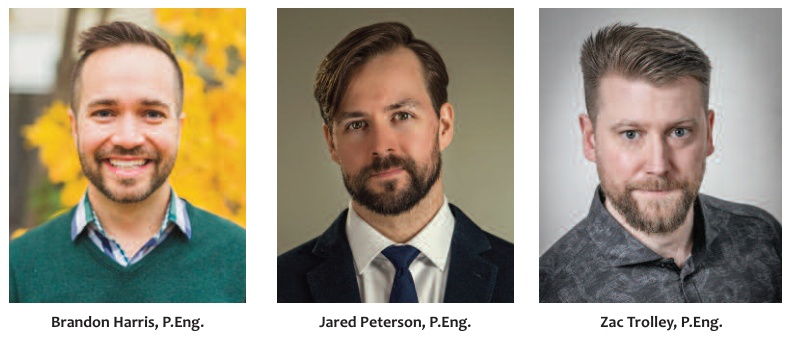
Harris is now Peter Lucas’s chief operating officer. He and Peterson also joined engineer Zac Trolley in developing the Lunar Water Supply Company. The venture launched in October 2020, bringing a space-resource ambition into a career already connected to the resource sector.
The proposed business concerned water resources on the Moon. Peterson’s explanation in 2021 linked that interest to existing skills and the future of mining. He was considering how experience accumulated in one setting might become useful in another. The Moon supplied an unfamiliar operating environment; the professional question was about assembling the expertise a project would require.
That history is best understood as an ambition being developed at a particular moment. Launching a company and supplying lunar water are different milestones. The interest here lies in the route Peterson and his collaborators were exploring: taking a resource-industry background seriously enough to ask where else it could apply.
Taking the question into the room
In January 2021, the topic reached a Saskatchewan professional audience through a presentation called Mining the Cosmos. Peterson, Harris, and colleague Keira Sawatzky were named in the event announcement. The discussion connected skills already present in the province with the work a space-resource industry might need.
The proposition had a local purpose. Engineers, scientists, financiers, lawyers, and entrepreneurs were all part of the audience’s possible contribution. The subject was space, but the immediate conversation concerned the usefulness of people and experience much closer to home.
A March 2021 SIMSA lunch-and-learn returned to lunar water mining and Saskatchewan’s potential role. Peterson and Harris were listed as the presentation contacts. In the same event description, Peter Lucas explained its approach to matching project needs with candidates’ skills and personality. The juxtaposition is pleasingly ordinary: an ambitious destination beside the familiar question of who should be on the team.
Public presentations also make an idea available for other people to examine. A private plan can remain wonderfully frictionless. Once it enters a professional room, it has to coexist with other people’s expertise, questions, and calendars. Peterson’s space-resource chapter included that outward-facing work.
- 2011Peterson founds Peter Lucas.
- 2020Lunar Water Supply Company launches.
- 2021Space-mining discussions reach professional audiences.
- 2024He records a conversation on business, travel, and parenting.
What changes when the team grows
By the time Peterson recorded an interview with Pavan Sidhu in November 2024, Peter Lucas had grown from a startup into a team of more than 60 people. The first part of their conversation, titled Business of Limitless, covered entrepreneurship, leadership, and the company’s development.
Its advertised subjects included living with intention, the choice between fear and excitement when facing challenges, and what makes project management successful. Those are useful topics for a founder whose company sells the ability to help other organizations execute work. The conversation puts the person making decisions beside the services the business provides.
Headcount offers one concrete marker in that story. It is a dated measure of the organization discussed in the interview. The more interesting question is what growth asks of a founder: a larger team makes coordination, delegation, and the experience of other people increasingly consequential. A business built around project professionals has to make room for their judgment as well as their availability.
Peterson’s short professional introduction gives this chapter a useful frame. Teams, businesses, and opportunities are connected undertakings. Each depends on other people agreeing to participate. A company’s growth gives those agreements an organizational shape, with all the work that follows.
The other demands on the calendar
The second part of the Sidhu conversation moved into travel and parenting. Its themes included experiencing different cultures, the perspective children can gain from travel, and making decisions about time that reflect personal priorities. That gives the profile a scale beyond the company without requiring a grand revelation.
There is a particular pleasure in the change of subject. After project delivery and entrepreneurial decisions come questions about family and how to spend a day. The calendar has to accommodate both. Business biographies can make a career look like a sequence of uninterrupted professional advances; an actual life has competing appointments.
Peterson brings those interests into the same conversation. Industrial work, an interest in space resources, and a discussion of travel each involve unfamiliar situations, but their stakes and responsibilities differ. They belong together here because he chose to talk about them, and because they broaden the picture of what occupies his attention.
The route from Weldon to Saskatoon is easy enough to trace. The lunar chapter adds a question about the reach of familiar skills. The family conversation adds another about the use of finite time. Between them sits Peter Lucas, the company Peterson founded in 2011 and continues to lead. It is a working life with several destinations, and people to consider at every stop.
Follow the conversation
Explore Peter Lucas, Jared Peterson on LinkedIn, and the Peter Lucas company profile.
Listen to Business of Limitless and Perspectives on Travel and Parenting. Watch Mining the Cosmos on YouTube.
Read the 2021 event introduction and Mining Moon Water in The Professional Edge (pages 10-12).