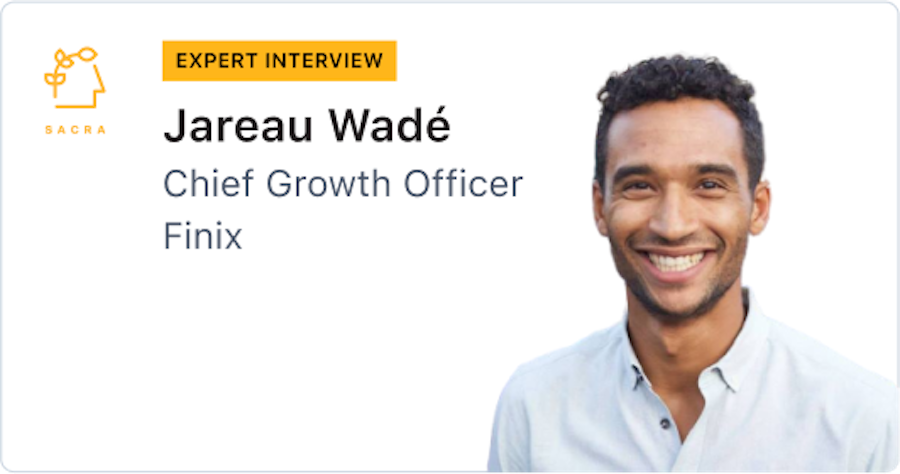
The clearest voice in payments is a guy who actually shipped the product.
Every Tuesday, somewhere in Atlanta, a former electrical engineer sits down and explains how money actually moves. Not the press-release version. The plumbing. The interchange, the settlement, the awkward economics nobody at the conference wants to say out loud. The newsletter is called Batch Processing - a settlement-industry pun hiding in plain sight - and its readers run product at the companies he writes about.
That is the trick with Jareau Wadé. Most people who write about fintech have never had to make a payment facilitator profitable at 2 a.m. Most people who have built the infrastructure can't write a sentence you'd want to read twice. He does both, which is rarer than it sounds and explains why a VP at FIS calls his work "the most comprehensive and insightful analysis in the payments space."
By day he leads product partnerships at Ramp, the finance-automation company that turned corporate cards into a software story. By night - and on weekends, and on the train - he takes apart Square, Stripe, Adyen, Worldpay and PayPal for an audience that already knows the basics and wants the part that's hard. He has earned the right to do it. Twice.
The reviews read like the credits of an industry that doesn't usually hand out compliments. The founder of Simple Donation calls Batch Processing "the most anticipated newsletter in my inbox." A VP of product at Clearco describes it as "news and opinions from one of the best experts in payments." When the people building the products say your analysis of the products is the best around, the title earns itself.
I moved to Atlanta, in part, to live in a place where I'm not seen as suspicious in my neighborhood.
- Jareau Wadé, on leaving Oakland after a decadeTucson, then Accra, then everywhere money flows.
He grew up in Tucson, Arizona, in a mixed-race household - Black father, white mother - one of five kids. At the University of Pennsylvania he studied electrical engineering and built emergency-personnel tracking systems with GPS, the kind of project that teaches you that infrastructure is the thing nobody notices until it fails. He also found his footing among Penn's small Black student community, a thread that runs through everything he's done since.
Then he did something most newly-minted Ivy engineers don't: he flew to Accra, Ghana, and spent a year as a teaching fellow at the Meltwater Entrepreneurial School of Technology, training African founders to build software companies. Years before "global talent" became a slide in every venture deck, he was in the room handing out the tools.
The Bay Area came next, and stayed for a decade. He was the first employee at Milo.com, the local-inventory search engine, where he ran data acquisition and, by his own account, managed roughly 60% of the staff before eBay bought it in 2010. That was the on-ramp. Payments was the highway.
Balanced, Finix, and the engineer he hired who'd later run the company.
In 2010 he co-founded Balanced, a payments API for online marketplaces and one of the first payment facilitators in the United States. Two-sided payments - paying buyers and sellers, splitting funds, handling the mess - were genuinely new then, and Balanced was a pioneer of the model. One of the engineers Jareau hired there was a young developer named Richie Serna. Stripe acquired Balanced in 2015 and migrated its customers over.
Here's the part that reads like fiction: Serna went on to co-found Finix, the payments-infrastructure company built to let software platforms run payments in-house instead of renting them from Stripe. And years later, Jareau joined Finix as Chief Growth Officer - working for the engineer he'd once hired. The student became the CEO; the boss came back as the growth lead. In payments, the cap tables are small and the loyalties are long.
In between there was Pinterest, where he led commerce and visual-search business development, and Tilt, the group-payments startup Airbnb absorbed. A pattern emerges: he keeps showing up at the exact moment a company is trying to figure out how commerce should work, and he keeps being the person who figures it out.
Balanced wasn't just an early payfac; it was an argument made in code. The idea that a software platform could become the payments company for everyone built on top of it - splitting funds, onboarding sellers, owning the economics - was contrarian in 2010 and is conventional wisdom now. Wadé spent his Finix years carrying that same argument to vertical SaaS companies: stop renting your payments stack, own it. He also handled the harder, quieter work of growth and demand generation, the part of a startup that turns a clever thesis into a revenue line. Two venture-backed companies, one acquisition by the category's defining player, and a front-row seat to the decade payments grew up.
We want to create the operating system for fintech - to create the most accessible financial service ecosystem in history.
- on the mission behind platform paymentsRamp by day, Batch Processing by night, the long game always.
In 2024 he joined Ramp to lead product partnerships - the connective tissue between a fast-moving fintech and the ecosystem it has to plug into. It's an operator's job, and he's an operator. But he never stopped writing. Batch Processing started in 2023, went fully free for readers in 2024, and kept a modest $5-a-month patronage tier for people who find that reading it makes them better at their jobs.
He writes in public with unusual honesty, including disclosing that he's a shareholder in Adyen, Finix, Shift4 and Stripe - the very companies he dissects. He's a limited partner in several early-stage venture funds, advises a small handful of companies in exchange for equity, and is openly looking to back emerging fund managers. Much of that energy points the same direction it has since Penn: toward founders the rest of the industry overlooks, which is part of why he served as an entrepreneur-in-residence at Collab Capital, the Atlanta firm investing in Black founders.
The Atlanta move was deliberate. He left Oakland to raise his daughter somewhere with a thriving Black community and a real tech scene, and he says so plainly. The person who maps where every dollar in fintech is headed also thought hard about exactly where his own family should stand. He arrived not as a tourist but as a participant - exploring neighborhoods, championing Black-owned businesses, and pointing newcomers toward the institutions that anchor the city's tech community.
Why an operator keeps writing for free.
There's an easy cynicism about company people who blog: it's marketing, it's personal branding, it's a job application in disguise. Batch Processing is none of that, and the giveaway is the disclosure footer. Wadé tells readers, in writing, that he holds shares in Adyen, Finix, Shift4 and Stripe before he says a word about any of them. He covers companies he profits from and tells you he profits from them. That's not how you sell yourself. That's how you earn trust.
The writing itself avoids the two failure modes of fintech commentary. It isn't breathless - no revolution is announced, no incumbent is declared dead. And it isn't dull - the essays read like someone explaining a card to a smart friend across a table, not a sell-side analyst hedging every clause. He went fully free in 2024, keeping a five-dollar tier as pure patronage, because the point was never the money. The point was being read by the people who set the roadmaps.
Underneath it all is a thesis he's held since long before it was fashionable: that platforms - not individual merchants - are the engine of financial inclusion and the next wave of fintech. He's been arguing it from inside Balanced, inside Finix, and now from the page. Fifteen years in, the argument keeps winning, and the audience keeps growing.
Coffee, soccer, comic books, and an annual reckoning.
On his personal site he writes about music, soccer, coffee, film and comic books, and publishes a year-in-review every January - the kind of annual audit you'd expect from someone who thinks in systems. He's a self-described coffee enthusiast and an unembarrassed soccer fan. There's even an IMDb producer credit floating around, because of course there is.
He calls himself a "payments entrepreneur and recovering engineer," which is the whole man in five words: he can build the thing, he's slightly amused that he used to, and he'd rather tell you the story now. The recovery, for the record, has gone extremely well.