James Foster had a customer he could talk about, provided he left out the customer’s name. In June 2009, the XMOS chief executive described a company selling chips built on his company’s silicon. The customer had products in the market and its own logo on the package. It considered the underlying technology a competitive advantage. Foster agreed to keep the arrangement discreet. A semiconductor sales pitch had acquired a rather agreeable complication: success could mean somebody else getting the credit.
There was a practical argument behind that discretion. Foster wanted companies to use XMOS as a foundation for products they could make their own. They would program an existing chip platform for a particular application, then sell the result with their own identity. XMOS could supply the silicon without demanding a starring role on its surface. The logo was small. The business proposition underneath it was considerably larger.
Foster had already been chief executive of Oxford Semiconductor when he helped found XMOS in Bristol in July 2005. His public story in those early years turns on a question of access: could a smaller business enter the chip market without taking on the costs of designing new silicon from scratch? It was a question about engineering, money and whose ideas would make it into physical products.
Five people, and a different route to silicon
XMOS began with five founders: Foster, Ali Dixon, Noel Hurley, David May and Hitesh Mehta. Their backgrounds put several kinds of experience around the same table. Dixon had been a University of Bristol student. Hurley came from ARM. May had been chief architect at Inmos and was a professor of computer science at Bristol. Mehta came from Acacia Capital Partners. Foster brought experience running a semiconductor company.
May’s architecture supplied the technical foundation. Foster’s job as chief executive included explaining why anyone should build a business around it. That division gives the early company a human scale. A research idea needed colleagues who could turn it into a product, recruit people, find investment and persuade a designer to try something unfamiliar. The founding team connected university work with commercial experience rather than leaving the invention to fend for itself.
By September 2006, XMOS had received £625,000 in seed funding from Prelude Trust. The announced investment left Prelude with a 22.3 percent holding, and Russell Haggar of Esprit Capital Partners joined the board. Foster was identified as the company’s CEO. The precise figures are a useful reminder of the stage the business had reached: an architecture was becoming an organization, with investors expecting something that could eventually be sold.
The software was allowed to touch the hardware
In July 2007, XMOS set out its proposition publicly. Software-defined silicon would let designers specify in software functions that would ordinarily be implemented in hardware. Foster described a gap in consumer electronics: designers wanted flexibility and differentiation, while the available chip options imposed compromises over cost. Changing standards and changing tastes could both leave a product needing something its hardware had not been designed to do.
The proposed answer was a programmable processor platform accompanied by development tools and software components. In its early announcement, XMOS aimed to combine qualities associated with system-on-chip devices and field-programmable gate arrays. That was the company’s product ambition. For Foster, the commercial attraction was a route through which customers could build distinctive electronic products without commissioning an entirely new chip for every idea.
Timing mattered even before the first full launch. In 2007, Foster called potential users “teaching customers.” It is an unusually useful expression. It gives a customer something to contribute before there is a finished product to buy. XMOS was developing a new platform; prospective users could help expose the demands of actual applications. The phrase made room for feedback in a business often described through specifications alone.
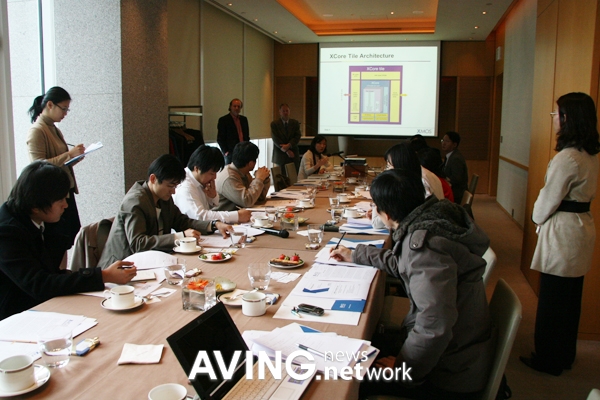
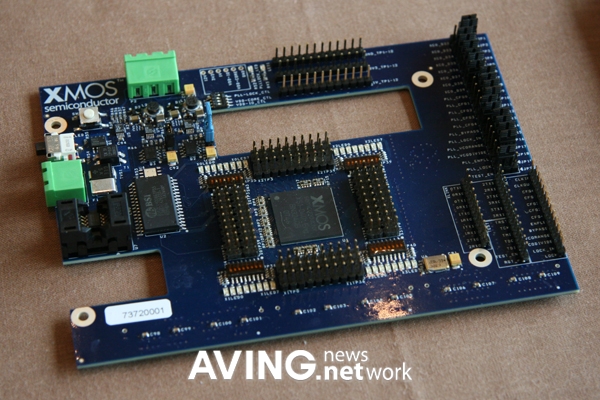
That December, Foster appeared in Seoul alongside Richard Terrill, XMOS’s marketing executive. The presentation covered test silicon and beta design tools, with engineering samples and tools planned for the first quarter of 2008. A development board sat among the material photographed at the event. The company was taking its proposition beyond Bristol, into a market where it had appointed ProGate to handle Korean sales.
Terrill had joined that autumn with experience at companies including Xilinx, Cadence and Altera. Foster’s statement welcoming him emphasized the work of establishing XMOS as a supplier customers could trust. A new architecture might attract attention. Someone still had to choose it for a product with a budget, a schedule and a market waiting at the other end.
A price of admission worth arguing about
By May 2008, Foster was describing a further possibility: other companies could customize XMOS silicon in software and use branding arrangements to take it to market. He presented the idea at a conference organized by the Institution of Engineering and Technology and the Global Semiconductor Alliance. XMOS itself was fabless, meaning it did not operate a chip fabrication plant. Its customers, in this proposed model, could go another step by building on silicon that already existed.
Foster argued that the route could bring non-recurring engineering costs below $100,000. He also made a striking claim about a prototype lead time measured in seconds. Those figures were part of his case for the platform, rather than a universal promise about the time required to create and ship a finished electronic product. His argument depended on moving work into software, where a customer could change the implementation on a stable silicon foundation.
“What if you could start a semiconductor company with $100,000 again?”James Foster, quoted in a 2009 European semiconductor report
The question reveals the business Foster hoped his company would enable. He was selling to designers, but also addressing the people deciding whether a new business could be financed. Lower development costs could make a different class of company possible. A small team with a particular application might have a route to market that did not begin with funding a completely new integrated circuit.
The customer whose logo mattered
A year later, Foster could describe a customer actually using that route. In June 2009, he said one business had reached the market in nine months at a cost of $100,000 and was shipping between 25,000 and 30,000 chips a month. Those were Foster’s reported figures for that customer. They gave his wider proposal a concrete example: a development bill, a calendar and products leaving the building.
XMOS was also working with two other semiconductor companies on getting products into the market. Foster described a willingness to help businesses bring their own intellectual property to customers. His formulation included a brief explanation of the attitude inside XMOS: “we’re all entrepreneurs here.” There was room in his sales pitch for somebody else’s company to succeed.
The reported cost for one customer to reach market in nine months, according to Foster in June 2009.
The unnamed customer’s branding arrangement made that willingness tangible. XMOS had not insisted on retaining its own name on the package. Foster said the customer preferred to keep its use of the platform private. The supplier accepted that preference. It was a small act of commercial accommodation with a large implication: customers could treat the resulting chip as part of their own product identity.
Bristol supplied more than an address
Foster’s account of building XMOS also involved people close to home. Asked in 2008 why Bristol suited a semiconductor startup, he pointed to university graduates who could put their studies to immediate use, and to nearby firms that created a pool of engineering talent. He described recruitment as generally manageable, while acknowledging that some disciplines offered fewer candidates. The city supplied a working environment as well as a location.
When asked what gave him a buzz about a startup, Foster spoke about enjoyment and enthusiasm spreading through staff, friends and marketing. “Sharing authentic enthusiasm is infectious,” he said. His account of electronics careers was similarly concrete: good pay, useful products and the satisfaction of affecting how people interact with technology. The rewards he described included both the work itself and its consequences outside the company.
A career moves; an idea keeps its shape
By October 2010, a NESTA report identified Foster as formerly of XMOS and then at Apple. In 2014, he was described as a senior director of engineering there. The move places his early XMOS leadership within a longer career in hardware. It also gives that founding period a boundary: the company’s subsequent development belonged to other executives and to the continuing work of its engineering teams.
What remains distinctive about Foster’s early XMOS chapter is the relationship he proposed between a supplier and a customer. A customer could bring an application, build on programmable silicon, and sell a product under its own name. Foster’s ambition gave the platform a purpose beyond selling more of the same chip. It could help other companies attempt products they might otherwise struggle to finance.
The anonymous customer is a fitting place to leave the story. Its own logo was visible. XMOS’s contribution stayed behind the scenes. Foster was willing to describe the result without taking possession of the customer’s identity. In a business built around things too small to inspect with the naked eye, he had found another useful way to be less conspicuous.