A payment had failed, and Jake Goh went to the customer’s home to help put it right. This was early in the life of RateX, the shopping extension he had built with Davis Gay and Lim Jing Rong. The company’s promise concerned money saved on overseas purchases. Delivering that promise, on this occasion, required its co-founder to leave the office. Software is supposed to travel effortlessly. Sometimes the person responsible for it has to travel too.
The visit is a useful place to begin Goh’s story. Years later, RateS would take on storage and shipping for Indonesian resellers. The scale was different, but the question was familiar: how much of the troublesome work could his company do for the person trying to trade?
A payment problem with a front door
Goh Jian Kai, who goes by Jake, grew up with a money changer for a father. Exchange rates were close at hand. At eleven, he bought and resold collectible trading cards until he had enough money for a Sony PlayStation. His first documented commercial ambition had an admirably definite finish line: a games console.
There is a pleasure in that detail beyond the familiar story of an entrepreneurial child. The point of the trading was something he wanted to buy. Profit had a use. Later, RateX would similarly appeal to the ordinary wish to keep more money after a purchase, rather than ask shoppers to become fascinated by payment infrastructure.
Before university, he also helped a friend’s family with a vertical-garden business, visiting Thailand and Malaysia to study markets. The objects changed from cards to gardens to online orders. What stayed close to the action was the practical exchange: a thing somebody wanted, a cost somebody had to meet, and work that connected the two.
New York, pet toys and unfinished honours
In 2015, the NUS Overseas Colleges programme took Goh to New York. He worked at PlayDate, a pet-technology startup developing a remote-controlled ball with a camera. An owner could interact with a dog or cat from elsewhere. It was an unusual classroom for a future commerce founder, although cats are famously difficult customers.
A small startup also offers little shelter behind a single function. Goh’s internship covered product work, engineering, marketing and fundraising. The transferable lesson was how to launch an initial product, listen to customers and revise it. A pet toy and a payment extension need different technology. Both must survive contact with somebody who simply expects the thing to work.
Returning to Singapore, he joined Gay and Lim in building Rate. Their student venture became a full-time commitment for Goh, who gave up the honours year while his co-founders continued theirs. “That didn’t make my family too happy,” he recalled. A subsequent newspaper appearance helped persuade them that the project was serious.
The decision deserves its precise wording. NUS lists Goh as an Economics alumnus of the class of 2017. He left the honours year, a particular choice at a particular stage. The familiar college-dropout shorthand makes a tidier anecdote, but the real version reveals more about what he was choosing between.
His early duties were equally specific: the nontechnical side of the business, plus weekly office cleaning. The latter is a useful corrective to the glamour of a chief executive title. A company can divide front-end and back-end development quite carefully and still need somebody to attend to the floor.
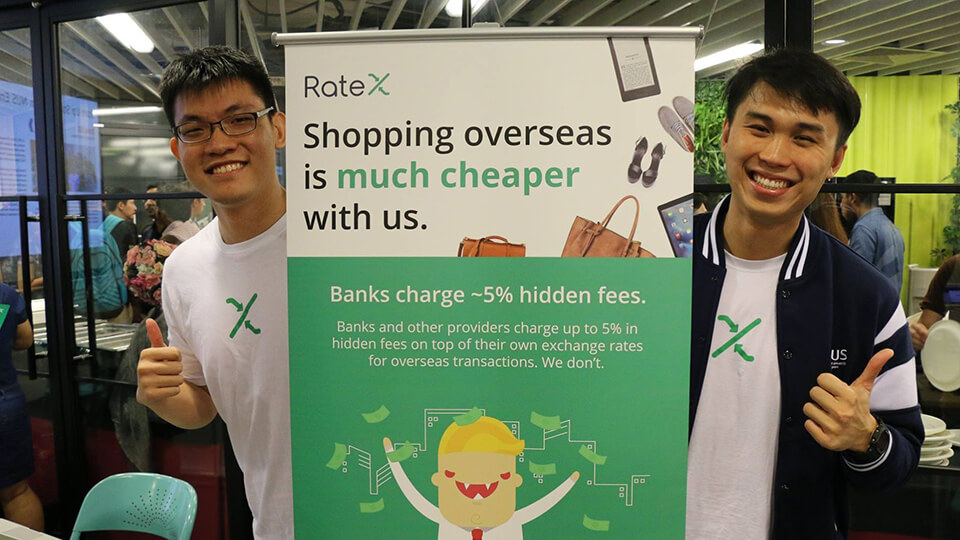
The work had an audience beyond his family. NUS professor Francis Yeoh described Goh as confident and clear about his model when applying for an incubator place. Goh also returned to the student startup community as a speaker, sharing the UniCON stage in 2018 with fellow founders Bjorn Lee and Kenneth Lou. He was becoming somebody younger students could question about the practicalities of starting.
The price at the bottom of the screen
RateX launched in December 2016. Its starting point was foreign-currency shopping: the gap between the price a customer saw and the cost of paying from Singapore. The extension later combined exchange-rate savings with coupon codes. A shopper did not need a new enthusiasm for currencies to understand the appeal.
That distinction matters. Many technical businesses explain their invention before explaining why anybody would want it. RateX could begin with the amount at checkout. The complicated work was behind the screen; the benefit was a number the customer could recognise.
By March 2018, the company had announced a S$3 million pre-Series A round, approximately US$2.3 million, with Alpha JWC Ventures and Insignia Ventures Partners among its backers. It also described a commercial arrangement in which shoppers saved money while merchant partners received affiliate sales. The saving and the business model had to coexist.
“I still have to be prepared for uncertainties.”
Jake Goh, 2017
Goh’s career record includes hackathon wins in New York, including competitions associated with Hearst, Barclays and Amazon Audible. In 2019, he joined Forbes’ 30 Under 30 Asia list in Consumer Technology. These were markers of recognition, alongside a much less ceremonial test: could the product reliably complete an order?
Rate also explored blockchain through Rate3, a project that raised US$15 million in a token sale. This belongs in the chronology because the company’s path was never a straight line from one browser extension to one reseller app. Different approaches to commerce sat within the same founding journey. Their ambitions should not be mistaken for a single, uninterrupted product.
The shopkeeper was already there
RateS launched in Indonesia in June 2019. Goh and Lim redirected their attention toward social commerce in tier two and tier three cities. Here the customer could be a seller: someone with relationships and potential buyers, but with a business to assemble around them.
The shift changed the problem. Saving on one overseas purchase is relatively contained. Running a small selling business introduces sourcing, payments, stock and deliveries. Each additional responsibility can consume money or time before there is much of either to spare.
RateS offered a division of labour. Resellers could build their customer relationships while the platform provided the machinery behind the order. Its investor descriptions emphasised the underserved retail markets outside Indonesia’s largest centres. Geography was part of the proposition, rather than merely another setting for the same checkout extension.
A storefront needs a backstage
Find customers
Share products
Make the sale
Source products
Handle fulfilment
Support payments
There is a tempting way to tell this part of the story in which an app creates entrepreneurs out of thin air. The more interesting reading is that people already knew how to sell to people they knew. The company could make more of that skill usable by supplying the operations around it.
That is an interpretation of the model, rather than a claim to know every reseller’s experience. It also keeps the founder’s contribution in proportion. Goh and his colleagues built a platform. The people using it still had to persuade customers, answer questions and earn another order.
A network is a collection of obligations
By February 2021, RateS was reporting more than 500,000 resellers. The mix extended beyond its initial housewife and student agents to include warung owners and other small retailers. Its Series A investors included Vertex Ventures and Genesis Alternative Ventures.
A measure of participation in the network. Individual businesses had their own sales, costs and outcomes.
A registered network of that size is a substantial organisational fact. It is also a number that needs to keep its original meaning. Registration counts people enrolled; it does not, by itself, show how frequently each person sells. Goh’s company reported income improvements for some resellers, but a potential benefit is different from a universal result.
Keeping that distinction makes the business more interesting. The question becomes how the arrangement supports the next transaction, rather than whether one large figure can stand in for half a million separate working lives. A network earns its usefulness in repeated, smaller events.
The following year, RateS announced further Series A+ financing. Its plans included introducing in-house brands, beginning with products for mothers and babies manufactured in China. Product sourcing was moving closer to the company itself, adding another layer of responsibility behind what a reseller could offer.
Investors can fund an expansion plan. Customers meet the consequences of that plan as goods, prices and deliveries. For a founder, the distance between those two perspectives is where much of the actual job takes place. The announcement is brief. The obligations continue after everyone has finished reading it.
The company changed shape. The work remained.
- 2016
RateX launches
- 2019
RateS enters Indonesia
- 2021
Series A financing
- 2023
SIRCLO acquisition
In September 2023, RateS’s acquisition by SIRCLO became public. Goh’s own career profile says Rate was acquired that year, and now lists Kaidee among his affiliations. The RateS founder story has an ending to this chapter; it should not be left permanently poised before the next funding round.
Reading backward from an acquisition can make the earlier choices appear unusually orderly. They were choices made before the outcome was known. Leave an honours year. Build a payment product. Explore another technology. Change the customer and the market. Each required work without the comfort of the finished timeline.
The customer visit remains a good counterweight to that timeline. It offers a concrete action where the larger story offers milestones. A person tried to buy something, the tool failed, and the founder helped repair the experience. Later, his company tried to make selling easier by taking on work that a small shopkeeper might struggle to carry.
For Goh, commerce kept producing new versions of a familiar problem: the purchase looks simple until somebody has to make it happen. His career is most revealing when you look at that somebody, and at the tasks he was willing to put inside the business.