In October 2009, while much of the business world was still peering nervously at the wreckage of the financial crisis, Jai Shankar was looking at a calendar. GITEX, Dubai's technology exhibition, was approaching. Consumers had postponed purchases. Corporate budgets were waiting for product announcements. The ordinary expectation was for someone in marketing to sound bullish. Shankar, then marketing manager at Brother International Corporation Gulf, sounded more useful.
He separated a regional launch from a global one. Dubai, he argued, remained the place to unveil products for the Middle East and Africa, even if it had not yet become the world's launch stage. He talked about channel partners, distributors, enterprise clients and the peak buying season that followed the show. The glamour of a technology launch was translated into footfall, timing and a route to the customer.
That distinction offers a compact introduction to Shankar's career. For more than two decades he has worked at the junction where a product's promise encounters a market's habits. The objects have changed. Early on, they included retail goods, labels and printers. Today, as Chief Sales and Marketing Officer at Tychons, the catalogue is digital: commerce platforms, cloud deployments, warehouse systems, analytics and automation. Yet the commercial puzzle has survived every upgrade. A new thing matters only when people are ready, able and persuaded to use it.
“It is definitely the place to unveil products for the Middle East and African markets.”Jai Shankar on GITEX, 2009
A marketer educated by geography
Shankar's professional map begins in Chennai, where he studied commerce at the University of Madras from 1993 to 1996. He then travelled to England for an MBA in marketing at Durham University Business School, completing it in 1997. Degrees are tidy things. Careers are not. His took shape in Dubai, a city that turns distribution into architecture: ports, malls, exhibition halls and regional headquarters all stacked into one restless trading system.
At Grand Stores, beginning in 1999, he worked as a marketing specialist. The assignment was close to the ground: retail plans, implementation and the evaluation of new products for the UAE. This was marketing before it floated into dashboards. A product occupied shelf space. A buyer could pick it up. A campaign either brought people into a shop or left the aisle quiet.
In 2001 he moved to Avery Dennison's label and packaging materials business. His responsibility expanded across 15 countries in the Gulf, Middle East, Africa and Europe. The remit required a different sort of eyesight. A regional title can make a territory look like one block on an organization chart. In practice, fifteen markets mean fifteen sets of partners, commercial customs and competitive temperatures. His remit included turnaround work in South Africa and Turkey. The job lasted six years.
The printer years, when channels did the talking
Brother International Gulf brought Shankar into consumer and office technology in 2007. He arrived as marketing manager and later became senior marketing manager, then senior sales and marketing manager. His work covered product development, branding, advertising and the expansion of Brother's channel presence in Middle Eastern and African markets. He was also involved in Brother's first Asia-Pacific marketing campaign.
Printers can be comic objects: indispensable five minutes before a deadline, mysteriously offended by everyone the rest of the day. Selling them across a region is less whimsical. It depends upon resellers, retail chains, supplies, service and the small arithmetic of when households and offices decide to spend. In the difficult market of 2009, Shankar expected consumer demand to revive around GITEX and the festival season. He did not pretend the downturn had vanished. He identified the occasions that could loosen a delayed purchase.
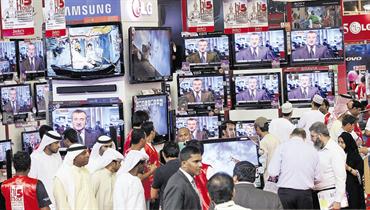
At GITEX, he saw more than launch theatre. The exhibition gathered regional distributors, channel partners and corporate clients in one place. Its date mattered because it fell before peak business season. Its location mattered because Dubai could convene the Middle East and Africa. Its limitation mattered too: he judged the UAE promising but still primarily a regional hub rather than a peer to Europe's largest global launch venues. This was a marketer refusing to confuse importance with universality.
Three years later, at Brother's annual channel meeting in Bahrain, the pattern continued. Company leaders reviewed performance and strategy; Shankar presented the marketing plan for the year. Such meetings rarely enter business mythology. They are nevertheless where a regional strategy discovers whether partners will carry it. The slide deck must eventually survive the showroom.
Grand Stores
Avery Dennison
Brother Gulf
Tychons
From machines on desks to systems behind screens
Shankar joined Tychons as Director of Sales and Marketing in July 2015. Five years later, in October 2020, he became Chief Sales and Marketing Officer. The move altered the technology around him. Tychons builds and supports digital-commerce operations across Adobe Commerce, Shopify and other platforms, alongside cloud integration, analytics and warehouse management. Its customers buy systems that shoppers may never notice, even while depending on them for every search, recommendation, payment and delivery.
The invisible product still has a physical consequence. An online order travels from a screen into inventory, a warehouse and transportation. A personalization engine influences what appears before the buyer. A slow checkout can turn a marketing victory into an abandoned cart. For a commercial leader, this expands the old channel problem. The route to market is now also a route through software.
There is a pleasing continuity here. At Brother, Shankar worked with devices that sat at the end of an information chain and put digital work onto paper. At Tychons, he works with the chain itself. Ecommerce platforms, customer systems and warehouse software are less visible than a printer, but no less dependent upon integration and support. The buyer still wants the product to work on an ordinary Tuesday, long after the launch banners have been rolled away.
A technology may travel globally in an instant. A buying decision still happens somewhere specific.
The commercial value of showing up
In January 2026, Tychons appeared as a Showcase Sponsor at Meet Magento India in Ahmedabad. The event brought merchants, developers, agencies and platform specialists into the same rooms. Tychons described more than two decades of digital-transformation work and more than 250 supported B2B and B2C sites across North America, Europe and Asia. Shankar shared the announcement with a brief note: “Great to be a part of Meet Magento India.”
The echo from GITEX is hard to miss. Seventeen years earlier, he had explained the value of assembling partners, distributors and enterprise buyers around a technology market. Magento's ecosystem speaks a newer dialect, full of extensions, headless storefronts and agentic tools. The reason to enter the room remains familiar. Markets are made by networks, and networks require occasions to become human.
Tychons' public trajectory during Shankar's tenure has moved from its first Magento community project in 2015 to Adobe, HighJump and Körber partnerships, Salesforce Commerce Cloud work, and support for recognizable businesses in commerce and logistics. Those are company milestones, not trophies that belong to one executive. They do, however, define the territory his sales and marketing team must explain: a crowded stack in which platforms, operations and artificial intelligence increasingly overlap.
A career is also what other people carry
The public record around Shankar is mostly professional and sparing. One small item supplies a glimpse beyond titles. In 2024, a former Tychons intern named M Karthik Ram announced the beginning of a role at Yubi Group. In his note of thanks, he called Shankar his first recruiter and credited the learning he received from Shankar and the Tychons team. “Had it not been for the learnings inculcated by them,” he wrote, a page in his later career “would have been left incomplete.”
A sales leader can count revenue, campaigns and territories. Recruitment and apprenticeship create a quieter ledger. The person hired for an internship carries a method into the next company, and perhaps the one after that. Shankar's own comments on colleagues are similarly concise. When a Tychons human-resources leader celebrated workplace recognition, he replied, “Well done team Tychons. Very proud of you guys.” When she was shortlisted for a leadership award, he wrote, “Congratulations Maha. Continue the good work.” No trumpet solo, just the nudge onward.
His return to formal study in 2023 fits the same preference for useful frameworks. More than twenty-five years after his MBA, he completed Harvard Business School Online's certificate in Disruptive Strategy. The subject is apt for an executive selling into ecommerce, where disruption is discussed so often that the word itself risks needing maintenance. Strategy restores the necessary questions: which customers, which job, which constraints, which path from novelty to adoption?
The old question inside every new platform
Shankar's path can be read as a procession of expanding abstractions. He began with products evaluated for UAE shops. Labels and packaging opened a fifteen-country regional view. Printers added technology channels and launch cycles. Digital commerce pulled the storefront, customer data, cloud and warehouse into one system. Artificial intelligence now promises to make portions of that system act for themselves.
But abstraction has never abolished geography, timing or trust. An enterprise platform still needs a champion inside the buyer. An integration still has to cooperate with an existing system. A regional market still has its own calendar. A partner still decides whether a vendor's plan deserves attention. Even the most autonomous software arrives through deeply human channels.
That may be the durable argument of Jai Shankar's career. Technology sales is not a parade of new nouns. It is the practiced work of bringing a market along without pretending every market moves at once. The clever product gets the demonstration. The careful operator watches the room, the route and the clock.