The clue was not hiding in a futuristic laboratory. It was sitting in a handoff: one team wrote the notes, another translated them into codes, and expensive pieces of meaning slipped through the middle. Isaac Park had spent a career learning how to notice this sort of gap. He began as a coder, became a product manager, built an innovation studio, and eventually found himself staring at one of software's least glamorous frontiers - forms, scans, summaries, and the stubborn ambiguity between what a person writes and what a database understands.
Park's company, Keebler Health, started in Durham in 2023 with a metaphor fit for a two-minute pitch: “Grammarly for medical coding.” The early product would flag inconsistencies and omissions so trained professionals could review them. The phrase was modest, legible, and unusually effective. Everyone understands the little colored line beneath a sentence. Far fewer people wake up eager to discuss hierarchical condition categories.
Three years later, the metaphor has stretched. Keebler describes itself as an LLM-native risk-adjustment platform. Its software processes the material that tidy systems tend to neglect - provider notes, imaging reports, discharge summaries, scans, and PDFs - then presents relevant evidence for review. In April 2026, the company announced a $16 million Series A led by Flare Capital Partners, with Sands Capital and existing investors participating. That brought disclosed funding to $23 million.
An apprenticeship in shipping
Park learned to code in high school, then studied computer science at Duke University. His first professional chapter was close to the screen: software development and front-end frameworks. The work trained him to care about the point where machinery meets a person. He later moved into product management, the job where elegant architecture must survive budgets, deadlines, customer confusion, and the occasional meeting about another meeting.
In 2009, he co-founded Pathos Ethos, an innovation studio that built software for startups and enterprise clients, including work in healthcare and defense. The studio launched multi-million-dollar platforms and supported applications that reached more than a million users. Public profiles credit Park with shipping more than 50 products across his career. The interesting number is not 50 by itself. It is the variety hiding inside it. Repetition taught him to recognize when a complaint was local and when it was evidence of a durable market.
After exiting Pathos Ethos in late 2022, Park joined Duke's Pratt School of Engineering as a faculty member at the Christensen Family Center for Innovation. Teaching innovation after years of client work feels like a neat return loop: build, explain, discover which parts you only thought you understood, then build again.
“Risk adjustment doesn't just have an awareness problem, it has an approach problem.”Isaac Park, April 2026
The opportunity between two desks
Park met operator and investor Andrew Stickney through mutual friends. They had worked together through Pathos Ethos and advised a healthcare startup. While studying the economics of medical billing, they saw the same costly fracture from several angles: documentation, coding, billing, and audit were connected in theory but awkwardly separated in practice. Keebler's original pitch treated AI as a co-pilot for the professionals already doing the work.
Kevin Hill, a neuroscientist and AI leader, joined as co-founder and technology chief; physician Terrell Bacchus joined as founding chief medical officer. Their combination mattered. Park brought product and engineering fluency, Stickney brought operating experience, Hill brought model expertise, and Bacchus brought the judgment of the intended professional environment. The company trained its early model in spring 2023, joined Primordial's September cohort, and emerged from beta with initial customers.
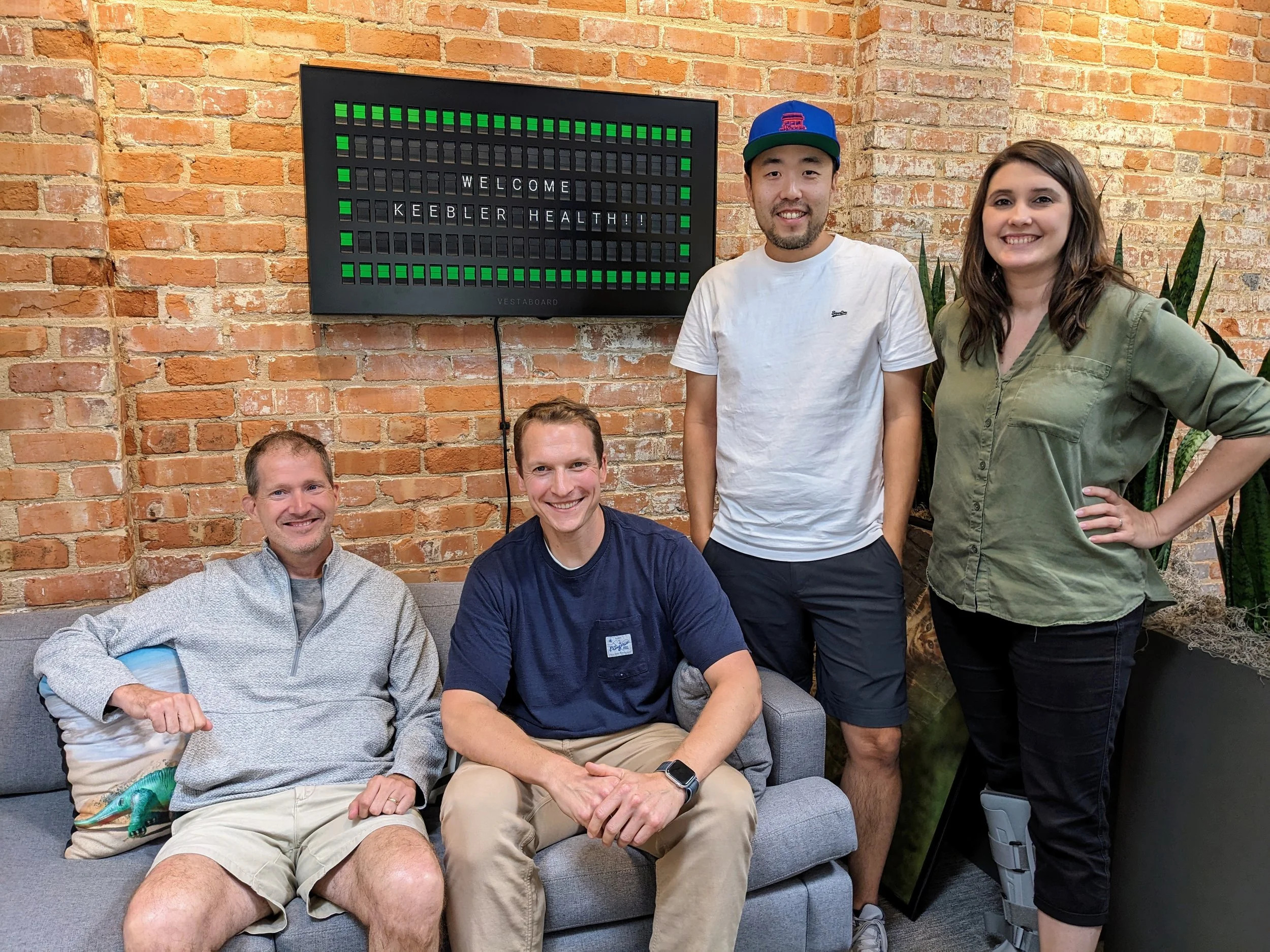
The brand met the density of the problem with a wink. Its website talks about magic in the footnotes. Early coverage carefully clarified that no cookie elves were involved. When the company announced its seed financing, the corporate post wondered which ICD code applied to being “tickled pink.” Park added a line from his then three-year-old daughter: “Let do this.” The grammar was imperfect. The operating instruction was sound.
Trust is part of the interface
Park's public argument for AI is more practical than prophetic. In interviews, he has drawn a line around appropriate autonomy. Low-consequence administrative workflows may tolerate more automation. Decisions requiring clinical judgment need evidence, transparency, and a human in the loop. In one conversation, he reduced the philosophy to a sentence: “It's not about replacing clinicians - it's about giving them leverage.”
That distinction shapes the product. A flag without an explanation merely moves uncertainty from one inbox to another. Keebler's interface is designed to show why something was surfaced, allowing a clinician to inspect the underlying support. The company has also built feedback loops with clinicians and tuned its models for the odd formats and edge cases that polished demos conveniently avoid.
Park has reported 3-to-5-times better throughput as the platform evolved and up to a 50 percent reduction in inference costs through model optimization. Those are company-reported figures, but they reveal what the team is measuring: not only model performance, but the price and speed required to make it operational. A clever answer that arrives too slowly or costs too much remains a clever answer, not a product.
“It's not about replacing clinicians - it's about giving them leverage.”Isaac Park, in conversation with Hank Ross
From co-pilot to platform
Keebler's 2024 launch became a year of provider partnerships and production rollouts. Park has described one group using the platform across a panel of 7,000 patients, a task that would have taken months by hand. He has also recounted a smaller pilot in which clinicians validated 98 previously undocumented conditions across 44 complex cases. The point of those examples is not that software gets the final word. It is that a complete review can begin from more complete evidence.
- 2009Park co-founds the product and innovation studio Pathos Ethos.
- LATE 2022He exits Pathos Ethos and joins Duke's engineering faculty.
- 2023Park, Stickney, and Hill found Keebler Health with Bacchus as founding CMO.
- FEBRUARY 2025Keebler announces a $6 million seed round for product development.
- APRIL 2026A $16 million Series A brings disclosed funding to $23 million.
The February 2025 seed round gave Keebler $6 million for product development. Fourteen months later, the Series A supplied $16 million for commercial growth, team expansion, and infrastructure. The investor list grew to include Flare Capital Partners, Sands Capital, Freestyle Capital, Everywhere Ventures, MBX Capital, New Stack Ventures, Tau Ventures, and several others.
Funding creates runway and a new kind of paperwork. Park's challenge is now organizational: preserve the clarity of the early metaphor while widening the product. Keebler's stated direction includes audit readiness, population health, and what it calls “Next Best Diagnostic Action” - using the context inside the longitudinal record to help teams decide where attention belongs next.
A founder's useful contradictions
Park sits in several productive tensions. He is technical, but speaks in product metaphors. He runs an AI company, but keeps emphasizing human judgment. He works in a graveyard of acronyms, yet communicates with jokes. He has spent years in startup work, but returned to a university classroom. None of these pairings need resolving. Together they explain why he chose a business built around translation.
There is a founder lesson here worth stealing. Search for the handoff people complain about with a shrug. Study the parts of the workflow that are too boring for keynote slides. Keep the first description simple enough to repeat. Then measure what happens after the demo: Did the person find the evidence? Did the work move faster? Could they understand why the machine suggested it?
Park's ambition extends beyond the first wedge. He has named predictive analytics, quality measurement, care coordination, and broader population health as possible directions. The connective tissue is the clinical narrative itself: the rich, disorderly record that never fit comfortably into a row of database fields. If Keebler's early bet was that software could underline what humans might want to revisit, its longer bet is that overlooked context can become a working layer for an entire organization.
The work remains cheerfully uncinematic. There are faxes to normalize, charts to parse, edge cases to test, and professionals who need reasons rather than oracles. Park seems comfortable there. A career spent shipping dozens of products taught him that hidden complexity does not disappear when a pitch deck does. Often, hidden complexity is where the useful company begins.