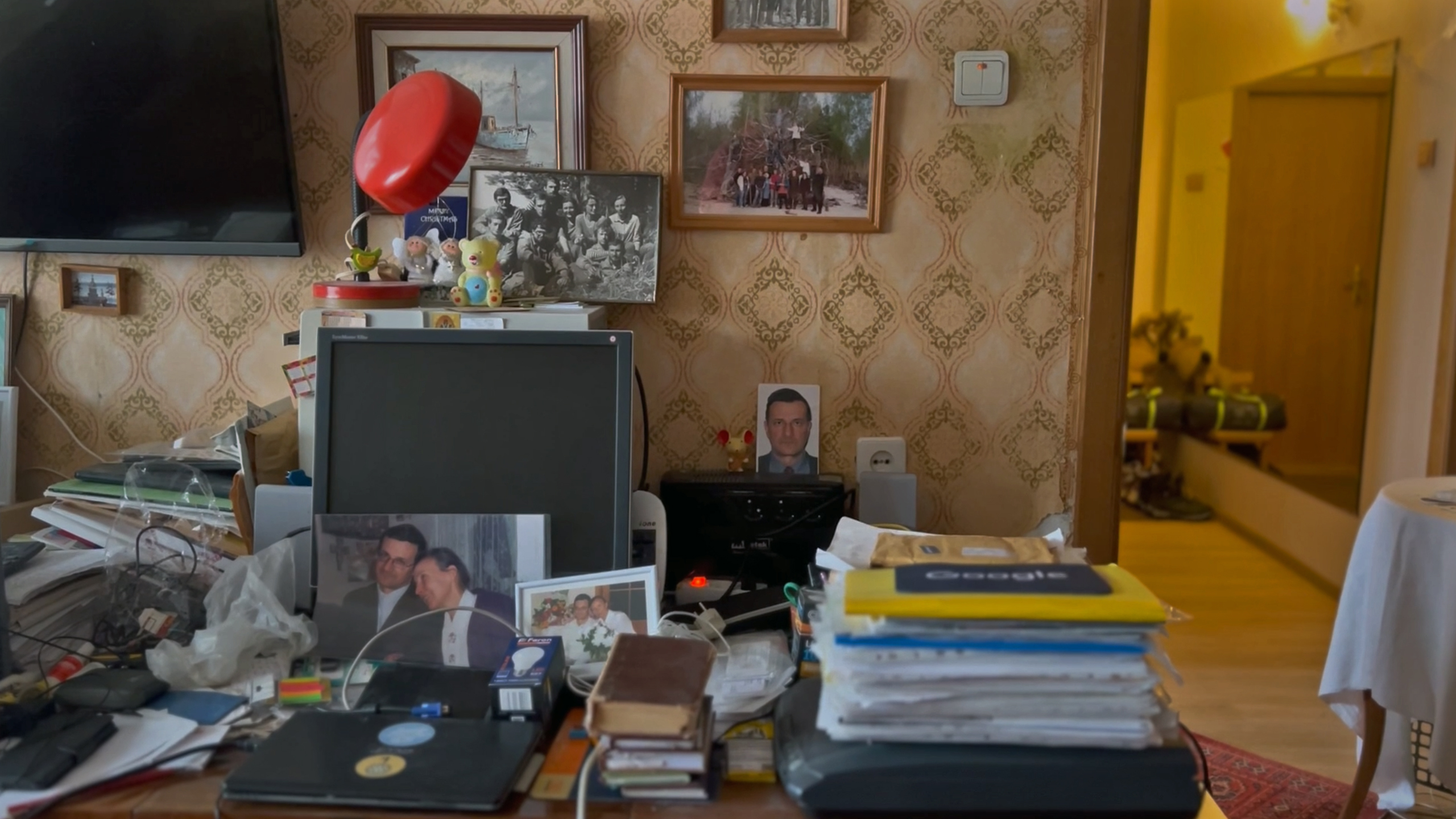
A photograph of Iryna Shostak’s father disappeared from a university website. In his apartment, the evidence of a working life remained: books, papers, the accumulated material of scientific inquiry. Volodymyr Shostak researched lightning. His daughter knew him as her father. Discovering how much of his professional world lay beyond that relationship became the beginning of a film.
The absent image was one of the prompts for her debut documentary, My Dad is a Lightning Researcher. There is something wonderfully awkward about its title. It sounds like a child’s proud announcement, then opens onto the adult discovery that a parent can contain a whole unfamiliar universe. Her father’s work had a public record. Knowing the person behind it required another kind of investigation.
Shostak brought together family photographs, footage of his apartment and conversations with his colleagues at Kyiv Polytechnic. She was preserving her own recollections while making room for other people’s versions of him. The family album had company. A room full of papers could become a meeting place between the daughter and the scientist’s wider life.
When discussing the film, she asked for something very specific: that her father’s name be included. It is an unusually useful introduction to her work. Before the campaign, the exhibition, the audience, there is a person or an object whose name deserves to remain attached.
02 /A poet learns to hold a camera
Shostak studied sociology and public relations at the National University of Kyiv-Mohyla Academy. Her creative life also took her into poetry: a collection titled Changeable, publications in anthologies, and the poetic and musical project EVTERPA. In 2017 she helped organise White Readings, a series bringing music and poetry together.
There were exhibitions too. She participated in the group projects Procrustes and the Rest and Where I Am, and curated an exhibition by M. Matiashova. These activities gave her several ways to work with an audience: a page to read, a room to enter, a performance to hear. Film added duration, voices and the possibility of looking again.
Her debut emerged through Indie Lab’s 2022-2023 programme. She wrote and directed it and shared cinematography duties with Olena Kyrychenko. Ella Shtyka produced it; other collaborators worked on sound and editing. A personal film still needed a team. The credits make a helpful correction to the romantic picture of an artist proceeding entirely alone.
In 2024, My Dad is a Lightning Researcher received a special diploma in Doc Kyiv Fest’s national competition. The distinction recognised a film about the connection between a daughter and her father. A private attempt to remember had found a cinema audience.
03 /The pastry clause
Her agency work has room for a different register. In October 2022, linza began developing a series of Instagram conversations with creative business leaders. The eventual format, Balachki and Baklava, paired discussions of failures and victories with actual pastry. Remote guests introduced a logistical consideration rarely encountered in a communications strategy: locating baklava in another city.
Shostak hosted. Guests included Roman Tymotsko of Stroom Digital, Dmytro Vlasov of infocus, Irina Metneva of Vandog Agency, Natalia Holod of WARTO and Veronika Kobzysta of 9.Department. Creative copywriter Mykhailo Komarov described the wordplay that helped produce the name. A discussion about keeping a business afloat acquired a rather more edible identity.
“I love talking to people, hearing, sharing insights,” Shostak said of the format. She also described listening to other managers’ podcasts and broadcasts, using their experiences to reflect on her own. The pleasure was in finding similarities and differences across businesses. The baklava gave everyone permission to arrive without sounding like the final slide of a conference presentation.
“I love talking to people, hearing, sharing insights.”
Iryna Shostak, on Balachki and Baklava
04 /A campaign has to go somewhere
At linza, Shostak’s credits have included CEO, marketing lead and communications lead. The agency works with nongovernmental organisations, socially important projects and socially responsible businesses. Its tools range from research and strategy to identity, PR, animation and video. The practical question running through that service list is what someone should understand or do after encountering the work.
Consider the 2024 recruitment campaign for Teach for Ukraine. The programme brings professionals into teaching in small towns and villages. Linza made a video manifesto, four short interviews with previous participants and three collage explainers addressing potential applicants’ fears and misconceptions. Social targeting helped put those materials in front of prospective recruits. Shostak was credited as CEO and marketing lead.
Another collaboration, with the English-language outlet WithUkraine, examined misleading language in international reporting on Russia’s war. WithUkraine supplied the texts; linza handled visualisation. Five Reels used rapid collage and examples from media coverage. The agency reported more than 284,000 views. The point was unusually granular: an expression in a headline could alter how a reader understood responsibility.
Work with Brand Ukraine carried Ukrainian culture and science into videos for the country’s official social accounts. Topics included artists, space research and Christmas traditions. Again Shostak’s credit was CEO and marketing lead, alongside a producer, creative lead, art director and editor. These were collective productions, with distinct jobs behind the finished few minutes.
05 /Twenty students, five real briefs
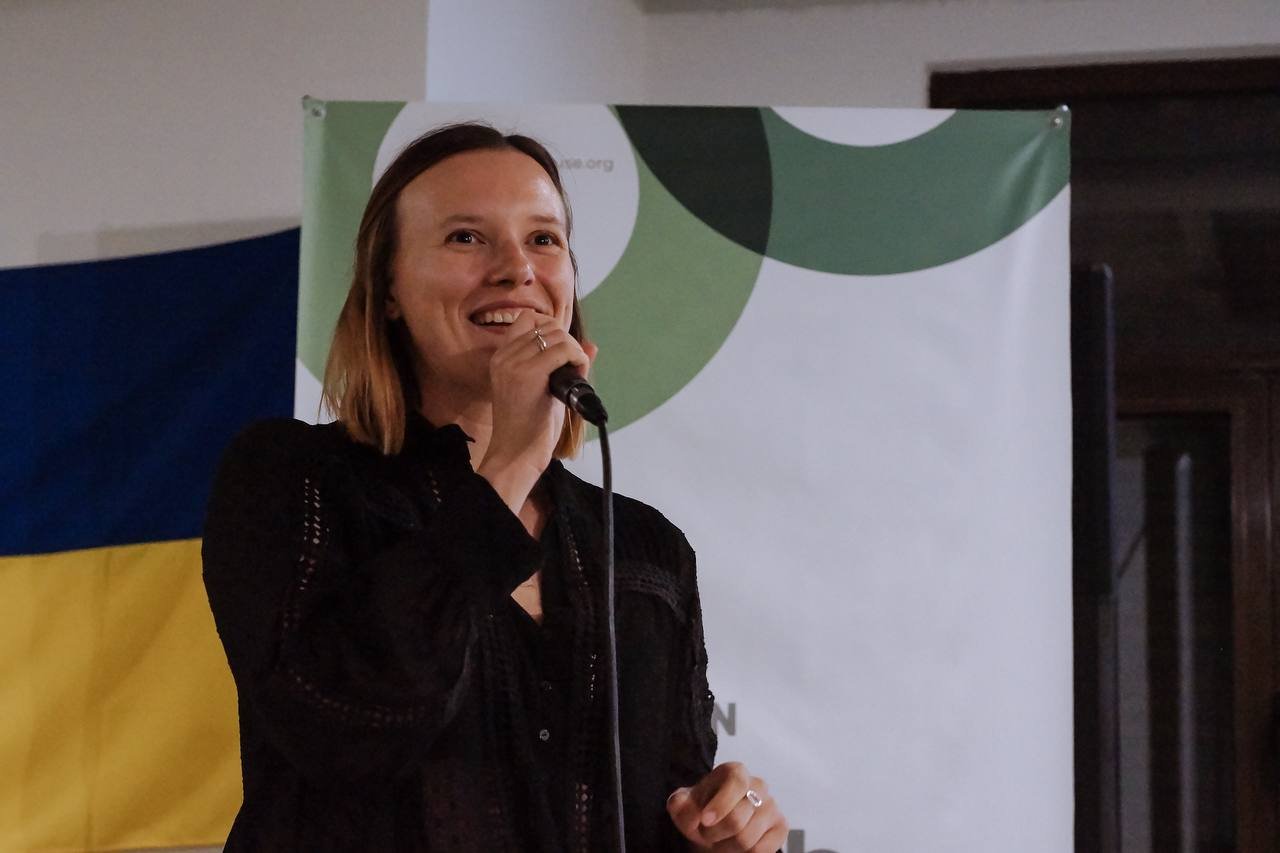
In September 2023, linza and the Ukrainian-Danish Youth House ran the Creative Communications Academy in Kyiv. Shostak was its programme manager as well as the agency’s communications director. Five organisations brought real requests. Participants worked in mixed teams, joining different creative skills around an actual client problem.
The programme included six lectures, seven practical sessions and a workshop. Teams could book time with mentors. Twenty students completed the course; five civil-society organisations received communications products or concepts; six students received internship invitations. Those are modest, legible measures. You can picture a group, a brief and a next step.
Shostak described the satisfaction of seeing one participant continue working with the organisation whose case she had tackled. That is a rather good result for a course: the exercise survives the certificate ceremony. It also shows how closely teaching sits beside her other work. The useful thing can be a finished piece of communication or someone newly equipped to make the next one.
the programme
received work
to internships
Creative Communications Academy / reported programme outcomes
06 /A museum built around absence
The Museum of Stolen Art gives the question of preservation a different scale. Its digital galleries display copies of Ukrainian cultural objects stolen, destroyed or missing as a result of Russia’s full-scale invasion. The first gallery centres on Mariupol’s cultural heritage. Visitors can encounter representations of works whose originals have been removed or destroyed.
Shostak is the project’s communications lead and has also been described as its co-founder and advocacy manager. Her colleagues include creative lead Les Yakymchuk, art director Olena Zenchenko and spatial designer Oleksandra Tumyk. The museum’s stated purposes include preserving memory, making the losses understood and pressing for the return of stolen pieces.
A digital copy cannot return an original to its home. It can make an absence visible to someone who otherwise would never know what was there. That distinction gives the project its force. The exhibition asks a visitor to remember an object and to understand the circumstances in which it vanished.
In June 2026, Shostak announced work on an ambassadors programme for young leaders already active internationally. She also outlined plans for a Friends community and a modular travelling exhibition. Each extends the museum beyond a browser window: people who can carry the stories, and an exhibition partners can bring to audiences elsewhere.
07 /Sarajevo asks a longer question
With filmmaker Tetiana Peresunko, Shostak co-directed Between the Ends of War through the WARM Foundation’s Reporting from the Future project. The documentary places experiences in Bosnia and Herzegovina alongside those in Ukraine, asking what a war’s aftermath can illuminate about a war still being lived.
In Sarajevo, she also wrote a series of sketches dated April 17, 2024. They move between the city around her and the places and people that keep her connected to Ukraine. Among the things she wanted to pursue was a visit to her great-grandmother’s village, flooded by a reservoir, to ask whether anyone nearby still remembered it.
The detail belongs beside the father’s papers and the museum’s objects. A village can disappear beneath water and remain in someone’s account of it. A conversation may be the only available route back. Across these projects, Shostak keeps choosing forms that allow another witness to enter.
08 /Making room for the next piece of work
By 2026, Shostak had announced a change in her relationship with linza. She handed operational leadership to her business partner, Les Yakymchuk, while remaining a partner herself. She described a deliberate move toward expert work: communications strategy, mentoring teams and developing projects and partnerships with social impact.
The change fits an argument she had made publicly in December 2024 about nonprofit funding. Organisations, she wrote, need a wider base of support: communities, business partnerships and ways to use their own expertise. Her advice was practical about audiences, messages, formats and evaluating results. An organisation’s purpose still needs the means to continue.
In September 2026, she described leading the opening module of the MOSA Heritage Advocacy Lab, an international programme with more than 40 participants. Her session moved from the fundamentals of advocacy to case studies and participants’ first campaign plans. The task was to turn an overwhelming issue into a specific problem people could work on.
That offers a useful place to leave her: teaching people to give a large concern a workable shape. A film begins with photographs and conversations. A museum begins by making objects visible again. An advocacy campaign begins with a problem somebody can name. Shostak’s work keeps bringing the scale down far enough for a person to take part.
Keep following the thread
- LinkedIn / Iryna’s public updates ↗
- linza agency / projects and team ↗
- Museum of Stolen Art / visit the digital galleries ↗
- Watch / My Dad is a Lightning Researcher trailer ↗
- Watch / Between the Ends of War ↗
- Read / Iryna on nonprofit fundraising ↗
- Explore / film credits and biography ↗
- Read / Sarajevo sketches and film project ↗
- Explore / Balachki and Baklava ↗