A movie theater is designed to make leaving feel slightly awkward. The lights come up before your eyes are ready. People gather coats, inspect the floor for phones, and file out while the music insists that something important is still happening. For most films, the transaction is over. Picture Motion built a company around the possibility that this is the exact moment when it should begin.
The New York agency works in the odd territory between entertainment and organizing. A filmmaker has a story about maternal health, Indigenous land, sugar, gun violence or press freedom. Picture Motion asks who needs to see it, who can credibly host it, what they should receive with it, and what a useful response might look like. Then it assembles the campaign: nonprofit partners, school screenings, discussion guides, panels, digital hubs, email sequences, surveys and a trail of small actions.
This is called impact producing. The name sounds cinematic. The work is gloriously practical.
The business of afterward
Christie Marchese founded Picture Motion in 2012 after working in advocacy and at Participant Media. Wendy Cohen, another Participant veteran, joined the following year. Their insight was less romantic than it was useful: an important film does not automatically find the people who can use it. Distribution puts a title on a screen. Impact work puts it into a community with context, a host and a next step.
That distinction created a business-to-business agency. Filmmakers, studios, streamers, foundations, nonprofits and brands commission a campaign. Picture Motion scopes the strategy and performs the labor - research, partnerships, outreach, events, toolkits, digital promotion and measurement. There is no public price list; the work is custom and sold as professional services, not as a consumer subscription or a screening platform.
- Name the change
- Map the audience
- Recruit partners
- Equip the room
- Count response
Its clients have included National Geographic, Patagonia, TIME, Smithsonian Channel and Harpo Productions, alongside independent filmmakers and advocacy groups. The format can be a documentary, a television series, a book or a podcast. The product is not the content. It is the system around the content.
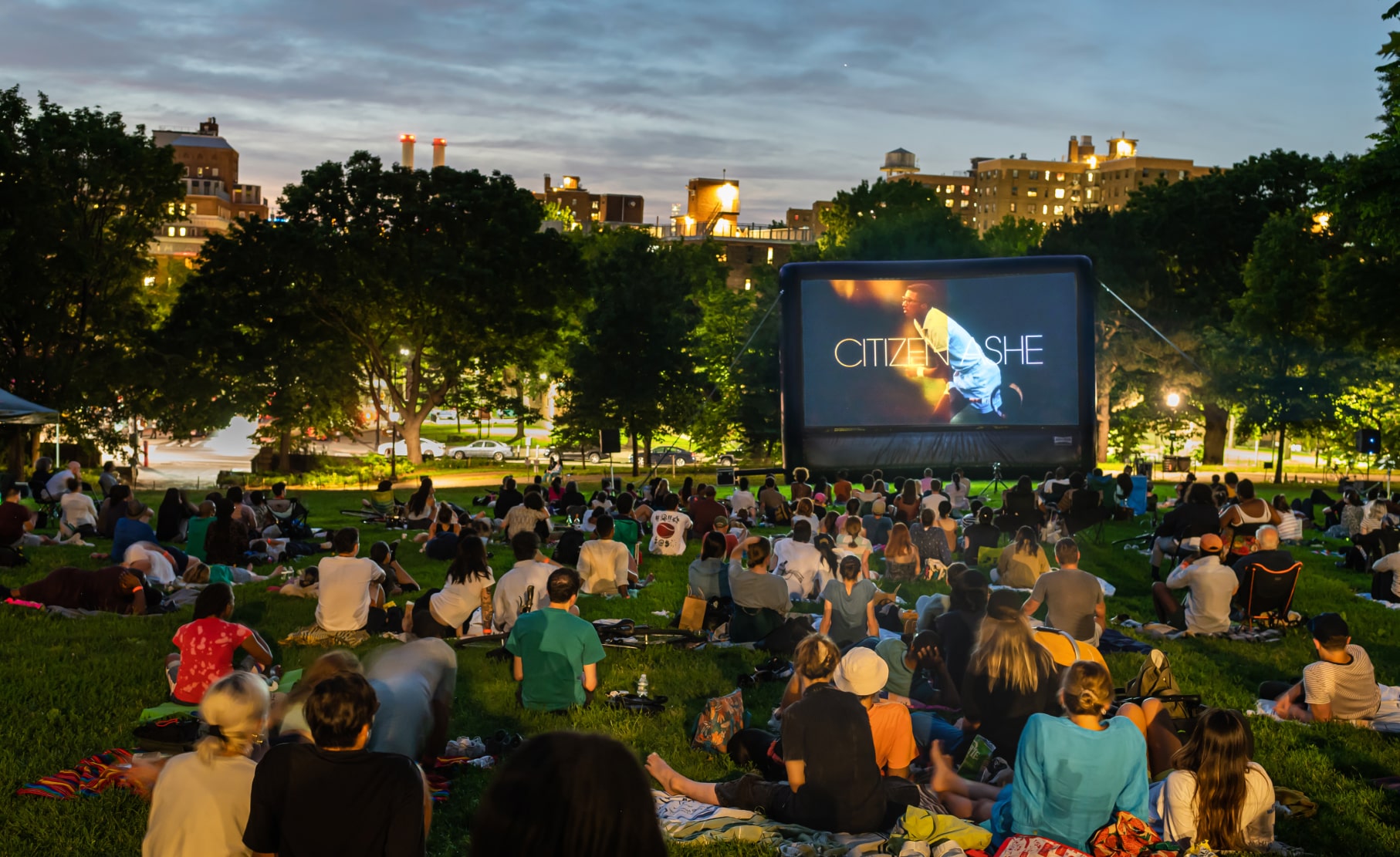
The useful small room
Advertising has trained us to admire scale: millions of impressions, enormous openings, national conversation. Picture Motion's scorecards contain stranger, more intimate units. A host. A toolkit download. A post-screening survey. A classroom. A pledge. Each number describes not merely a person reached but a person doing something.
For True Justice: Bryan Stevenson's Fight for Equality, the agency conducted educator outreach and supplied screening hosts with resources for conversations about racial injustice. The tour facilitated 366 grassroots screenings and reached an estimated 30,000 people, including 10,000 students. Four correctional facilities hosted screenings. Five participating organizations were already working to place lynching memorial markers in their communities. The point was not to manufacture a movement around a film. It was to introduce the film to movements already working.
“Audience identification is the way we look at it at our company.”Christie Marchese, on finding supporters and evangelists
That sentence is the operating system. “Everyone” is not an audience; it is an evasion. A useful campaign names teachers, speech-language pathologists, medical students, public-lands activists, young athletes or families touched by incarceration. The narrower description produces the wider ripple because it tells the agency which institutions already have trust.
The day the rooms disappeared
In spring 2020, the first thing to fail was the venue. Picture Motion canceled upcoming in-person events and called confirmed and prospective hosts to ask how their gatherings could move online. The company admitted it did not have a perfect answer. Then it built a virtual screening room and began testing one.
The result was not a pale livestream imitation. The Story of Plastic became a worldwide network of 1,373 virtual screenings and panels across 86 countries and 33 languages, with an estimated grassroots audience above 50,000. There were 146 events on Earth Day and World Oceans Day alone, and 1,173 potential new members flowed toward the Break Free From Plastic movement.
What changed their mind was necessity, followed by evidence. Shared viewing did not require shared real estate. It did require capable local hosts, accessible technology, translated material and a reason to stay after the video window closed. Remove those conditions and the apparent scale becomes a grid of silent laptops.

Hollywood's neglected arithmetic
Picture Motion is most legible in the things it chooses to count. The Territory, about the Uru-eu-wau-wau people's fight against deforestation in the Brazilian Amazon, led to 140 educational screenings across 39 countries, 820 completed post-screening surveys, and 6,174 clicks and downloads across campaign assets. The Color of Care engaged more than 200 partners and drew 13,000-plus visits to its impact hub. For My Beautiful Stutter, 98 percent of surveyed attendees said they felt compelled to educate their peers.
Not every outcome is attitudinal. The Aftershock campaign, focused on Black maternal health, reported more than 215 grassroots screenings, 11,431 digital-asset clicks and downloads, and $90,500 generated through panel honorariums. Fed Up turned its argument about hidden sugar into a ten-day detox: 65,000 people accepted, and 96 percent of surveyed participants said it changed how they consumed sugar.
This restraint matters because “impact” is a word capacious enough to hide almost anything. The agency is strongest when it reports the thing it actually observed - attendance, a completed survey, a partner action, money generated - without pretending that every screening rewrote society.
The expensive middle
Picture Motion occupies a market gap between an entertainment marketer and an advocacy organization. A conventional agency can sell awareness. A nonprofit knows the issue and the constituency. An in-house studio team understands the release. Picture Motion's differentiator is the connective tissue: a network of thousands of activists, nonprofits and foundations, plus the production discipline to run the campaign all the way through.
The alternative is to assemble independent impact producers, screening specialists, publicists and community partners, or use firms such as Together Films, Peace is Loud or Film Sprout. That can work. The tradeoff is coordination. Picture Motion packages the strategy, relationships, materials, execution and reporting under one brief. According to the company, it has now worked on more than 400 pieces of media.
But there are conditions. The story needs a real constituency, not a purpose statement added in the marketing meeting. Partners need time and a reason to participate. The requested action must fit the audience's power. And somebody must fund the unglamorous middle between inspiration and outcome. In a Sundance case study for The Devil We Know, the filmmakers described a limited budget and choices they could not afford, including a publicist or small theatrical run. An impact campaign does not abolish tradeoffs. It makes them explicit.
A very large parent meets a small-room idea
In November 2024, Publicis Media U.S. acquired Picture Motion for an undisclosed price and placed it inside Publicis Media Content & Innovation. The rationale was straightforward: Publicis already had concept development, distribution, monetization and promotion. Picture Motion supplied the part that connects a story to communities and causes. It was also assigned to help develop original film and television projects with brands and entertainment partners.
The deal expands reach and resources. It also creates the company's most interesting tension. Impact work depends on credibility with communities; global advertising groups depend on commercial clients and scale. The useful question is whether a network built for patient, issue-specific relationships can remain particular inside a machine built to repeat success.
So far, the agency is extending rather than abandoning its premise. In 2025 it launched To Be Seen, backed by Pop Culture Collaborative, to give awards-season marketing support to films from underrepresented filmmakers and talent. The inaugural projects were Bob Trevino Likes It and Speak. In 2026, Picture Motion joined Solidarity House at Sundance, a coalition space for independent storytellers and movement builders.
The part worth stealing
You do not need a documentary, a celebrity panel or a global holding company to copy the core of Picture Motion's method. You need to resist the flattering vagueness of “raising awareness.”
Name one observable change. A hosted conversation is observable. A toolkit used in class is observable. “Starting a dialogue” is fog.
Find the people already carrying the issue. Their trust, language and calendar matter more than a giant contact list.
Equip the smallest useful room. Give a host the material, permission and follow-up that make gathering easy.
Count the action you requested. Do not use impressions as evidence of learning, or attendance as evidence of change.
A film may be the spark, but sparks are famously bad project managers. Picture Motion's real product is the careful apparatus waiting nearby: the host list, the partner call, the translated guide, the survey link, the second invitation. When the lights come up, someone has remembered to give the audience somewhere to go.