The glass case in a good pastry shop is designed to erase evidence. It shows a raspberry dome with a lacquered shine, a croissant whose honeycomb seems mathematically impossible, a chocolate curl frozen at the moment before it breaks. What it conceals is a pile of engineering problems. A filling must hold without tasting stiff. A glaze must survive refrigeration. Chocolate needs the right snap, melt and viscosity. Fruit should taste alive in February. Make ten desserts and instinct can carry the batch. Make ten thousand, in several countries, and instinct needs infrastructure.
IRCA Group supplies that infrastructure. The Gallarate, Italy-based company makes ingredients and semi-finished products for pastry chefs, bakers, chocolatiers, gelato makers, hotels, restaurants and industrial food companies. Its catalog now runs beyond 7,000 products: chocolate and alternatives, creams, fruit purees, pistachio preparations, bakery mixes, gelato bases, decorations, inclusions, fillings, variegates, icings and more. It operates 19 production facilities, employs more than 2,200 people and reaches customers in over 100 countries.
The company is almost invisible to ordinary diners because it lives upstream. Its labels are more likely to appear on a pail in a prep room than on a supermarket shelf. Yet in June 2026, when CVC Capital Partners agreed to buy IRCA from Advent International, Advent said revenue had risen from EUR370 million in 2021 to EUR1.5 billion. The price of the pending deal was not disclosed. The scale, however, exposes a useful truth about food: behind the theater of indulgence sits a large market for making it repeatable.
The most valuable ingredient is often not flavor. It is the removal of doubt.IRCA's commercial proposition, in plain English
A pantry assembled over a century
IRCA did not begin with bonbons. In 1919, the Nobili family took over a Gallarate business called The Italian Essences, producing essential oils and essences for liqueurs. Malt and malt extract for bakeries followed. New lines for bread improvers, pastry mixes and creams arrived in the 1960s. In 1970, the company installed its first machine for refining liquid chocolate and began technical demonstrations for customers. That pairing - machinery in the factory, instruction in the kitchen - still describes the business.
For decades, growth meant adding production capacity and exporting Italian know-how. Then the portfolio began to widen quickly. Joygelato launched in 2015. IRCA acquired Dobla, known for precise chocolate decorations, in 2018. In2food added American distribution in 2021. Cesarin brought candied and semi-candied fruit; Anastasi brought pistachio expertise. In 2023 came Ravifruit's fruit purees and Kerry Group's Sweet Ingredients Portfolio, a transaction that added facilities in the United States and Europe along with capabilities in baked inclusions, cereal pieces, confections, variegates and fruit.
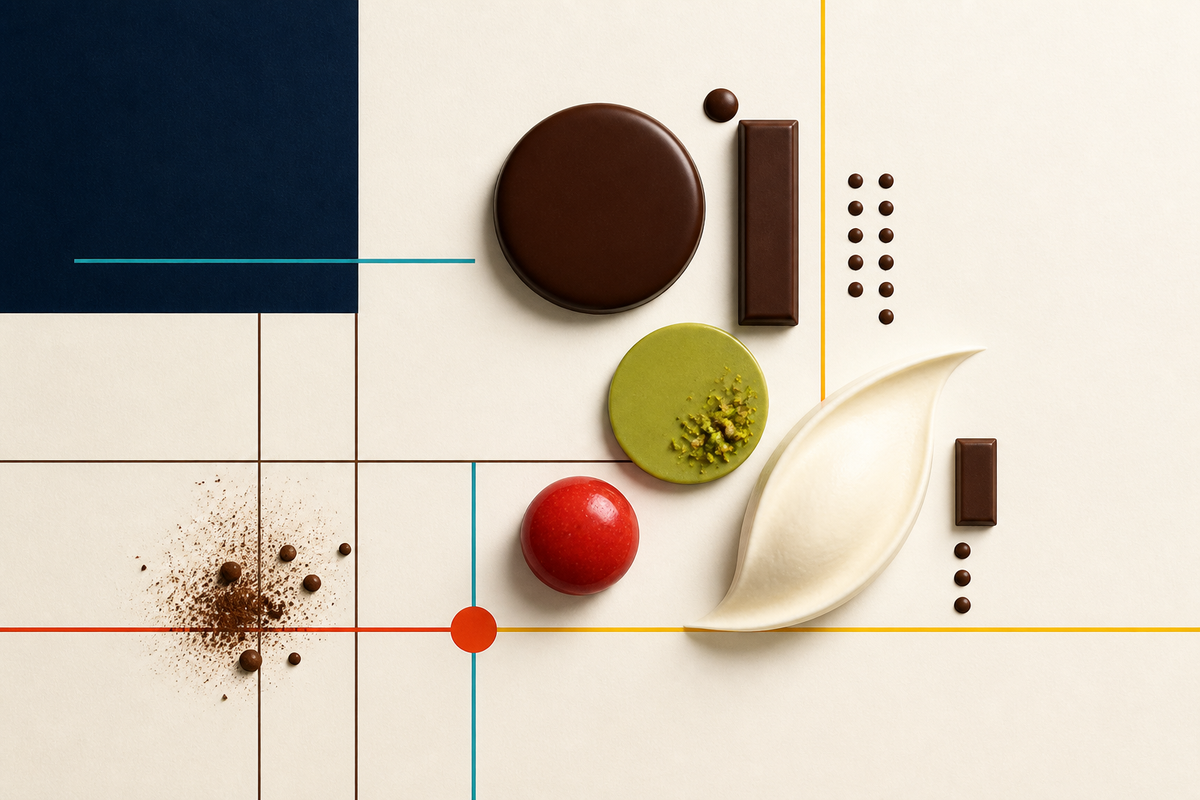
The full stack of something sweet
The acquisitions make more sense when read as a recipe than as a deal list. A customer developing a plated dessert might need a sponge mix, fruit center, cream, glaze and decoration. An ice cream brand may need a coating, sauce, variegate and crunchy inclusion. A nutrition-bar producer wants clusters, nuts, fruit pieces and a coating that behaves on a line. IRCA's one-stop-shop pitch is that more of those pieces can come from one commercial and technical relationship.
Breadth alone is easy to confuse with clutter. IRCA organizes the offer through distinct brands. The original IRCA Since 1919 range covers everyday professional workhorses. Joygelato speaks to gelato artisans. Dobla owns the visual finish. Cesarin and Ravifruit bring different forms of fruit expertise. Domori Professional, added in 2024 through a B2B license and acquisition, sits at the premium end of chocolate. In 2025, IRCA grouped Dobla, Cesarin, Ravifruit and Domori into a Signature Collection - a shop window for the more specialized side of the pantry.
The products solve a practical triangle: time, consistency and creative range. A bakery mix reduces steps and variance. A stable fruit filling protects texture across storage and baking. A ready decoration gives a hotel pastry team a refined finish without asking every cook to become a chocolatier. For a manufacturer, the same capabilities shorten development and support larger batches. The ingredient is useful because it does some difficult work in advance, while leaving the customer to determine the final form.
Three customers, one factory network
Pastry shops, bakeries, chocolatiers and gelato makers buy reliability, inspiration and manageable formats.
Hotels, restaurants and multi-site operators need a consistent finish across people, shifts and locations.
Food manufacturers need application support, line performance, supply assurance and customized solutions.
IRCA sells directly and through distributors. A 2022/23 sustainability report counted more than 1,000 direct clients and over 300 distributors in EMEA. The economic engine is recurring ingredient volume, but the surrounding services make the relationship harder to replace. Customers can run Innovation Days, work with corporate chefs, test applications, consult trend research and use recipes and technical documentation. The group has one Innovation Center, 10 research and development centers and seven academies.
Trend work is another form of service. IRCA's Americas team publishes forecasts, then translates broad consumer moods into things a developer can actually put in a freezer or display case. Its 2026 outlook emphasized multicultural combinations, familiar flavors with a twist and more deliberate sensory design. The commercial bridge is visible: pistachio becomes a TasteLab with recipes and applications; demand for texture becomes fillings with inclusions; renewed interest in classics becomes a modern Dobla decoration on a known dessert. A trend report alone is marketing. A trend report connected to chefs, sample formulas, factories and available inventory can change what a customer launches next season. That loop also gives IRCA early signals about which flavors, formats and technical constraints deserve investment.
Buying the Ashanti School of Pastry & Culinary Arts in Poland in 2023 made this flywheel unusually literal. A school can train professionals, expose the manufacturer to real kitchen problems and create trust before a purchase order exists. IRCA said its flagship Gallarate academy had delivered roughly 60 classes, more than 600 hours of teaching and training for 1,800 professionals over the prior year. Education here is culture, customer support and market research sharing the same workbench.
A good B2B supplier ships a product. A better one helps the customer understand what else the product can become.
Italian formulation, closer factories
IRCA competes with global chocolate and ingredient groups such as Barry Callebaut, Puratos, Cargill and Dawn Foods, with Orkla's food-ingredient businesses, and with specialist fruit, nut, decoration and gelato suppliers. Its distinction is not that no rival can make excellent chocolate or puree. It is the attempt to combine many indulgence categories with chef-facing expertise and a manufacturing network able to serve artisans and factories alike.
The St. Louis chocolate investment shows the approach. In 2025, IRCA said the facility had begun producing artisanal, industrial and specialty chocolate for the Americas, including the RENO X range. “Crafted in Italy, produced in the USA” is marketing, but it also describes a supply-chain calculation: keep formulation heritage while cutting distance, improving availability and giving regional customers more flexibility. The Kerry assets supplied a similar jump in proximity, adding plants across Illinois, Kansas, Missouri, California and Europe.
Scale creates its own risk. Seven thousand products and a string of acquired brands can produce complexity faster than advantage. Different plants, systems, recipes and sales teams have to behave like one group without flattening what customers valued in each specialist. A 2026 redesign of IRCA's pails offers a tiny but telling example of the work: one design across core formats, no formulation or item-code changes, fewer packaging materials and shorter lead times. Corporate integration, expressed through buckets.
What comes after the buying spree
CVC's announced acquisition places IRCA at another hinge point. The buyer said it would focus on operational excellence in manufacturing and supply chain, selected add-on acquisitions, and further expansion in the United States and EMEA. Those priorities suggest that the next chapter is as much about connecting the pieces as collecting new ones.
Essential oils and essences establish the Gallarate business.
Liquid-chocolate refining and customer demonstrations arrive together.
Dobla and the IRCA Academy expand decoration and education.
Kerry's sweet portfolio, Ravifruit and Ashanti broaden the platform.
US chocolate production begins in St. Louis.
CVC agrees to acquire the business from Advent.
Sustainability will sit inside that operational test. IRCA publishes annual reports, has highlighted an EcoVadis Gold rating for IRCA S.p.A. and frames its program around responsible ingredients, people and resource-efficient production. In cocoa, fruit, nuts and dairy, environmental and social claims are inseparable from sourcing and traceability. Customers increasingly expect proof, not adjectives. A large ingredient platform can impose standards across more volume, but it also inherits more supply-chain exposure.
The appeal of IRCA is finally quite modest. It promises to make difficult sweet things easier to produce. That promise travels from the solo pastry chef who needs a cream to hold through service to the multinational planning a new frozen dessert across markets. The visible result may be playful, seasonal or luxurious. The hidden system is specifications, application tests, sourcing, factories and logistics. IRCA has spent 107 years learning that the dessert can look effortless only because somebody took the effort out of the process.