A restaurant menu has a demanding little job. It must carry a business’s personality, help a hungry person choose, and survive being handled. In IQ Graphics’ portfolio, a Volcano Rabbit menu tackles the assignment in hot pink and blue, with big white headings announcing tacos, salads, and entrees. Nobody could accuse it of whispering. It is also a useful introduction to this San Diego company: graphic design here ends up on objects that have work to do.
IQ Graphics brings design, printing, signs, and branded clothing together in a family-owned shop. Its company profile dates the business to 1997. The appeal is easy to understand for a customer juggling several purchases: a business card, a menu, and a sign can begin with the same conversation. The resulting objects differ enormously in size and material. They still need to look as though they belong to the same business.
The reluctant helper becomes an owner
Amir Rezai’s route into ownership took a detour. In a 2018 interview with SDVoyager, he described a family journey from Iran through Austria to the United States, where his father bought a printing business. As a teenager, Amir helped reluctantly. Later, after working in nonprofits, he returned with an appreciation for his father’s work and became his partner.
The partnership required adjustment. Amir recalled disagreements with his father, promising projects that evaporated, customers departing for larger companies, and difficulty retaining employees. He also described customers returning for personal service. His account makes the business’s chosen identity understandable: expansion mattered, but so did preserving the feel of a family shop.
The current team page lists Hassan and Amir as owners, alongside Carl and Enrique. That is a useful way to read the service list. Its organizing principle is the customer’s business, with design and production offered as related jobs.
“I love helping people succeed and grow their businesses.”
Hassan Rezai / Owner
A logo needs somewhere to go
On its graphic-design page, IQ Graphics describes work in layout, typography, color, retouching, and illustration. Those are specific capabilities behind an otherwise broad phrase. A customer might arrive with artwork that needs refinement, or with an idea that needs a visual form. The company emphasizes the audience and the purpose of the finished piece.
Its logo-design page advertises a starting price of $99. That gives a prospective buyer an opening number for a conversation, rather than a complete budget for launching a brand. A logo can be one purchased item; printing it on paper, applying it to a vehicle, or stitching it onto clothing involves other work. Buyers should establish those requirements before treating the first price as the whole project.
Logo designs, as advertised on the company website. Confirm scope, revisions, deliverables, and final pricing with the shop.
This is where a combined design-and-production business can be useful. A customer can discuss the intended objects while the visual decisions are still being made. For a new restaurant, for example, the sensible brief might include the menu, the front window, and staff shirts. That is an illustrative buying scenario, but each category appears in IQ Graphics’ advertised services.
The practical question is whether the identity works at the scale people will encounter it. A mark that looks appealing on a laptop still has to earn its place on a small card or a large sign. Asking about those uses early gives the designer a more concrete assignment than simply asking for something attractive.
The menu is part of the meal
IQ Graphics prints business cards, brochures, postcards, flyers, posters, and menus. Its discussion of brochures focuses on the action the reader should take. Its menu offering similarly treats the object as a marketing piece. In both cases, the design has an assignment beyond carrying information: make the next decision easy to understand.
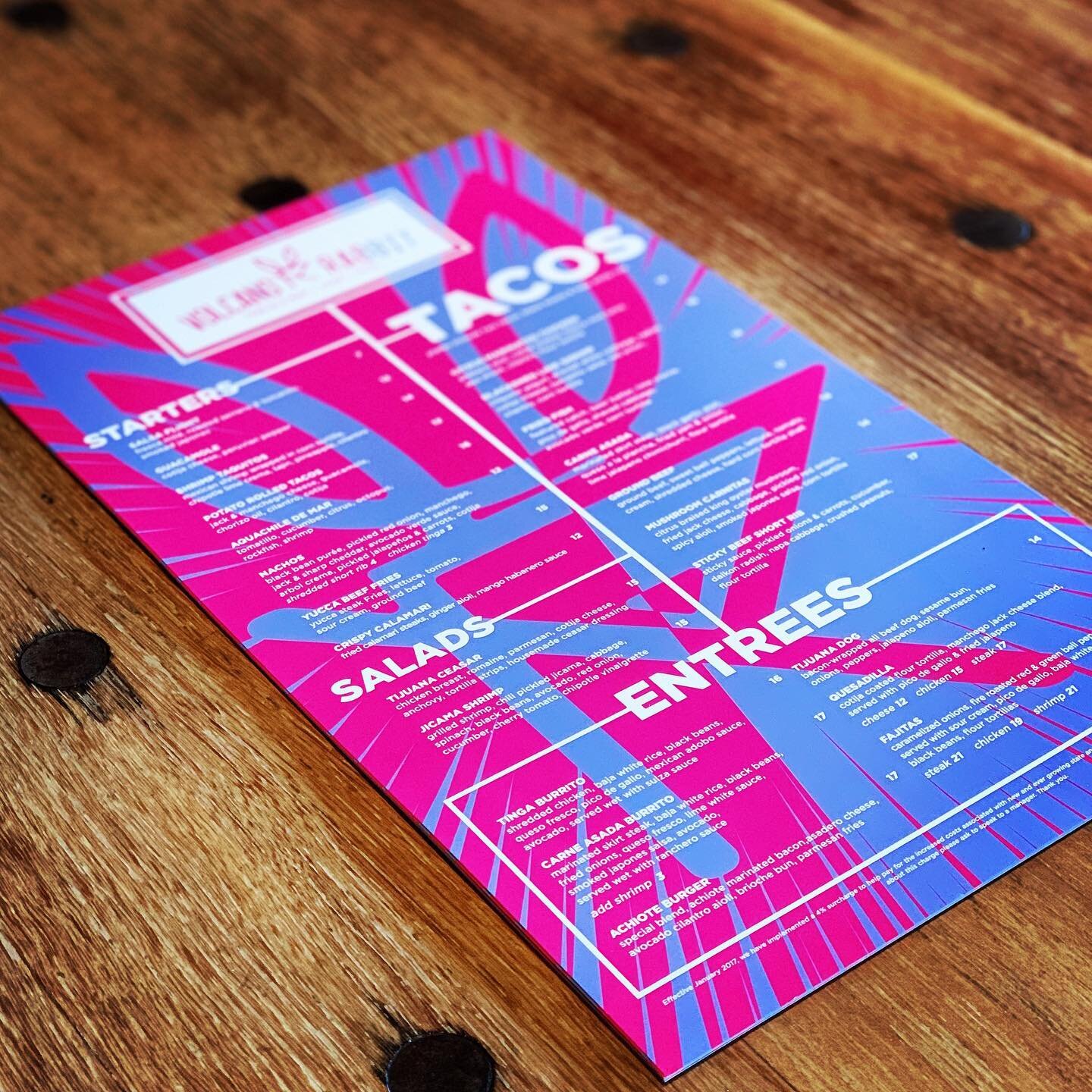
The Volcano Rabbit photograph shows that thinking in a particularly colorful form. Large headings separate the food categories, while smaller text carries descriptions and prices. The pink-and-blue pattern supplies the personality. The hierarchy supplies the route through it. A customer looking at this example can discuss both the appearance of the piece and how it organizes a reader’s attention.
Hospitality is a visible part of the company’s customer mix. Its featured-client page displays Luna Grill, RMD Group, and Rustic Root, among other names. These are the company’s own client selections, rather than a measure of contract size. They nonetheless help explain why menus and signs occupy so much space in its presentation.
The wider customer list includes businesses, hospitals, nonprofits, and individuals. On its reviews page, the company republishes a designer’s account of receiving help printing wedding invitations, and another customer’s comments about menus and posters. Those selected testimonials emphasize assistance with the job as well as the finished print. For a buyer who has designed something but needs help producing it, that is a relevant distinction.
Take the design out onto the street
The signage range moves from paper-sized communication into the built environment. IQ Graphics lists car-window signs and partial wraps, A-signs, light boxes, real estate signs, three-dimensional letters, and retractable banners. The range gives customers several ways to make a name or message visible, depending on where it needs to appear.
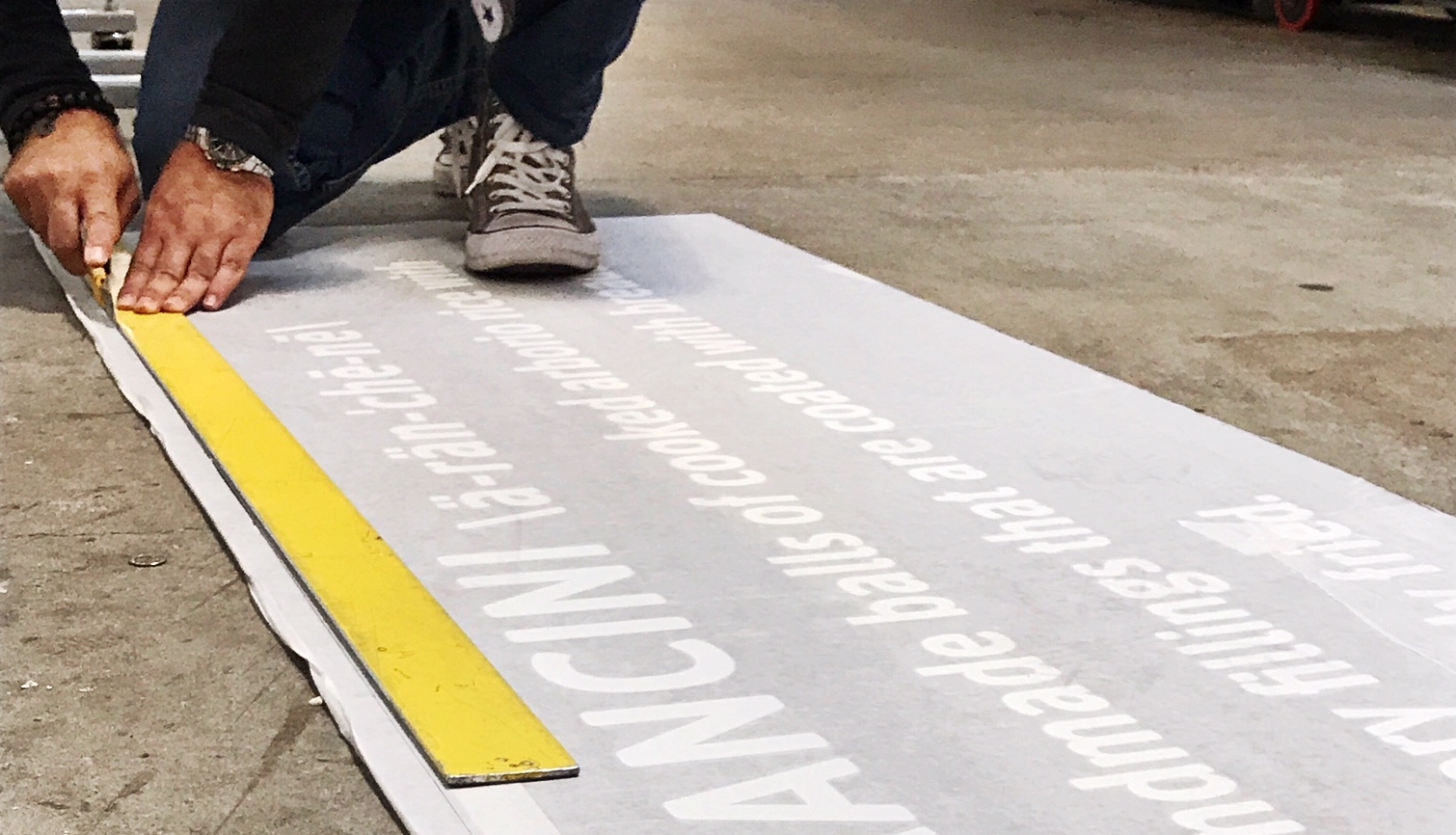
There is a pleasantly unglamorous photograph on the team page: hands, a cutting tool, and a long yellow straightedge working on a large piece of lettering. It shows the physical attention behind the portfolio. Someone has to handle the material and finish the object after the screen work is done.
For a buyer, this range is a reason to describe the location before choosing the product. A message for a vehicle, a storefront, and a temporary event creates three different briefs. Useful questions include the intended viewing distance, how long the item is needed, and what the final quote includes. The consultation should settle those details before an attractive portfolio image becomes an order.
A map of advertised services, not a bundled package.
The next shirt order can start online
Screen printing and embroidery extend the offering to T-shirts, hats, and other apparel. Alongside those familiar products, IQ Graphics advertises a personalized online platform for company shirt orders. Employees and the business can use it to order clothing. It is a small detail on the website, but a revealing one.
The first apparel job may need discussion about the artwork and the garment. Later orders create a different problem: making an established choice easy to buy again. A dedicated company page can give those repeat purchases a clear destination. That is the practical appeal of the service as advertised; its suitability depends on the ordering arrangement the customer agrees with the shop.
For another local service business, this is a useful idea to borrow. Examine the point where a custom job becomes a recurring request. The first conversation and the fifth order may benefit from different ways of working. Keep help available for the decisions that need it, and give familiar purchases a straightforward route back.
Buy the job, not just the object
IQ Graphics’ business model is built around paid design and production work, with a free consultation offered as the entry point. The company says referrals have driven much of its growth. Its stated advantages are personal service, quality, competitive pricing, and quick turnaround. Those are promises a prospective customer can translate into questions about a particular order.
Start with what the item must accomplish. Bring the existing artwork, desired quantity, dimensions, deadline, and intended use. Ask for the complete price and an explanation of what happens before production begins. The website also provides a Hightail upload link, so files have a defined route to the shop. A useful conversation should end with both parties understanding the same job.
The local model is especially appealing when a customer values discussing related pieces with one provider. It may be less compelling for someone buying a fully specified commodity item solely on price, or whose deadline requires a production commitment the shop cannot make. Comparing quotes only works when the scope is comparable. A starting logo price cannot answer what a finished storefront will cost.
IQ Graphics occupies the space where a design decision becomes a practical business purchase. The menu must be readable, the sign must suit its setting, and the next shirt order must reach the right place. Its portfolio makes those everyday jobs visible. For the customer, the useful outcome is equally tangible: a business that looks recognizably like itself wherever people meet it.