At Ericsson’s Australian operation, the problem was almost too tidy an irony: people working for a telecommunications company needed a cheaper way to communicate. Overseas data roaming had become expensive enough that management announced the costs would come out of employees’ paychecks. The business still required travel. The work still required a connection. Somebody had to reconcile the two.
- iPass made participating Wi-Fi networks accessible through one service.
- Its customers bought fewer passwords, predictable bills and easier travel.
- In 2017, revenue fell while network access costs rose.
- Its software ambitions outlived its independence: Pareteum acquired it in 2019.
The roaming bill nobody wanted
Free hotel Wi-Fi offered only a partial answer. It was not always available, and a procession of local accounts and passwords made a poor substitute for a managed service. Ericsson Australia chose iPass through Telstra. The pilot went to frequent travelers who had influence inside the company. They were told to keep it quiet. According to the case study, they promptly told everybody.
“We piloted a test group first, those who traveled a lot and were influential within the company.”Guy Schofield, IT Delivery Manager, Ericsson Australia
The deployment reached 1,700 employee laptops. Staff activated smartphone apps themselves, and international roaming was switched off by default. This is a historical customer account, with all the selectivity that implies. But the mechanics are useful: the pilot began with people who repeatedly experienced the problem. Their enthusiasm helped win internal approval. The product solved an annoyance they could explain without a slide deck.
A passport for other people’s networks
Founded in 1996, iPass grew out of the business of remote connectivity. Its customers were mobile workers and the enterprises responsible for them. The company went public on Nasdaq in July 2003. Including the underwriters’ additional shares, the offering raised $112.7 million before fees and expenses. There was money to be made in helping a laptop reach the office from somewhere inconvenient.
Wi-Fi changed the scenery without abolishing the inconvenience. Airports, hotels and cafés could each offer internet access, yet every network had its own arrangements. A signal was only the beginning. A traveler still needed permission, authentication and a connection worth using. iPass assembled access from network partners and wrapped it in software. The charm was that the customer could stop thinking about the assembly.
A 2015 roaming agreement with Devicescape helped expand that footprint. This was aggregation: iPass did not have to install every access point. Its expertise lay in commercial relationships, authentication and connection management across networks it did not entirely control. That position made it a useful intermediary between the owner of a hotspot and the person standing near it.
The same service could reach customers by different doors. Tech Data distributed iPass and expanded the relationship into Brazil in 2018. HSBC offered access to qualifying Premier credit-card holders. Its activation instructions required a code, registration and device setup; the benefit was not simply an app anyone could download and use. Distribution partners could turn connectivity into an employee tool, a carrier feature or a perk in somebody else’s package.
The software hiding inside the service
SmartConnect was the practical center of the proposition. It selected networks according to availability, performance and cost, handled connection tasks, and could return the user to cellular when Wi-Fi was unavailable. The point was not to make a traveler a better amateur network administrator. It was to spare the traveler that promotion.
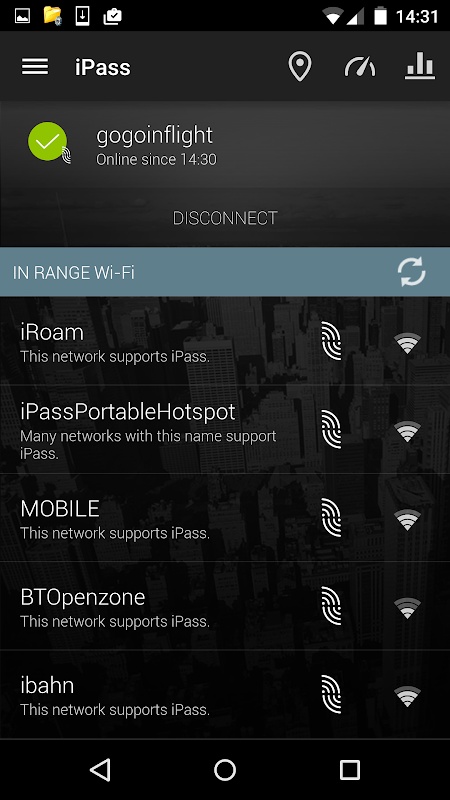
In early 2016, iPass released a software development kit. Developers could incorporate activation, authentication and network selection into their own applications. A partner no longer had to persuade users to adopt a separate branded experience. It could buy the machinery and put its own interface in front of it. At the end of 2016, iPass reported the SDK was in the hands of 28 partners.
There were boundaries to the promise. The first SDK brief explicitly said autoconnect was not supported on iOS. That dated limitation is instructive: a connectivity product depends on what a device’s operating system allows, as well as what the network permits. A large map cannot overrule either. The company also developed Veri-Fi analytics, later renamed iPass Network Intelligence, to turn network observations into location and performance information.
Security and administration were part of the sale. Historical offerings included a Last Mile VPN tunnel; the Microsoft marketplace lists SmartConnect integration with Entra ID for organizational sign-in, requiring an existing subscription. Enterprises were buying control alongside access. A direct hotel connection or a cellular plan might get someone online, but those alternatives did not automatically supply the same bundle of network selection, entitlement and centralized management.
Find02
Assess03
Authenticate04
Connect
Unlimited meets the supplier’s invoice
The business model had an attractive sentence: a flat fee per user for unlimited Wi-Fi. For buyers, predictability relieved the anxiety of a meter running abroad. iPass also retained usage-based plans and sold through strategic partners. Software licenses offered another route to revenue. The uncomfortable detail was that the underlying network access still cost money.
In 2016, revenue was $63.2 million and gross margin was 35.8%. In 2017, revenue dropped to $54.4 million and gross margin to 17.7%. Network access costs rose from $33.2 million to $38.5 million. The merger filing explains that iPass purchased additional capacity to support unlimited plans and strategic partnerships, seeking to lower the cost per unit consumed. Capacity arrived; enough revenue did not.
Unlimited-plan revenue grew, but declines elsewhere outweighed it. The trouble was visible in the economics before the merger: lower sales meeting higher access expense. It is tempting to blame an unlimited offer alone, but the record is more precise. Purchasing capacity in anticipation of demand exposed the company when the expected business did not cover the expanded bill.
Management’s language registered the pressure. In February 2017, Gary Griffiths said, “Today, we have made our mark as a software company.” A year later, the results release still described 2018 as the year to prove the software and analytics products could transform a Wi-Fi reseller into a technology company. The aspiration was clear. Completing the transformation was harder than announcing it.
A buyer, then a bankruptcy
In June 2018, iPass arranged $10 million of initial Fortress borrowing, with up to another $10 million at the lender’s discretion. The financing was secured against company assets, including intellectual property. Pareteum had already become a reseller and licensed SmartConnect for up to 25 million authorized devices. The eventual buyer first got to know the technology as a commercial partner.
The acquisition agreement followed in November. The merger closed on February 12, 2019, exchanging each iPass share for 1.17 Pareteum shares. iPass ceased trading independently on Nasdaq. Pareteum’s announcement emphasized customers, patents and global access. Those were assets a larger communications platform could use; the deal also promised substantial cost savings.
Then business travel contracted. The bankruptcy disclosure later described significantly diminished iPass usage during COVID-19 travel restrictions and flight reductions. Pareteum and affiliates, including iPass, filed Chapter 11 petitions in May 2022. An asset sale to Circles and Channel Ventures Group closed that July; contemporary reporting placed iPass activities with Channel Ventures Group. The corporate history and the continuing product identity should be read separately.
Today, iPass’s public company profile lists Chicago and promotes app and SDK connectivity across millions of hotspots in more than 100 countries and territories. Those are company descriptions, not a reason to treat the 2018 footprint as today’s operating scale. The enduring idea is still recognizable: make fragmented networks easier to use.
What the pilot teaches
For someone building an enterprise product, Ericsson’s pilot offers a practical move to copy: start with frequent users who can judge the result and explain it to colleagues. For someone buying connectivity, test the actual routes, venues, devices and activation process your people need. Count successful working sessions. A hotspot count is a poor consolation when the particular hotspot beside you will not cooperate.
For the seller, the lesson lives in the gap between a convenient subscription and a costly supply contract. Model enthusiastic usage and disappointing sales together. Software can remove passwords and choose a better connection. It cannot manufacture nearby coverage, override platform restrictions or make unused capacity free. The customer may enjoy a single, simple bill. Somebody still has to understand everything underneath it.