The peculiar thing about a court filing is how much of it has already been written. The parties have names. The lawyer has an address. The document has a caption. Yet someone still has to tell another computer what the first document says. Electronic filing moved the counter onto a screen. The typing followed it there.
- File documents, order service, and track the results in one workflow.
- Connect existing legal software so documents and expenses return to the right matter.
- Pay primarily by transaction; check court coverage and integration details before committing.
InfoTrack US occupies this unglamorous stretch of legal work. Its customers include attorneys, paralegals, and litigation teams who need a case to move through several systems without becoming several separate administrative projects. The company’s proposition is easy to picture: information should travel with the case. A person should not have to carry it every step.
The form came back
Consider the ordinary journey. A firm keeps documents in its case management software. A court needs a filing. A process server needs instructions. Later, a stamped copy, a service affidavit, and assorted charges must find their way back. Each handoff creates another opportunity to download, rename, retype, or forget something. Faster internet does surprisingly little for that particular problem.
InfoTrack’s answer is to connect the handoffs. A user can select documents from a compatible matter record, submit a filing, and have the results and costs returned automatically. The integration is part of the service’s appeal: a firm can retain the case software around which its working habits have formed.
The idea predates the current enthusiasm for legal AI. An InfoTrack factsheet from April 2020 already described prefilled filing details, returned court-stamped documents, and expenses recorded inside Clio Manage. That history matters. The new technology was added to an existing workflow whose purpose was already clear.
Let the document answer
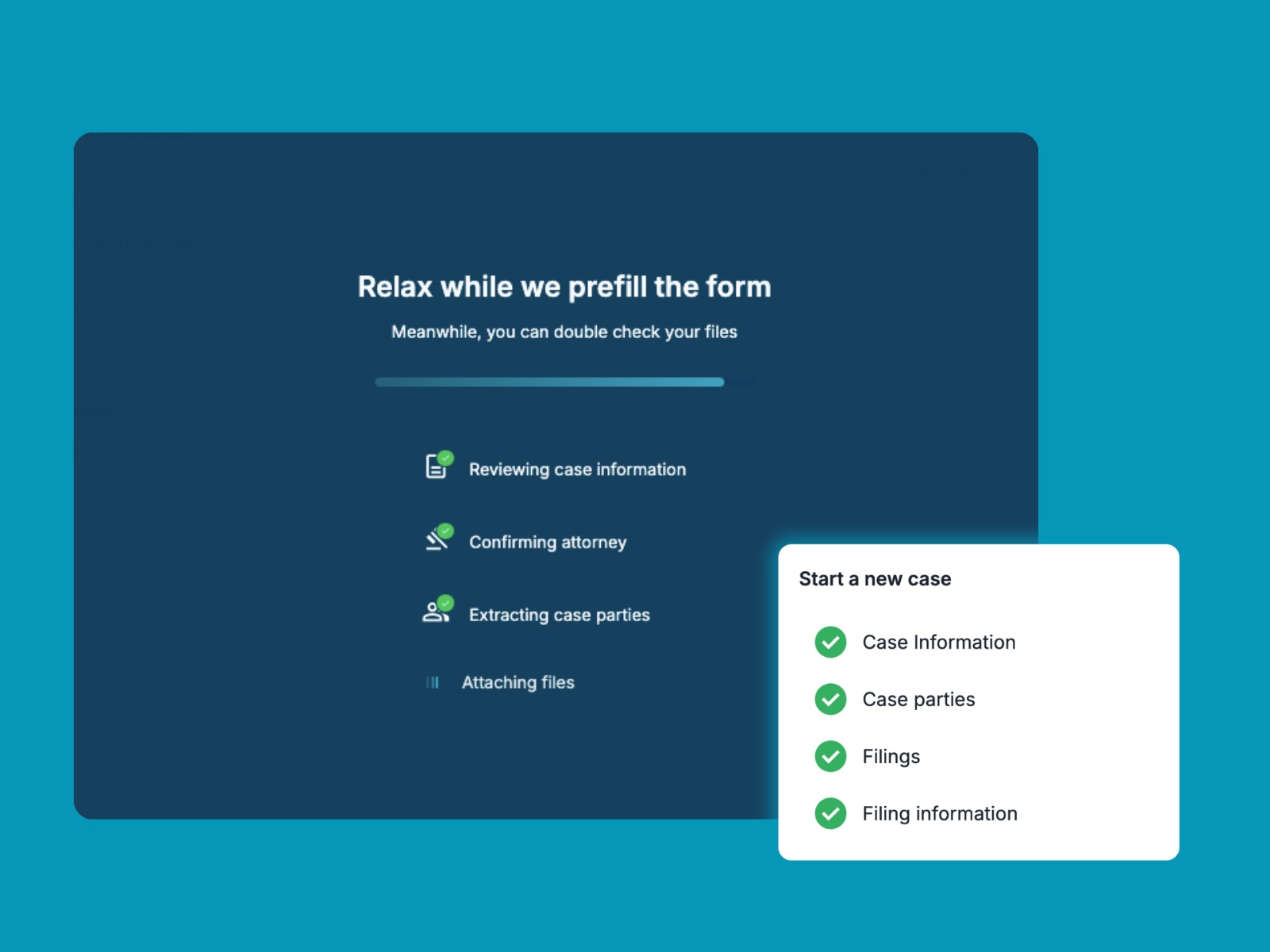
In April 2025, InfoTrack launched Intelligence, shifting the starting point toward the uploaded document itself. The system combines artificial intelligence, optical character recognition, and court-specific knowledge to extract information for filing forms. Instead of beginning with empty fields, the filer begins with a document and a set of proposed answers.
The distinction is practical. A traditional integration can reuse information stored in a matter record. Document-driven extraction can also use information sitting inside the filing. The user still checks it, completes missing sections, and submits. The work becomes reviewing a draft of the form rather than reconstructing the document one field at a time.
InfoTrack advertises 95% of fields automatically filled and a 50% reduction in filing rejections. Those are company-reported performance claims, not a guarantee for an individual case. They describe the attraction, though: fewer keystrokes are useful; fewer rejected filings can matter more when a deadline is approaching.
of fields auto-filled
Review remains part of the job.
The return trip is the product
There is a temptation to judge filing software by the moment of submission. InfoTrack gives the buyer another place to look: what happens afterward. Its process-serving workflow can connect a filing to service, then connect the completed service to the proof that must be filed. Litigation produces paperwork about paperwork. Someone has to keep the chain intact.
The same logic reaches billing. A filing fee that never reaches the correct matter is easy to overlook when an invoice is assembled. InfoTrack records expenses through supported integrations. Its InfoTrack Pays offering advances court fees and related service costs, then invoices the firm monthly. Administrative convenience and financial housekeeping become part of the same transaction.
“Having [InfoTrack] take care of the billing has just been such a great time saver for me.”Kara Schacher · Schacher Family Law
Company-published customer testimonial
Other services extend that connected approach. SignIT handles electronic signatures. DocketSync brings supported court information and documents into the matter. Physical filing and courtesy-copy delivery address the occasions when a court still needs paper. It is an amusing detail for an automation business: sometimes the last useful step is somebody carrying a printed document.
Put a price on the handoff
InfoTrack charges primarily by transaction, with no account fee. Its published pricing lists electronic signatures at $5 per document and process serving at an average of $110. Filing charges vary by state. Court charges, urgency, location, and other service requirements can change the final bill. A free account is an entry point, not a free litigation service.
That model makes a small pilot possible. Follow a handful of representative matters. Count the minutes spent reviewing forms, retrieving results, and reconciling expenses. Compare the total service charges with the work actually removed. Passing a cost through to a client also depends on the firm’s agreement and billing practices; automatic recording does not settle that question.
The relevant alternatives include direct court portals, other filing providers, and separately managed process servers. InfoTrack competes on the coordination surrounding those services. Clio and Filevine, meanwhile, are partners in that coordination. Filevine’s integration, announced in September 2025, lets returned documents and expenses flow into the relevant projects.
A calendar with somewhere to go

In April 2026, InfoTrack and LawToolBox announced another connection: a filing deadline could lead directly into the filing workflow, and a filing event could return to the deadline system. With the appropriate triggers configured, that event can start the next round of calculated deadlines. The calendar becomes an entrance to the work it describes.
There are conditions. The court must be supported. The integration must expose the needed functions. Extracted data needs review, and deadline calculations depend on correct setup. A firm doing little filing, or using unsupported systems, may find less value in the connections than a busy litigation team does.
The lesson travels beyond law. Pick a task that appears finished, then follow its documents and costs home. That is where the second round of clerical work often begins. InfoTrack’s business rests on making more of that journey happen without somebody typing the same answer twice.