A lawyer finds a filing. Then someone downloads it, gives it a useful name, sends it to the case team and saves it in the right place. The argument inside the document may be fascinating. Its journey to the lawyer’s desk rarely gets a round of applause. Gavin McGrane built PacerPro around that journey, following the small administrative jobs that stand between a court record and the people paid to understand it.
He came to the problem as a San Francisco litigator. PACER, the federal courts’ electronic records system, was familiar territory. So was the frustration of using it. McGrane founded PacerPro in 2012, initially offering a more convenient way into those records. Over the following years, the company moved further into the daily operations of law firms: collecting documents, distributing them and capturing them in systems where they could be used again.
There is something pleasantly unromantic about the starting point. A courtroom rewards the persuasive sentence. A law office also needs the attachment to arrive. McGrane’s entrepreneurial career has given that second requirement sustained attention. The ambition grew, but it remained attached to an ordinary question: how does the information get from the court to the person who needs it?
The search box was only the beginning
Early PacerPro coverage described McGrane working with John Sanders, whose background included Apple and Autodesk. In November 2012, the pair demonstrated a preview of the service. They were combining legal experience with technical experience to improve the way researchers interacted with PACER. That combination mattered: someone understood the records, and someone understood how the software around them could behave differently.
The preview included search tools and an archive of documents retrieved through the service. It also had subscription prices. The early proposition was recognizable to anyone who has used an awkward database: keep the underlying material, improve the route to it. A better interface could save a regular user from repeating the same tiresome motions every time a case required attention.
By early 2014, PacerPro had removed its monthly fee for search, with paid enhancements planned. The distinction was practical. People could try the service’s basic usefulness before deciding whether additional capabilities belonged in their working day. PACER credentials and applicable court charges still mattered. PacerPro was building on an existing court system, with all the constraints that relationship implied.
McGrane received an ABA Journal Legal Rebel designation in 2014. In 2015, he joined the Fastcase 50. The recognition put him among legal professionals trying to change how their field operated. His contribution began with a specific piece of infrastructure, close enough to everyday practice that users could recognize the problem without needing a lecture on the future of law.
A family holiday, with a sales booth attached
The company’s history includes another kind of recruitment. McGrane called his sister Anna at night to talk about the startup he was working on. She was a lawyer too, with experience as a corporate and capital markets associate in Moscow. His subject was the wealth of information in federal court records and the difficulty of making that material easy to reach and use.
During a family holiday in 2014, he asked her to help run a sales booth at an industry conference. The conversations there helped bring her into PacerPro. She became a co-founder and COO. A sibling asking for a hand at a booth is a modest scene in a company history. Here it carried consequences well beyond the end of the conference.
It also brings the story down to a human scale. Before a product becomes infrastructure, somebody has to explain it across a table. Somebody else has to recognize their own working life in the explanation. The McGranes’ shared legal background gave them a starting vocabulary. Listening to users supplied the details that a job title alone could never provide.
The useful tool should know when to disappear
By 2016, McGrane was discussing government data with people who knew the less visible workings of law firms. A PacerPro panel brought together DLA Piper librarian Jean O’Grady, New York Law Institute executive director Lucy Curci-Gonzalez and voxgov founder Robert Dessau, with Bob Ambrogi moderating. Access to information was one subject. Getting people to use the appropriate tool at the appropriate moment was another.
McGrane’s approach to adoption was concrete. PacerPro’s PDF delivery could be configured behind the scenes and send filings into attorneys’ inboxes, matching a routine they already understood. The service took on steps that secretaries, paralegals and docketing teams otherwise performed. A familiar destination spared the attorney another place to check. There is a certain courtesy in software that arrives where you already are.
“The key is integration within and across products.”Gavin McGrane, 2016
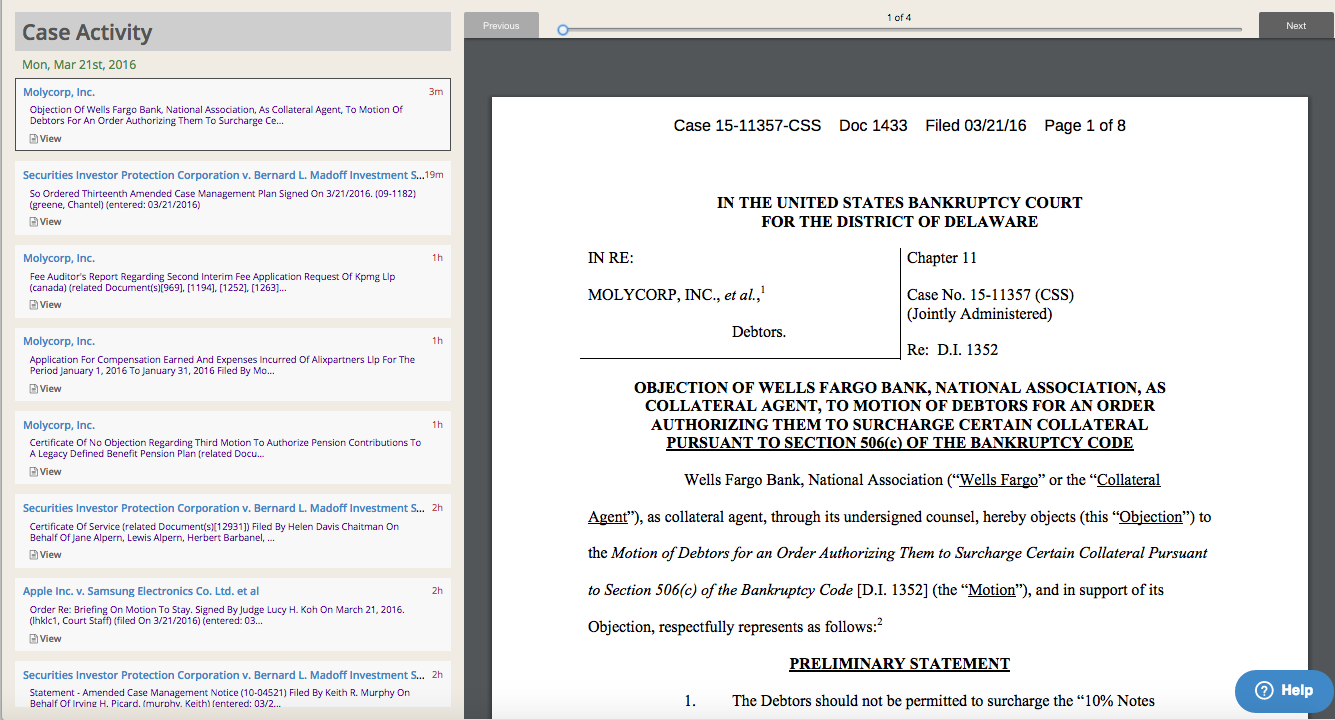
The historical interface shows another part of that thinking: connect a filing to related material and help users move through their cases. For McGrane, the useful experience extended beyond one product’s boundaries. His attention was on the information someone needed next. The product had to serve that sequence rather than require a new ritual for each task.
Following the file into the firm
The change from search to automation gave PacerPro a broader job. Its PDF2Go service delivered new filings to case teams. Manifold captured court documents in a firm’s document management system. The PACER overlay continued to improve access to the underlying records. Together, those functions addressed different stages of the same working process, from discovery to delivery to a place in the firm’s memory.
McGrane discussed that evolution on LawNext in 2021. The company had grown beyond the enhanced interface with which it began. A document could now be collected and distributed without each recipient repeating the retrieval job. Filing it properly in a knowledge or document system helped give the material a life beyond the immediate email.
The economics of this kind of product are easy to miss because each action looks small. Downloading, naming, forwarding and saving a file are ordinary tasks. Their repetition is what makes them consequential. Automating a recurring action gives a team back attention as well as time. For a founder with litigation experience, the appeal of solving those tasks had a direct connection to the work he knew.
- 01 / RetrieveCollect the court filing.
- 02 / DeliverSend it to the case team.
- 03 / CaptureSave it with the right matter.
In 2021, Berkley Capital invested $5 million in a Series C round. PacerPro described it as the company’s first institutional investor. It also hired Dhana Bala as chief technology officer and announced plans to extend its work into state courts. McGrane, then CEO, said firms using the federal products were asking for the same functionality in state matters.
Fifty states do not share a filing cabinet
The state-court expansion exposed a different kind of complexity. McGrane explained that courts used different electronic filing providers and case management systems. A firm might send a document through one service and receive communication through another. Uploading a filing did not necessarily give the firm an automated route back to the full set of notices and documents it needed.
PacerPro launched StatePro in November 2022, with coverage announced across 32 states. Noah Aron, whose experience included electronic court filing products, was brought in as an adviser for the expansion. The technical challenge followed the institutional landscape: many systems, different arrangements and a continuing need to assemble usable case files.
McGrane described case-file management as work suited to standardization and automation. That goal says something about the scope of his project. The lawyer still has to make sense of the case. The supporting machinery should make the record easier to gather and keep together. Every extra court system made the integration problem larger, while leaving the basic user need familiar.
Easy access still has boundaries
Court technology also brings questions about records that are sealed from public access. McGrane took part in a panel at the National Docketing Association’s Boston meeting in October 2023, with the discussion released on LawNext in January 2024. The group included UniCourt’s Josh Blandi, File & ServeXpress’s Sara Collins and court technology veteran Snorri Ogata. Ambrogi moderated.
The subject was how courts, lawyers and technology companies should handle sealed documents. It placed PacerPro’s co-founder in a conversation that went beyond convenience. A service operating around court records must fit the responsibilities of the institutions and professionals using it. Making documents easier to handle also requires understanding the limits around their availability.

The next destination is an AI workspace
In August 2026, PacerPro announced a partnership with Harvey. Federal and state records captured and structured by PacerPro would enter Harvey’s legal AI platform with their case context. McGrane was identified as CIO and co-founder. The announcement put his original interest in usable court records alongside a newer destination for the information.
His focus remained on what had actually been filed and how it related to the matter around it. The integration connected filings to docket history and other case information, as well as firms’ client and matter identifiers. He ended his statement with a short sentence: “We’ve been waiting for this.”
There is a line running from the early search interface to that announcement. McGrane kept following the document. First it needed to be found. Then it needed to reach a team and stay with its case. Now it could arrive in a workspace used for analysis and drafting. The destinations changed. The work before the work kept giving him something to build.