There is a peculiar moment in litigation when something important has happened but almost nobody knows what it is. An email from the court says a document was filed. The document itself sits behind a link. Someone clicks, downloads, renames, sorts, attaches and forwards it. Another person may do the same thing. A third wonders whether the right partner was copied. The law has moved; the lawyers are doing file clerking.
Gavin McGrane knew the ritual because he had been a commercial litigator in San Francisco. In 2012, he founded PacerPro to improve the interface to PACER, the federal judiciary's public-record system. That first proposition was sensible: put a humane layer over a fragmented government database. It was also incomplete.
The deeper problem began after the search. Each new filing set off a small relay whose steps were dull enough to ignore and consequential enough to fear. PacerPro's business grew when it stopped treating the court record as something a lawyer visits and started treating it as something that should arrive - complete, named, mapped and ready to use.
The first idea was right, but too small
PacerPro's early product made it easier to search across federal courts. The old process demanded that a user know where to look, navigate separate systems and pay court fees along the way. A cleaner interface helped. But search happened occasionally. Filing distribution happened relentlessly.
Anna McGrane, Gavin's sister and a corporate lawyer, saw the distinction in person. She helped him staff a legal-industry conference booth during a family visit in 2014. Conversations with users persuaded her that the service changed their working day. She joined sales, learned how large firms actually buy and operate, and eventually became chief executive. The booth supplied what product strategy decks often miss: people describing the irritating thing they do before breakfast.
The old relay, once per filing
A study produced with legal consultancy Fireman & Company timed manual processing at three to five minutes per court notice. That sounds harmless until volume arrives. Across 21 participating firms, 3,241,589 PDF2Go emails in a year represented a conservative 48,757 hours of eliminated rote work. At Shook Hardy & Bacon alone, the case study counted 208,044 annual deliveries and 2,862 hours saved.
“The real value of the court record isn't a docket entry telling you that something happened. It's what was filed.”Gavin McGrane, co-founder and chief innovation officer
The product is the disappearing act
PDF2Go is the clearest expression of the company. It watches tracked matters, retrieves a new filing and its attachments, combines and names the files, then sends them to the configured case team. The user receives an ordinary email. That ordinariness is the point.
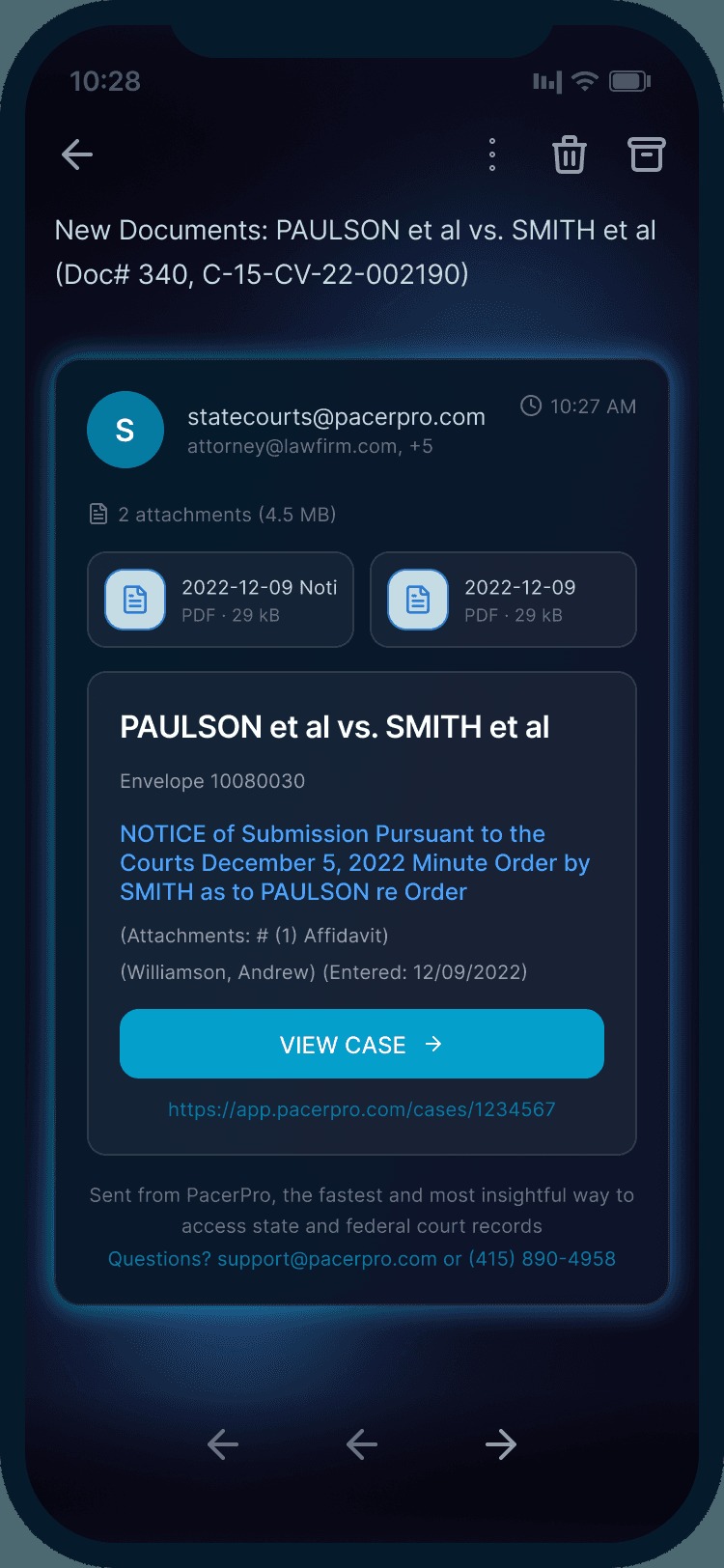
Manifold carries the same logic one room deeper. It takes the filing and more than 50 ECF metadata fields, connects them to the firm's client-matter number and places the record in the correct iManage, NetDocuments or other knowledge workspace. Court Monitoring turns activity, fees and errors into scheduled reports. Case Digest compresses the noise from 50, 100 or 300 matters into one portfolio summary. Court Search keeps the original promise, now spanning federal courts and a growing state-court network.
The visible tool
- Search a docket
- Open a link
- Download a PDF
- Repeat the task
The data layer
- Capture the filing
- Reconcile its context
- Map it to the matter
- Feed every downstream system
This is where PacerPro sits in the market. Westlaw, Lexis and Bloomberg offer broad research and docket products. Smaller specialists monitor cases or simplify downloads. PacerPro has chosen the narrow, infrastructural position between courts and a firm's working systems. Its claim is not merely that it can find the record. It can deliver the full document, with usable metadata, to the place where work continues.
What it costs, and what it removes
PacerPro sells subscription software. Enterprise contracts are quoted privately, while public pricing directories have listed professional access around $20 to $30 per user a month. The court's own charges do not vanish: paid PACER searches remain 10 cents per page, and a scheduled docket refresh can cost up to $3. PDF2Go can use the free-look access granted to attorneys and authorized recipients, which helps avoid duplicate paid downloads when the firm configures it correctly.
The better economic comparison is not subscription versus zero. It is subscription versus staff time, repeat court charges, incomplete files and the awkward cost of discovering that one person missed one document. Those benefits rise with filing volume. A solo practice with a handful of matters may be adequately served by PACER itself. A firm must also map attorneys, distribution lists and client matters accurately; automation cannot route around bad setup, restricted documents or courts outside its coverage.
Twenty million documents meet the AI moment
By 2026, PacerPro said it covered every federal district, bankruptcy and appellate court and more than 30 state courts. Its repository had passed 20 million filings. The company had raised a reported $5 million Series C from Berkley Capital in 2021 to expand beyond federal records and had become court-data infrastructure for most of the Am Law 100, including eight of the ten largest US firms.
Then the unfashionable work became newly fashionable. Legal AI can draft and analyze, but it needs a current record. In August 2026, PacerPro and Harvey announced an integration that sends each new filing into Harvey with its docket history, judge, parties, counsel and the firm's own matter identifiers. A motion posted today can meet the firm's earlier briefs and outcomes without somebody assembling the packet first.
This partnership is less a pivot than the payoff. PacerPro spent years cleaning the inlet while the market stared at the engine. AI made the inlet visible.
“It's the microwave oven experience. You don't realize how much you needed it until you have it.”Patrick DiDomenico, former Am Law 100 knowledge and innovation leader
The copyable part is not legal
The useful lesson is not to build a PACER overlay. It is to watch what happens immediately after a supposedly finished task. A notification is not delivery. A PDF is not a record. A record is not useful until it reaches the correct person, folder and decision.
A small-friction field guide
- Find the event that makes five people repeat the same low-value steps.
- Count the minutes, then multiply by real annual volume.
- Automate inside the tools people already open.
- Preserve context, not merely the file.
- Pilot on a few live matters so value appears before a grand rollout.
PacerPro says a pilot can be running on a handful of active matters within 48 hours, without a broad deployment. That is an adoption strategy disguised as implementation. The company is not asking a litigator to admire a new dashboard. It is asking whether the filing arrived before the client called.
The original search problem never disappeared. It simply turned out to be the front porch. The larger house was the handoff: who gets the document, what it is called, where it lives, which matter it belongs to and whether it becomes memory or clutter. PacerPro built in that quiet space. The most interesting thing about its product is how little the person opening the email has to think about it.