The ambulance has stopped, but the call is not over. A medic still has a patient chart to finish. A hospital needs to know what happened before the emergency-room doors opened. A billing team needs the right codes. A state repository needs a compliant record. A fire chief wants to see whether response times are drifting. Somewhere in that procession of forms, handoffs and dashboards sits ImageTrend - a Minnesota software company that has made a large business out of the work after the siren.
This is not software people photograph for glossy launch events. It is the administrative nervous system of emergency response: electronic patient-care reports, fire incident records, inspections, crew schedules, professional licenses, hospital exchanges, trauma registries, claims and analytics. The pitch is simple enough - capture an incident once, then let the information travel. The engineering and politics underneath are not.
The anti-Y2K bet
ImageTrend began with a disagreement about the future. In 1998, Mike McBrady worked for a company that wanted to focus on fixing the Y2K bug. McBrady considered that a temporary business and thought browser-based applications were the longer game. He left, cleared out a room at home and started building. His wife became the first employee. Within days, Cargill called with a contract.
The original ImageTrend designed websites, managed content and built online catalogs for companies including Cargill and Ag-Chem. In 2001 it built StateBridge, a system for collecting electronic patient-care reports at the state level, first implemented in Minnesota. EMS Service Bridge and Field Bridge followed in 2003. Fire records arrived in 2006. A general web shop had found an industry where data was mandatory, fragmented and unusually consequential.
That transition is the first useful thing to copy. The company did not merely pick a niche from a market map. It followed a recurring customer problem until the problem demanded a specialized product, then kept learning the adjacent workflow. Over time the Bridge family of products gave way to Elite, its configurable cloud platform, and a suite that follows an emergency from preparation through documentation to reimbursement and analysis.
What failed first
The clearest explanation comes from Coastal Valleys EMS Agency in California. Its old fire and EMS products did not speak to each other. There was no global reporting system. Every quarter, individual agencies exported the fields a county spreadsheet requested from their separate buckets. Worse, the software was no longer supported, did not meet the current NEMSIS standard and would not be upgraded.
This was not an abstract inconvenience. Coastal Valleys coordinated 65 fire departments, 18 ambulance providers and four air-transport organizations across Sonoma and Mendocino counties. A single patient could cross several institutional borders before a useful outcome came back to the clinician who treated them.
The system has allowed us to function and grow as an organization.Doug Butler Jr. · Data Manager, Coastal Valleys EMS Agency
The agency initially went shopping for an electronic patient-care record with patient tracking. What changed its mind was scope: ImageTrend could put fire, EMS, licensing, registries, reporting, hospital communication, notifications and mass-casualty tracking into one configurable environment. Coastal Valleys switched in 2015. The product was not simply a better form. It replaced a quarterly reconciliation ritual with a common system.
The product is the handoff
ImageTrend’s main customers are fire departments, EMS and ambulance services, hospitals, state administrators and public-health teams. Elite handles field documentation and records. Continuum turns operational and clinical data into dashboards, alerts and benchmarks. Health Information Hub passes prehospital records into hospital systems and returns outcome data. Billing Bridge starts a claim from the patient-care record. License Management replaces paper credentialing. Slate schedules crews. Patient Registry supports trauma, burn, stroke and cardiac programs.
The company’s differentiation is breadth with configuration. A small department can buy core documentation. A county can connect 18 departments. A state can operate a repository while agencies keep local rules. The U.S. Navy selected Elite and Continuum in 2025 to standardize EMS and fire reporting across installations while preserving base-level control. ImageTrend says its platform supports 43 state EMS repositories.
Competitors such as ESO, First Due, ZOLL, FirstWatch and broader public-safety suites can cover pieces of the same ground. ImageTrend’s defense is accumulated workflow depth: national reporting standards, state-specific fields, offline field use, hospital matching, claims logic and permissions for complicated agency structures. None is thrilling in isolation. Together they make replacement expensive.
What does it cost?
ImageTrend does not publish a universal rate card, and public records show why. One Virginia contract based on 35,000 incidents priced Elite Rescue at $46,626 a year. CAD integration, Data Mart, Continuum, analytics content and geocoding brought the visible recurring stack to roughly $95,000 annually. Pinellas County, Florida approved a much broader fire and EMS records system for 18 departments at $2.995 million over three years, including an initial $1.137 million configuration-and-first-year bill. Michigan’s 2026 extension lists about $59,000 for a year of license-management software and payment-gateway integration.
Public price sightings
This is classic enterprise and government SaaS: subscriptions, implementation, support, integrations and optional modules, priced around operational scope rather than a neat per-seat sticker. The business benefits from a stubborn fact - agencies must document incidents whether budgets are generous or not. But procurement is slow, migration is delicate and every integration adds another party to the room.
From record keeper to prediction layer
The 2023 growth investment from Welsh, Carson, Anderson & Stowe gave ImageTrend fuel to expand. Terms were not disclosed. It bought FlowMSP in 2024, adding visual building pre-plans used by about 500 customers, then bought biospatial in early 2025. Biospatial curates more than 100,000 new electronic patient-care reports daily from thousands of providers across more than 40 states. The pair extends ImageTrend in both directions: information before the crew arrives and intelligence after the record closes.
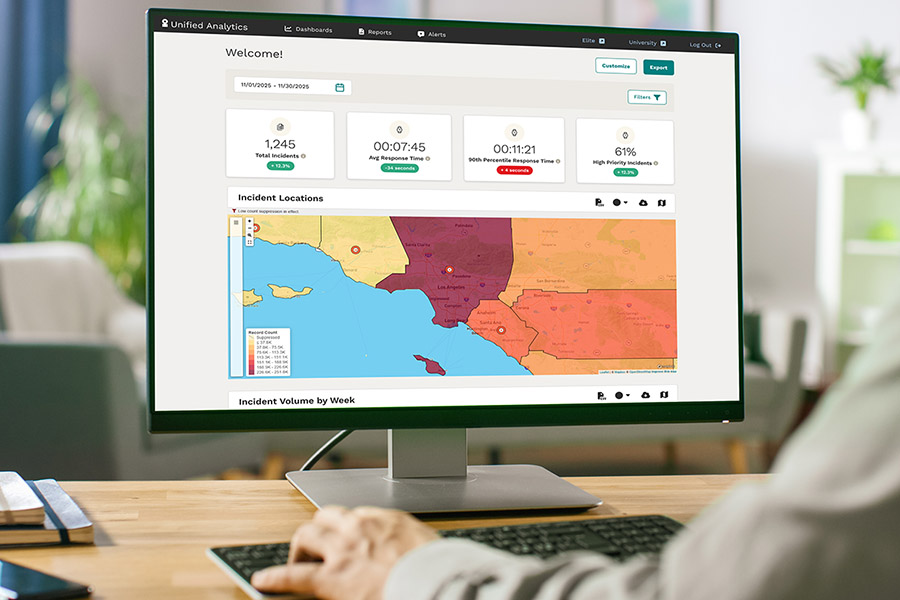
In 2026 the company launched AI Assist: CQI Check, which flags omissions and inconsistencies while a clinician charts; Unified Analytics, which lets users query consolidated data in natural language; and Carelytics, which matches hospital encounters with EMS records and analyzes handoffs and transport patterns. Chris Cartrett, formerly of Aderant, was named CEO in July with an explicit AI and product-velocity mandate. ImageTrend said revenue had more than doubled over the preceding few years, though it did not publish dollars.
The sensible part of this AI pitch is its modesty. Reading a medication bottle, detecting a contradictory chart or retrieving a dashboard answer is less cinematic than an autonomous ambulance. It is also closer to the daily burden customers already pay ImageTrend to remove. In a clinical and regulatory setting, a machine can suggest; accountable people still approve.
The copyable playbook
- Enter through compulsory work. Incident reporting and compliance happen in every budget cycle.
- Follow the record. Each handoff - field to hospital, report to bill, state to federal system - creates an adjacent product.
- Configure the core. Shared infrastructure wins only when local agencies can preserve their rules.
- Hire the operator. Former medics, firefighters and healthcare staff translate workflow nuance into product decisions.
- Earn the analytics layer. Predictions become credible after years of collecting structured, trusted data.
Where the model breaks
This playbook does not work merely because an industry has forms. The workflow must recur, the cost of error must matter and customers must tolerate a shared cloud platform. It weakens when buyers cannot standardize even a core data model, when integrations remain closed, or when frontline users see documentation as extra work imposed from above. A broad suite can also become a burden if a customer needs only one excellent tool.
National standards keep moving, too. NEMSIS governs EMS data; NERIS is replacing the older federal fire-reporting regime. ImageTrend publicly argued in 2025 that fire records should continue to flow from agency to state to NERIS, rather than bypassing the state, because local fields and oversight could be lost. That disagreement reveals the actual product: not the chart on screen, but the negotiated path data takes through institutions.
ImageTrend’s story is less about disruption than accretion. A web shop learned one regulated workflow, then another, then connected them. The moat arrived slowly - in configuration tables, hospital interfaces, state contracts and the trust required to store a patient record. Now the company is trying to make that accumulated data answer questions before a chief, medic or registrar has to ask twice. The sirens get attention. The system behind them gets renewed.