An elevator ought to make life simpler. Selling one, apparently, can do the opposite. At Residential Elevators, the Salesforce quoting system had accumulated roughly 2,000 products. Configurable elements were treated as products themselves. Bundles grew. Rules multiplied. Salespeople clicked through a system that sometimes made them restart their quotes. The machinery for selling an elevator had become a problem of its own.
- ideaHelix combines Salesforce consulting with its own assessment, migration and testing tools.
- Its recurring move: simplify catalogs and workflows before adding automation.
- The proof ranges from an eight-week elevator pilot to an eleven-month telecom rebuild.
Salesforce recommended ideaHelix. The resulting Revenue Cloud Advanced pilot replaced custom configuration logic with the platform’s standard constraint engine and reduced the catalog to 165 parameterized products. Average quoting time fell from five minutes to under two, according to ideaHelix’s account. An eight-week pilot established a route toward full deployment. The distinction matters: this was a demonstration of a better model before committing to the whole journey.
Smaller model.
in the redesigned catalog
People who know where the wires go
Founded in 2014 by Vignesh Shivraj and Subbu Parameswaran, ideaHelix occupies a particular corner of enterprise technology: making Salesforce work for businesses with complicated products, prices and orders. Revenue Cloud and Salesforce Industries are its home territory. It also builds Agentforce agents, the assistants that can act inside those workflows.
The work is sold to organizations, but the beneficiary is often one person trying to finish one task. A salesperson needs a usable quote. An underwriter needs current rates. A service representative needs the contract that matches the customer’s question. Those ordinary needs make a useful test of an ambitious software project.
The company describes a global team with more than 500 Salesforce certifications. Its leadership includes Salesforce and Vlocity alumni. Shivraj previously held leadership roles at Philips, Quinnox and Intelliswift; Parameswaran brings experience in quality engineering and operations. This is expertise in the plumbing: how a quote becomes an order, what happens when a contract changes, and which system must know about it.


A restart, with fewer souvenirs
At REV, the problem had a different shape. Three merged companies had left a fragmented collection of systems. A failing implementation program lacked industry expertise. Quotes, orders and billing were disconnected; manual processes and customization slowed the business.
REV restarted with a clean Salesforce Communications Cloud deployment led by ideaHelix. The team simplified the catalog and quote-to-contract workflows and replaced manual steps with standard automation. In the published case study, quoting and contracting dropped from more than ten minutes to under five. Delivery took eleven months, compared with another systems integrator’s twenty-month estimate. That comparison is a proposal benchmark, rather than a controlled race between two teams.
The useful lesson is the willingness to reconsider the design. Migrating every old exception preserves the very friction a new platform is supposed to remove. REV’s reboot gave the team room to question what deserved to survive.
Bottle the know-how
Consultancies sell expertise. ideaHelix also turns some of that expertise into software. Best Practice Assurance checks Salesforce configurations against more than 300 practices. Its Migration Estimator examines catalog structure, pricing, custom dependencies and integrations. Migration tooling moves configuration and customer data; the Test Automation Framework supports UI, API and Apex testing, with tests authored through spreadsheets.
These tools are the company’s stated difference in a crowded Salesforce services market. A buyer can choose a large integrator, a specialist partner or an internal team. ideaHelix’s pitch combines practitioners who understand an industry with reusable machinery that handles repetitive work. The business includes consulting, implementation, migration, optimization and managed services, alongside its tools.
The June 2026 FastTrack offering makes that proposition more concrete: greenfield and migration tracks target an eight-week minimum viable product, beginning with a two-week assessment funded by ideaHelix. Customers keep the assessment output. Mid-market packages come in Foundation, Growth and Expand versions. Scope, system readiness and validation still determine what a particular engagement can accomplish.
The trouble lives between systems
IRONSCALES, the email-security company, had leads in Salesforce and quotes in DealHub. Renewals were manual. Approval rules made salespeople duplicate and resubmit quotes. ideaHelix’s case study describes a six-week move to Revenue Cloud Advanced, replacing custom discount logic with native catalog capabilities and introducing asset-based amendments and renewals. Existing NetSuite, Snowflake and fulfillment integrations stayed in place.
“They replaced DealHub, got us live on Revenue Cloud Advanced in six weeks, and never touched our downstream systems.”Colton Bryant · IRONSCALES revenue operations
The customer roster extends beyond technology and telecom. At Delta Dental, ideaHelix replaced Pega-based fragmentation with a Salesforce platform spanning sales, underwriting and onboarding. A rate-page reader extracts plan details that underwriters previously reentered. At California FAIR Plan, its work centers on broker self-service and a connected data foundation; that case study labels the operational benefits as expected results.
Those examples explain the market fit. These are businesses where a sale starts a chain of obligations across departments. The problem is often the handoff: a rate copied twice, an approval detached from a quote, or a broker calling for information already held somewhere else.
An agent needs permission to say no
ideaHelix’s July 2026 agent demonstrations cover revenue management, advertising proposals, multi-site communications deals and insurance operations. In one example, an agent refuses to create a contract from an open deal because policy requires a closed deal first. The small refusal reveals the design priority: useful action within business rules.
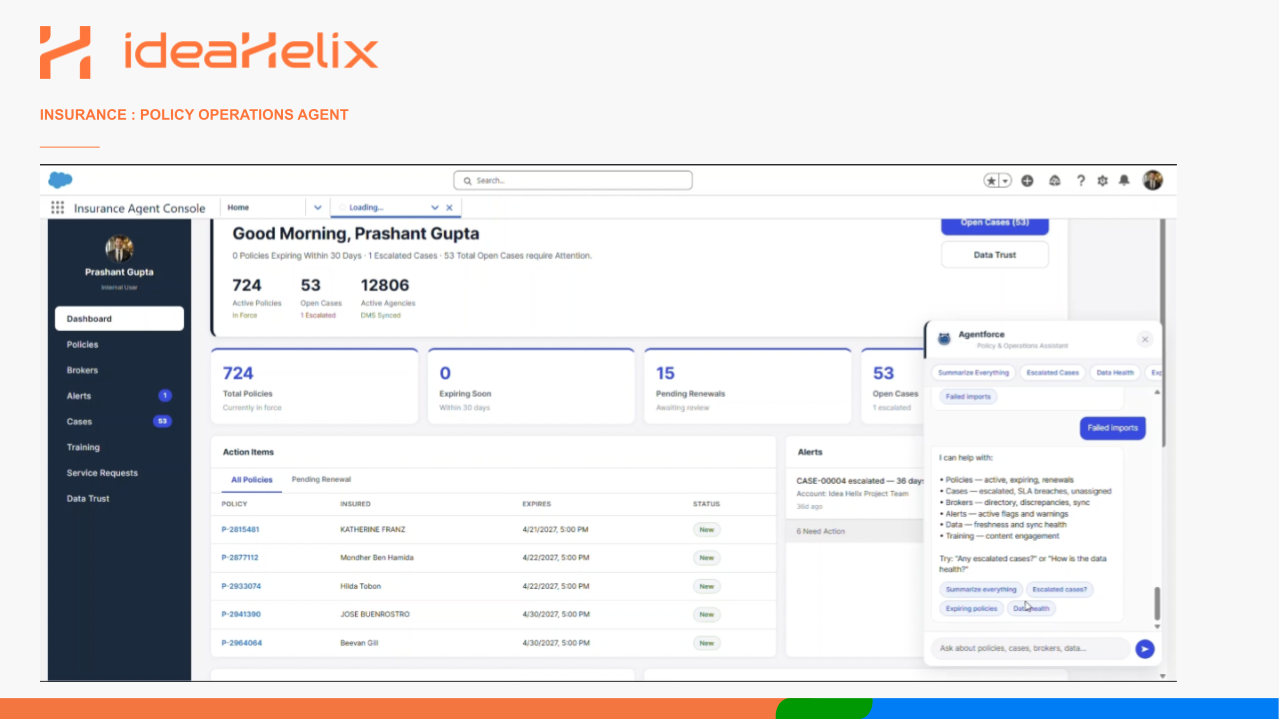
By September, the company’s webinar recap offered unusually practical advice for an AI seller. Start with one measurable use case. Include evaluations. Build a route back to a person. Sometimes a flow, integration or report is faster, cheaper and more predictable than an agent. Security, data residency and cost can constrain the choice.
There is a playbook readers can borrow without buying anything: count the exceptions, test a smaller model against real transactions, preserve working integrations, and measure the human task that should improve. The elevator pilot’s question remains a useful one. How much of your system’s complexity belongs to your business, and how much did the software simply accumulate?