The paperless office has been arriving for roughly half a century. Meanwhile, somewhere before dawn, a bank operations team is opening envelopes stuffed with checks. An insurer is sorting claims attachments. A county is staring at boxes of records that need archival-quality images. A mortgage servicer has a thousand-page loan package whose pages are not the same size, weight or condition. This is ibml's neighborhood: the expensive seam between physical documents and digital systems.
Imaging Business Machines, LLC was founded in Alabama in 1992 by Gary Murphy. Its original ImageTrac machines were not polite desktop peripherals. They were production equipment built to feed, image, read, endorse and physically sort mixed documents at speed. The first ImageTrac reportedly went to Australian Airlines to capture ticket numbers and color images for revenue accounting. That early job contains the entire thesis: the page matters only because of the data and decision attached to it.
Today ibml employs roughly 300 people and sells scanners, capture software, subscriptions, maintenance, implementation and outsourced processing. Banks, government agencies, insurers, healthcare organizations and business-process outsourcers use its systems. The company says its products operate in more than 48 countries and appear in over 80 percent of the world's largest mailrooms in banking, government and insurance. The claim is broad, but the niche is precise: high volumes, mixed inputs, strict deadlines and costly exceptions.
A scanner is only the opening act
The easiest way to misunderstand ibml is to stop at the machine. A scanner creates an image. A capture operation has to decide where one document ends and another begins, identify its type, extract fields, validate them against databases, flag weak images, route exceptions to a person, print an endorsement, sort originals into pockets and export clean data to an enterprise system. If any handoff fails, the fast scanner has merely produced a bad answer sooner.
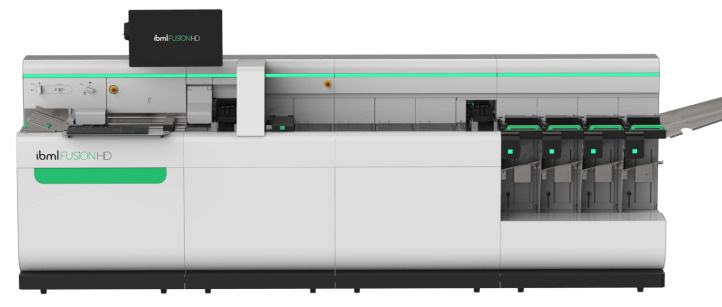
That is why the product stack has widened. Fusion HD is the current industrial centerpiece, with modular speeds and pockets plus a 600 dpi camera for preservation work. Capture Suite runs the on-premise workflow: scanner control, image quality, recognition, validation, analytics and integration. Cloud Capture combines ingestion, machine learning, robotic process automation and content services on a subscription. The as-a-service program bundles equipment, software, consumables and maintenance into quarterly or annual payments.
The newest layer is Coretex, introduced publicly in 2026. It classifies documents, detects boundaries and extracts metadata from scans, email, fax and other inputs. AutoIndex handles selected fields, AutoClassify separates and routes document types, and AutoForms tackles dense or variable forms, including handwriting. The notable choice is deployment: Coretex runs on the customer's servers or private cloud, behind its firewall. Confidence thresholds send uncertain answers to human review. For a regulated buyer, “where did the document go?” can matter as much as model accuracy.
“The data was always there; but ibml makes it easier to capture and use for our downstream business needs.”Banking customer quoted in an ibml case study
What failed first
ibml's customer stories are useful because the first failure is rarely “we need AI.” It is capacity. Illinois National Bank processed lockbox documents on two workstations, but customer-specific sorting rules left the devices idle while operators prepared work. New contracts pushed the choice into the open: buy an estimated 15 to 20 more workstations or install one high-speed capture device and stage batches before scanning. The bank chose ImageTrac systems and Capture Suite, then added another machine a year later as volume grew.
A mortgage-services provider hit a different wall. Ten desktop scanners each required an operator. Rollers needed replacement every two weeks. The setup could not read barcodes or upload automatically, and employees left their stations to photocopy and handstamp recordable documents. A technology partner proposed a machine that was 40 pages per minute faster. Management changed its mind after a finance executive watched an ibml system at another outsourcer. Speed alone would not remove the other nine operators or fix the missing workflow.
The resulting line used two ImageTrac scanners, barcodes, an inkjet endorser, dedicated printers and automatic export. The customer reported a 90 percent acceleration in loan review and boarding and a 400 percent increase in staff productivity. Those are vendor-published results, not universal promises. Still, they illustrate the purchase logic: a visible bottleneck, a live demonstration with comparable work and a redesign that touches more than the feeder.
What it costs - and what buyers count
ibml does not post list prices. An industrial capture line can vary by speed, camera, feeder, number of sorting pockets, software modules, document volume, integration, service level and purchase method. In other words, asking for “the scanner price” is like pricing a warehouse by the forklift. The total depends on the operation around it.
The check ibml asks you to write
- Hardware or subscription payments
- Software and AI modules
- Integration and training
- Maintenance, parts and consumables
The costs buyers try to erase
- Manual preparation and keying
- Rescans and downstream exceptions
- Desktop fleets and per-click fees
- Late batches, backlogs and idle labor
Public case studies give a few boundaries. One document-retention company said Capture Suite's license was 40 percent lower than its former software, with no click charge and a maintenance fee 35 percent lower. It replaced six desktop scanners and reassigned six full-time employees; cycle time fell by more than 30 percent. A bank with more than 130 offices expected its ibml project to repay itself in two and a half to three years. Its old process rescanned up to 20 percent of work, while loan-file preparation dropped from an average 30 minutes to under a minute.
The business model is designed to catch that value several ways. There is hardware revenue, recurring software, maintenance and consumables, plus professional services and outsourced processing. ibml-as-a-Service converts some capital expense into operating expense. Cloud Capture charges an annual subscription based on document volume and features. This layering also makes the vendor harder to dislodge: replacing a machine is one project; replacing the rules, integrations, training and service relationship around it is another.
The $30 million consolidation move
In June 2023, ibml acquired Exela Technologies' IntelliScan high-speed scanner manufacturing and maintenance operation for approximately $30.1 million, subject to adjustments and possible earn-outs. The business had generated $20.5 million in 2022 revenue. ibml took the hardware, capture software, intellectual property, parts, vendor relationships, customer obligations and identified employees, but not Exela's outsourcing operation.
The deal increased product choice and service coverage in a mature market where installed equipment can run for years. It also made strategic sense as customers weighed modernization: ibml could support more of the old estate while steering buyers toward Fusion, Capture Suite and newer AI modules. The risk is familiar to every acquisition of legacy machinery - support obligations can consume the attention meant for new products. The answer has been a stepped migration rather than a theatrical overnight reinvention.
Partnerships extend the same logic. Crown Records Management uses ibml technology in digital information services. RT Lawrence pairs Fusion HD with remittance and lockbox processing. Clear Ballot integrated ibml scanners with election systems. Quality Associates used ibml equipment in a large federal document-conversion program. These relationships put the scanner inside a complete outcome rather than asking customers to assemble every component alone.
The part worth copying
ibml competes with OPEX, Kodak Alaris, InoTec and Ricoh-owned scanner lines on hardware, and with OpenText, ABBYY, Tungsten Automation, Hyperscience and other document-AI platforms in software. Its difference is not that every component is unique. It is the integration of industrial feeding, physical sorting, image quality, extraction, validation and support for workloads where a missed page can become a rejected payment, a delayed claim or an audit problem.
A five-part playbook hiding in the mailroom
- Start with the queue. Count pages, prep minutes, rescans, exceptions and seasonal peaks before choosing technology.
- Test the ugly documents. Run the envelopes, onion-skin paper, checks, handwriting and mixed sizes that break the current process.
- Automate the handoffs. A faster image is not enough if a person still keys, stamps, files or uploads every result.
- Price the whole workflow. Compare labor, click charges, downtime, maintenance, space and error costs over several years.
- Keep a human escape hatch. Confidence thresholds and exception queues make AI useful where a plausible wrong answer is expensive.
There is also a product lesson. ibml did not abandon its physical advantage to chase an AI label. It placed AI where it can increase straight-through processing for the installed workflow, and it offered on-premise deployment because the target customer often has governance constraints. That is less fashionable than a universal cloud API. It is more coherent with the buyer.
When the play does not work
A small office scanning a few neat, uniform forms probably does not need an industrial capture line. The economics weaken when volume is low, labor is inexpensive, errors carry little consequence, workflows change too often to configure, or downstream systems cannot accept automated output. On-premise AI also asks the customer to own infrastructure and governance. If data may safely leave the network and the workload is modest, a lighter cloud OCR service can be cheaper and faster to adopt.
The broader market is moving toward software-defined document intake, but the physical edge will not vanish on command. Mortgage packages, remittances, archival records and claims correspondence remain stubbornly mixed. ibml's opportunity is to make its machines one input among many while preserving the speed, service and quality controls that earned space in the mailroom. Coretex is the clearest expression of that transition: scanner-agnostic software that can begin with existing devices, then pull Fusion hardware into the account when volume justifies it.
Paper may be an awkward interface, but it is attached to real money and real obligations. The company that handles it well does not need to make paper exciting. It needs to make the queue shorter, the exceptions rarer and the final data trustworthy. That is a decidedly unromantic promise. It is also the reason ibml still has something to scan.