The first thing to fail was the spreadsheet. Not dramatically. No smoking laptop, no actuary running down Borough Road waving a corrupted workbook. The failure was quieter: another copied file, another rating model with uncertain lineage, another underwriter waiting while a pricing team checked which version was real. In commercial insurance, where a single unusual risk can involve aviation, cyber exposure or a ship full of expensive machinery, that administrative fog becomes costly. hyperexponential built its business by clearing it.
Founded in London in 2017 by Amrit Santhirasenan and Michael Johnson, both described by investors as former actuaries and software engineers, the company created hx Renew to let insurance specialists build, deploy and improve rating tools in a governed, modular Python environment. The pitch was not that judgment could be removed. It was that judgment deserved better machinery.
01 / The useful failureExcel was flexible. Everything around it was not.
Spreadsheets survive in insurance for a sensible reason: they bend. An actuary can encode an eccentric line of business without waiting for a general-purpose vendor to understand it. The trouble begins after the model leaves the desk. Versions multiply. Data is rekeyed. Changes depend on IT or external developers. Reporting becomes a special request. AEGIS London had already moved beyond Excel to a bespoke web platform, but still found delays, errors, weak integrations and a poor user experience. Aviva's Global Corporate and Specialty team found Excel too slow, inaccurate and unstable for new-policy pricing.
That is the problem hx Renew attacked: keep the freedom to model complex risks, but add reusable components, access controls, integrations, testing and a consistent deployment path. Python matters because it is expressive enough for actuarial work and common enough to attract talent. It also introduces a cost that glossy case studies can blur - people must learn it. Aviva's pricing actuaries did not all arrive fluent, so hyperexponential provided tailored training. The migration was a software project and a skills project at the same time.
“Don’t make me rekey.”A recurring demand from underwriting design partners
02 / The decision that matteredAviva nearly built the answer itself
Aviva first considered an internal build. Then the insurer priced the distraction: complexity, scarce skills and a timeline long enough to pull its pricing team away from the work that made money. That changed the decision. Aviva bought from the market and began with a design phase that joined the new platform to its existing underwriting workbench while replicating and improving Excel models.
Nine months later, 20 models were live. For some models, build time fell by 75 percent. Shared modules meant a rating change could be made once and rolled through several tools. New-policy generation averaged under 10 minutes instead of taking as long as an hour. The least glamorous benefit may be the most important: actuaries spent less time checking bugs and processing data, while underwriters received answers faster.
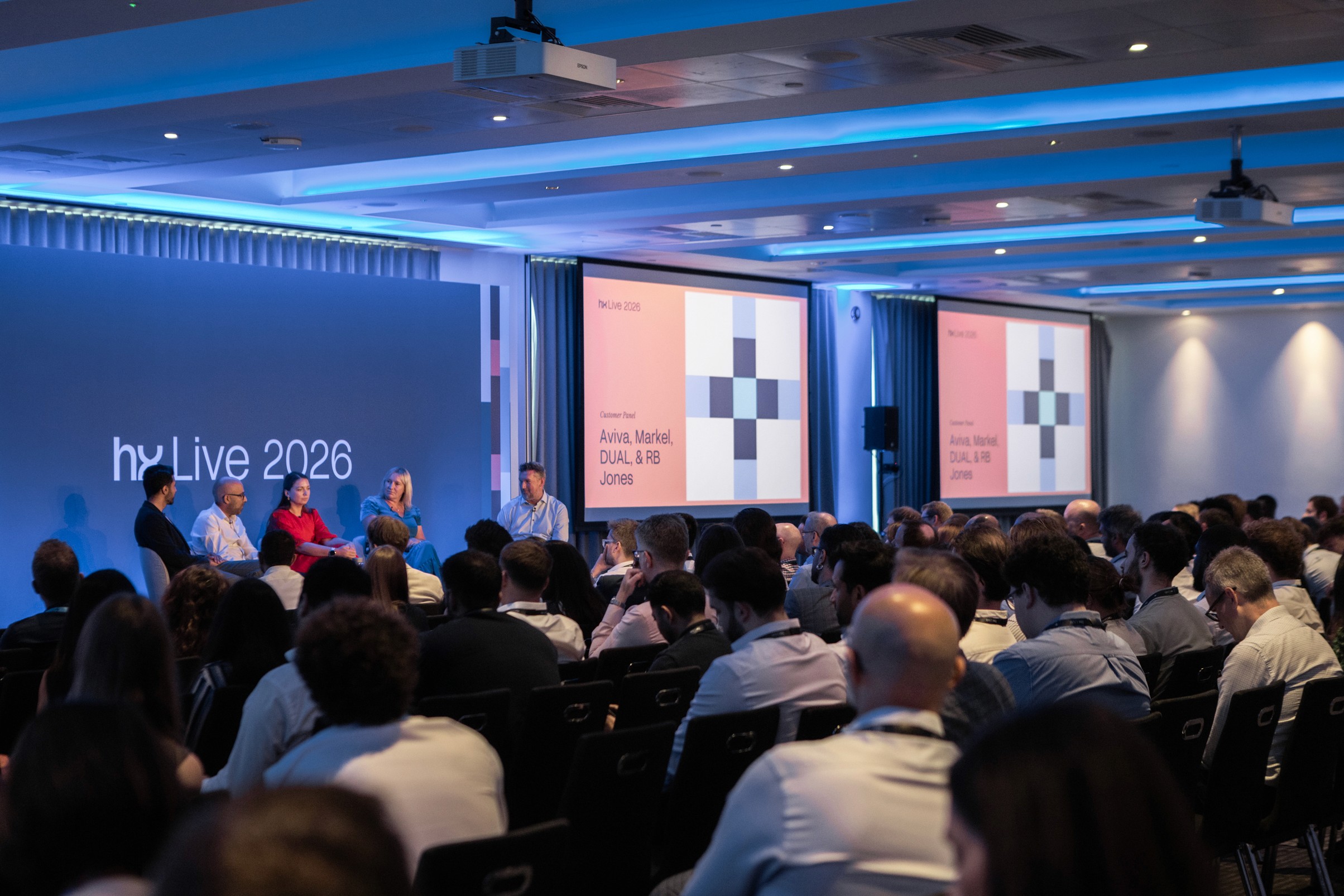
AEGIS London's procurement story is even more revealing. It gave six vendors a complex burn-cost model to build, shortlisted three for hands-on trials and asked actuaries and underwriters to judge the results. hx won on flexibility across 21 lines, integration and training. The insurer then moved all 58 models in nine months, built in-house by actuaries. This was not a cheap rip-and-replace stunt. It was a transfer of control from external development queues to the experts who understood the risk.
03 / A larger jobThe pricing tool ate the underwriting workflow
By 2025, hyperexponential was moving upstream. Triage was designed for the swamp that appears before a price exists: broker emails, PDFs, spreadsheets, missing fields and queues ordered by arrival rather than appetite. Its design-partner work produced two admirably blunt requirements: do not make users rekey data, and show value earlier. Triage ingests and structures submissions, scores them against appetite and pushes promising work toward pricing.
A submission's shorter commute
inside the hx platformThe 2026 launch of hyperoperator extends that logic. The agent can receive work through the hx app, email, Teams, Slack or mobile; assemble data; invoke the relevant pricing model; apply appetite and authority rules; and prepare a file for review. In a live demonstration, a broker submission became a triaged and priced cyber risk in under three minutes with no manual data entry.
The distinction from a generic insurance chatbot is architectural. A language model can summarize a PDF, but it does not automatically know a carrier's appetite, referral thresholds, calculation engines, authority structure or portfolio concentration. hyperexponential has spent years turning those things into governed software. The new agent is valuable only because it can work inside that context. Carriers choose among straight-through execution, human review, ad hoc analysis and always-on monitoring. The underwriter is not banished; the handoff is designed.
“The opportunity now is to bring agents into the decision workflow itself.”Amrit Santhirasenan, co-founder and CEO
04 / The company behind itA profitable sprint, then a $73 million turn
hyperexponential sells enterprise SaaS with the services enterprise insurance requires: implementation design, integrations, model migration, Python training and long-term customer support. Pricing is negotiated privately. Relationships can begin with one unit and spread across regions and business lines, a classic land-and-expand motion with unusually technical roots.
Highland Europe led an $18 million Series A in 2021. By January 2024, hyperexponential said sales had grown tenfold while the company remained profitable. Battery Ventures then led a $73 million Series B, joined by Andreessen Horowitz and Highland. The money funded a New York expansion, more product development and a plan to grow beyond the original specialty-pricing beachhead. Marcus Ryu, who co-founded insurance-software company Guidewire, joined the board alongside a16z's Angela Strange.
The customer list now includes Aviva, Allianz, Sompo, Beazley, Markel, HDI, Cincinnati, Convex, Conduit Re, AEGIS London, Bowhead and a widening group of MGAs. Reported premium supported rose from $45 billion to more than $75 billion in roughly a year. Allianz Commercial delivered 13 pricing tools in 13 weeks. Novacore plans to bring 20 specialty programs onto the platform, aiming to compare performance across a portfolio that once lived in separate systems.
Pricing first
Two insurance practitioners found the company in London and begin building hx Renew.
Series A
Highland Europe invests $18 million.
The expansion round
Battery Ventures leads a $73 million Series B after a tenfold sales increase.
Beyond the rating model
Triage and hyperoperator move hx toward the complete underwriting journey.
05 / What travelsThe copyable part is boring on purpose
The playbook is available to companies well beyond insurance. Start with a painful system experts already use, preserve its flexibility, then remove the operational penalties around it. Build reusable modules before promising automation. Train the people who will own the system. Integrate with the workbench already open on their screens. Make the first implementation a joint design exercise, not a parcel dropped at reception. And let skeptical users test the product on a hard, representative task - AEGIS London's vendor bake-off is a better sales method than a hundred polished demos.
The catch is organizational, not cosmetic
hx fits complex commercial carriers that have valuable pricing logic, repeated model work and enough operational discipline to govern it. It is a weaker fit where risks are simple, transaction volume is tiny, models change rarely or nobody can own the Python, integration and change program. An agent cannot repair ambiguous appetite or missing authority rules; it can only make well-defined operations travel faster.
That boundary explains both the opportunity and the risk. hyperexponential operates in a market where trust accumulates slowly and a bad price can echo for years. Its culture statements - ownership, depth, persistence, kindness - are easy to print and hard to audit. The customer evidence is more useful. Quarterly reviews at AEGIS focused on real pain points. Aviva followed training with an expanded AI pilot, then adopted the broader suite. Those are signs that implementation did not end at go-live.
The company now occupies an interesting seam between pricing engines, underwriting workbenches, data providers and the heavyweight core systems sold by firms such as Guidewire. Partners including Deloitte and EY help with transformation; Cytora links digital risk intake; Swiss Re's CatNet adds natural-catastrophe intelligence; Duck Creek, Send, Akur8 and Supercede connect adjacent parts of the insurance stack. Rather than pretend one vendor owns everything, hx is trying to become the place where the decision comes together.
Nine years after the first line of code, the spreadsheet has not vanished. It rarely does. But hyperexponential has shown insurers an alternative with evidence attached: fewer copies, faster builds, reusable logic and an audit trail sturdy enough for new agents to enter. In an industry that prices hurricanes, satellites and cyberattacks, making the model itself less risky is a pleasingly practical ambition.