Ten months can be enough time to change a life and not nearly enough time to understand what happened to it. In November 2025, Hudson Williams walked onto a Toronto red carpet for the premiere of Heated Rivalry. By the following September, he was back in the same city, filming its second season and taking a day off to speak to a sold-out TIFF audience. Onstage, he looked at an image of his earlier self and supplied the only sensible caption: “Holy shit, what the hell happened?”
The compact answer is Shane Hollander. Williams plays the Canadian hockey star whose long, secret romance with Russian rival Ilya Rozanov gives the six-part series its pulse. The performance depends less on speeches than on tiny betrayals of feeling: a glance held for a beat too long, a jaw trying to keep an emotion inside, a body that knows something before the character will admit it. Viewers inspected those choices with the concentration usually reserved for disputed penalties. A young actor with a modest television résumé became internationally recognizable before the season had finished airing.
The better answer takes longer. It begins in British Columbia, passes through an eight-month film program and a New Westminster restaurant, and includes an impressive quantity of leopard print. The fame was sudden. The readiness was not.
The long apprenticeship inside the overnight success
Williams was born in Kelowna in 2001 and raised in Kamloops, a place he has called a “pocket desert.” The landscape was only one of its contrasts. He described the population with the affectionate precision of someone who knows the local fault lines: “rednecks and bougie people who are always going to Vancouver to do some shopping.” His childhood moved between arts and athletics. He attended a theatre-focused school young, studied music and dance, played competitive basketball, and practiced mixed martial arts.
Basketball, he later admitted, was partly an attempt to fit in. Acting proved stickier. A two-week course before grade 12 clarified the difference between something he could do and something he wanted to pursue. In 2020, he moved to Vancouver and completed Langara College’s Film Arts acting certificate. The program mixed actors, writers, and directors in the practical business of making things. That mattered. It taught him that an actor did not need to spend every quiet month sitting politely beside the phone.
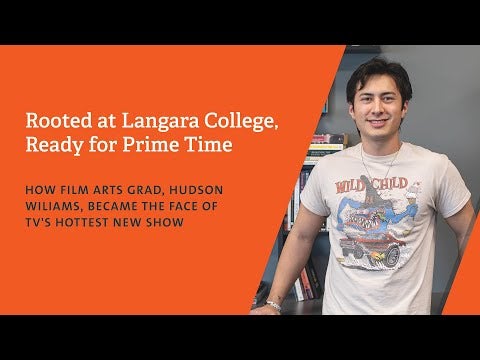
After graduation, Williams waited tables at the Old Spaghetti Factory in New Westminster, trained at MDS Actors Studio, and auditioned. A teacher connected him with his first agent. Meanwhile, he and friends from film school kept making shorts - sometimes nearly one a month. The films gave him room to act, write, produce, and direct. They also gave him permission to be odd. In one, he performs a striptease to “Buttons” by the Pussycat Dolls. Leopard-print shorts recur often enough to qualify as an early-career motif.
“I still don’t know where I got those original leopard shorts. Then I bought a more Speedo version for a sequel.”Hudson Williams
It is tempting to treat those films as the amusing preface to the proper work. They are closer to the engine. Making small projects teaches a performer where a scene comes from, what an editor can rescue, and how brutally a vague idea behaves once a camera is pointed at it. It also builds a creative life that does not depend entirely on being selected. The phone may eventually ring. In the meantime, there is a movie to finish.
The route - less lightning bolt, more fuse
Shane Hollander, played under the dialogue
Before Heated Rivalry, Williams had appeared in Allegiance, Tracker, and television movies. The new series asked more of him. Shane is disciplined, adored, and deeply practiced at concealment. He can dominate a hockey game and lose an argument without raising his voice. Williams understood that the role could not be reduced to repression. He had to make the silence active.
He was also drawn to the love story on its own terms. Queer films such as Moonlight and Brokeback Mountain had stayed with him because their characters carry feelings that the world tells them to hide. He cried when he read the season’s scripts. Here was a romance in which the obstacle was not a lack of feeling but the cost of saying it aloud.
Chemistry settled the casting. Connor Storrie’s Ilya is loose where Shane is controlled, provocative where Shane is careful. Their rhythms oppose and complete each other. Off camera, the friendship became part of the production’s trust. After filming, they got matching “SEX SELLS” tattoos - a joke about the show’s explicit surface and their belief that something more substantial lived underneath it.
“There’s something about queer stories that I feel are very universal.”Hudson Williams
The show’s Canadian identity was equally important to him. Canadian cities often spend their screen lives pretending to be American ones; Canadian actors become fluent in disappearing their own country. Here, Williams could play a Canadian athlete in a proudly Canadian production that traveled anyway. “It felt good to be playing the Canadian on the Canadian show,” he said. The line sounds simple until one notices how rarely the opportunity had seemed imaginable.
The result was both popular and professionally decisive. Heated Rivalry earned a second season after three weeks on air. In June 2026, Williams won the Canadian Screen Award for Best Lead Performer in a Drama Series. By then he had presented at the Golden Globes, opened a Dsquared2 runway show in Milan, and joined Balenciaga as a Friend of the House. A restaurant server’s black apron had given way to tailoring of a considerably less marinara-friendly kind.
Fame makes a strange scene partner
Success did not merely enlarge the audience. It changed Williams’s relationship to his own work. Returning to Shane for season two, he and Storrie assumed the characters would click back into place. Instead, each wondered whether he was performing an impression of the person he had already played. Fans were now present in the memories: every pause had been replayed, every expression assigned a meaning.
“Our memory isn’t ours, it’s everyone’s,” Williams said at TIFF. That is an unusually precise description of what happens when private craft becomes public property. The old performance returns through clips, commentary, and other people’s attachment. The actor must somehow find the character beneath the reception.
The familiar crew helped. So did the intimate atmosphere creator Jacob Tierney preserved around the set. Shane came back, not with a dramatic flourish but through work. The new season, Williams has suggested, moves from the private pressure of yearning toward “external adversity” and relationship problems that feel recognizably human. For a character famous for leaving the crucial sentence unsaid, communication may finally become the action.
The peculiar way forward
Williams’s post-breakout parts refuse to form a neat row. In the folklore mystery Yaga, which premiered at TIFF in September, he plays two very different men: Henry Park, a charming and manipulative fishery heir whose disappearance drives the plot, and Logan, a stranger creature with some heart perhaps buried under the grime. In Apparatus, opposite Dylan O’Brien, Williams describes his character Jason as an “Uber driver incel” dressed in bad shoes, a miserable jacket, and greasy hair. He adored playing him.
These are useful escape routes from Shane’s polished containment. They also fit Williams’s taste. He talks admiringly about David Lynch, Nicolas Cage, horror, and heightened stories that reach honesty by becoming more peculiar. That preference existed before anyone had a commercial reason to indulge it. The homemade shorts were already playful, physical, and strange.
His compass now sounds less like a franchise plan than a reader’s test. The script comes first, then the director or creator. With attention multiplying the demands on his schedule, he calls time and energy his biggest luxuries and guards both with a priority list. Reading, writing, drawing, and painting remain the quiet arts that settle him. Watercolor currently wins because he cannot be bothered with more elaborate cleanup. Practicality survives even a rocket ship.
“I would start there, trying to find an idea that feels like only I can make it.”On the feature he hopes to create
That future feature is the ambition that best joins the two versions of Williams: the actor newly watched around the world and the film-school graduate making things with friends. He wants to begin with an idea singular enough to demand him, then write, direct, and act in it. He jokes that this would turn him into a power-hungry, conceited maniac. Jokes are useful containers for serious plans.
For now, he is back inside someone else’s story, filming season two while Yaga prepares for its October debut. The public chronology looks absurdly compressed: premiere, phenomenon, runways, award, return. The private chronology is steadier. Learn the craft. Make the small film. Take the shift. Audition. Make another. When the world finally watches, give it something worth watching. Then go make the strange one you had in mind all along.