There is a reliable way to make a roomful of people inspect their shoes: say you would like to discuss data-center permitting. Hot Paper Lantern, a New York marketing and communications agency, has made a business from the subjects that do not explain themselves. Data centers. Industrial components. Financial services. Sports-betting infrastructure. Microscopic photography. The company enters where the nouns are technical, the stakeholders disagree, and the obvious story is often the wrong one.
That sounds like a specialty firm. It is, except HPL also sells an unusually wide menu: strategic communications, growth marketing, design and development, analytics, and category advisory. The intriguing part is not the menu. Plenty of agencies print long menus. It is the sequence. Hot Paper Lantern goes deep enough into a category to earn the right to go broad across the assignment.
A press release was too small for the problem
HPL began in 2018, when veteran communications executives Ed Moed and Ted Birkhahn started the firm as an affiliate of Peppercomm. The founding idea had been forming earlier. Clients were building their own marketing capabilities. Consultancies were moving into agency territory. A media-focused professional-services firm could keep polishing the old answer, or admit that the question had changed.
The new answer fused communications with consulting, technology, customer experience, and analytics. It was less tidy than a conventional public-relations shop and more closely matched what clients were asking: not simply, “Can you get this mentioned?” but “Can you help us decide what this means, make it legible, put it in front of the right people, and prove that anyone cared?”

Ed Moed
Twenty-three years before day one
Moed spent more than two decades building Peppercomm before creating HPL. The startup advantage was not youthful innocence. It was knowing exactly which habits of the old agency model he wanted to leave behind.
Then the first great stress test arrived almost immediately. In the founders’ fifth-anniversary account, the pandemic was “crushing.” They were scared, uncertain, and forced to improvise. There is no heroic gloss in their description. They experimented. They made mistakes. They carried on. The first thing to fail was the fantasy that a modern agency could plan its way around every shock.
“Expect the unexpected to happen.”From HPL’s five-year founder reflection
The proof is hiding in the categories
Consider Nikon Small World, a competition for photographs made through a microscope. The raw material is visually arresting but scientifically specialized. HPL’s ongoing program mixes media relations, social distribution, and narrative work so the images travel far beyond laboratories. In 2025, the campaign won PR Daily’s award for media relations. The agency says the annual work produces hundreds of media hits and billions of impressions.
Or consider Advantage Solutions, whose footprint in retail was larger than its public profile. Over an 18-month engagement, a company testimonial says annual media placements rose from fewer than 40 to appearances in more than 400 publications. The agency did not invent a more interesting company. It helped the company claim credit for the scale it already had.
Advantage Solutions / annual media placements
Reported by the client for an 18-month HPL engagement. The bars visualize the stated thresholds, not an audited media value.
For Barnes Aerospace, the assignment was broader again: brand strategy, identity, content and video, web design, and implementation for a business with more than 165 years of history. The client’s marketing manager praised an MVP launched within weeks of the signed request and called the full relaunch unusually relaxed. The small detail matters. In agency work, “relaxed” is usually an outcome produced by a great deal of invisible discipline.
Now the pitch has a dashboard
In 2026, HPL turned its category thesis into an actual product-like object: the Data Center Narrative Risk Dashboard. It grades the climate in all 50 states using earned and social media sentiment, public engagement, and legislative activity around moratoriums. Negative sentiment accounts for 60 percent of the composite. Positive sentiment receives 20 percent. The asymmetry is sensible. A planning meeting rarely gets canceled because the public is too pleased.
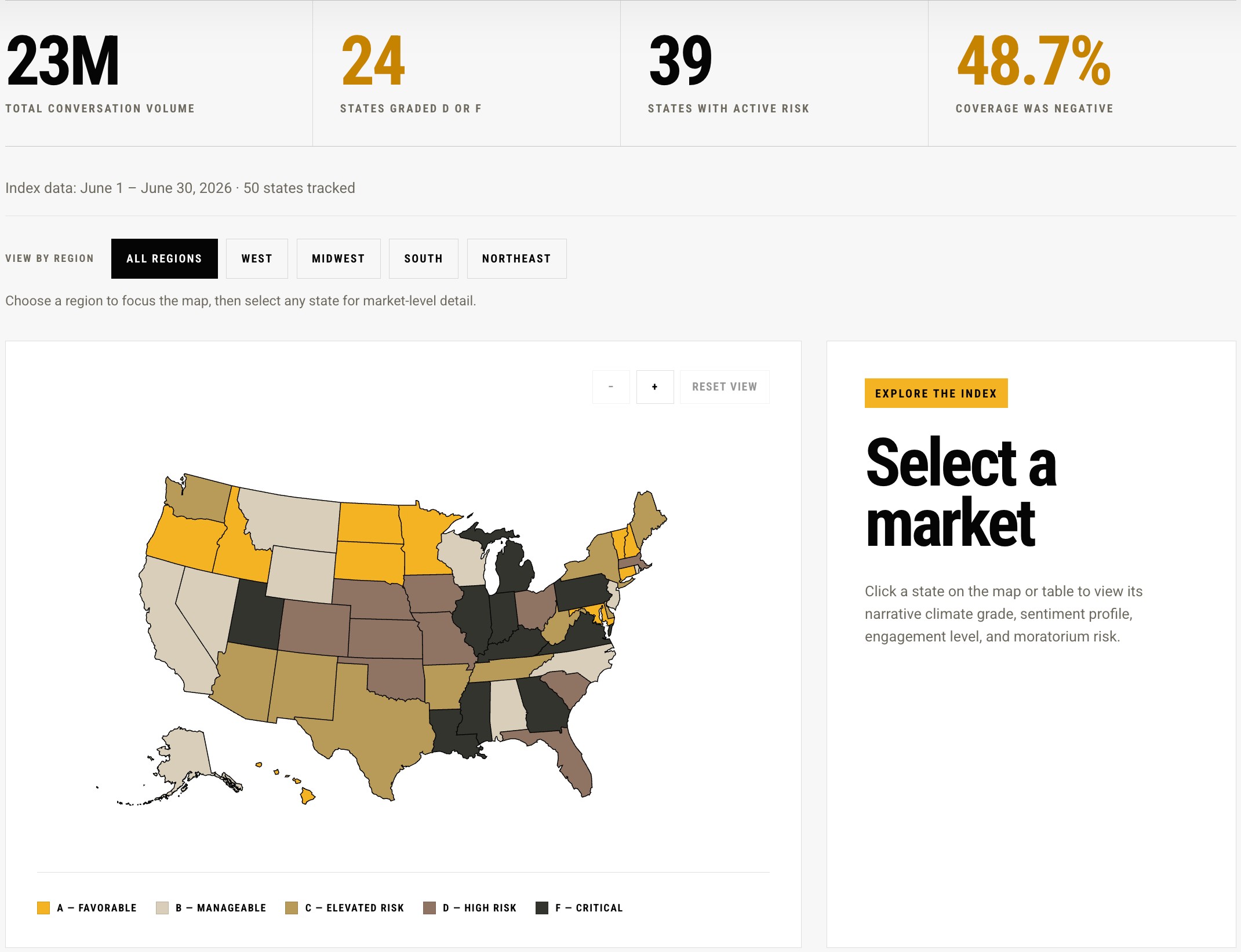
HPL grades the conversation, not the engineering. A green power plan can still meet a red public mood.
The dashboard reveals where HPL now fits in the market. It is not software in the normal subscription sense, and it is not only publicity. The map is a credential made useful: a public demonstration that the agency has studied noise, water, power, jobs, taxes, local opposition, and regulation before it enters a client meeting. It turns “we know your industry” from a sentence into something a prospect can click.
The business sells coordinated judgment
Hot Paper Lantern is privately held and sells tailored client engagements rather than an off-the-shelf product. Prices are negotiated, not posted. Some clients need an agency of record. Others need a rebrand, a website, a research-led campaign, an internal-communications system, or specialist advice at a market entry. The common purchase is coordinated judgment: when to research, when to simplify, when to design, when to pitch, and when to stop counting activity and measure an outcome.
The sports division makes the model especially clear. Digital Sport by HPL works in the dense overlap of leagues, technology, betting, fan products, and regulation. Its partnership with Cardinal Sports Capital joined marketing and communications support to an accelerator with up to $100 million of investment capacity. Capital was Cardinal’s part. HPL’s part was helping young companies sharpen strategy, find partners and customers, articulate value, and become credible enough to grow quickly.
This is not the cheapest answer to a simple assignment. A company that wants one routine announcement probably does not need researchers, designers, developers, analysts, and category advisers orbiting the problem. Integration pays when the challenge crosses audiences or disciplines. It also depends on people who can collaborate without defending little professional kingdoms. Breadth without that habit becomes overhead.
The five things worth stealing
On its fifth birthday, HPL published the nearest thing it has to an operating manual. Build a culture strong enough to attract and keep versatile people. Invest in relationships without treating each one as a transaction. Prioritize the few results that matter. Adapt when the market invalidates the plan. Keep learning because the next interruption will not resemble the last one.
What can another company copy? Not the list of services. Copying the list is easy and produces a website full of rectangles. Copy the proof. Pick a difficult corner of a market. Learn its vocabulary and its sources of friction. Build a small instrument, framework, or body of research that is useful before anyone hires you. Then use that depth to connect work that clients usually scatter across five vendors.
Hot Paper Lantern’s advantage is not that it can make complicated things simple. Every agency says that. Its advantage is a willingness to stay with the complicated thing long enough to discover which simplicity is true.