A factory machine has a limited vocabulary. It hums, rattles, heats up, slows down and, on a particularly expensive afternoon, stops. The people around it are expected to translate. Hoon Paek has spent much of his career making complicated signals legible, and he now wants those machines to become less mysterious. His company, EdgeCross, attaches devices to existing industrial equipment, sends operating data to the cloud and gives workers tools to monitor, control and question what is happening. The premise is almost comic in its modesty: before building a sentient robot, perhaps teach the old compressor to ask for help.
Paek's route to that idea began with pictures. At Seoul National University, he earned engineering degrees and studied motion-compensated coding, image recovery and video communication. Those are problems of compression and reconstruction: how to preserve meaning while a signal travels through an imperfect system. Later came Samsung Electronics' System LSI business, then a move to Silicon Valley in the mid-2000s and work across several startups. At Seeways Technologies he was a chief system architect. At NeoPlatform, a company he founded and served as CTO, the signal became video that software could search and interpret.
From seeing to sensing
The scenery changed, but the engineering habit held. Convert messy input into something a person can use. During four years as CTO of Maum AI, formerly MindsLab, Paek worked on visual intelligence, smart-factory systems and edge computing. He helped develop systems that could process selected information near the camera or device, reducing delay and limiting the need to send every raw image elsewhere. He also participated in the company's public-listing period, where laboratory ambition had to meet the less lyrical disciplines of customers, delivery and scale.
By the time he joined EdgeCross as co-CEO in April 2023, he had crossed several layers of the computing stack: semiconductor systems, video algorithms, web platforms, cloud AI and edge devices. EdgeCross gave him a physical target. The company, founded in 2015 under the name Vitcon, had already built IoT hardware for industrial equipment. Paek pushed its scope toward what he calls the smart machine. In March 2024, the board moved from co-leadership to Paek as sole CEO.
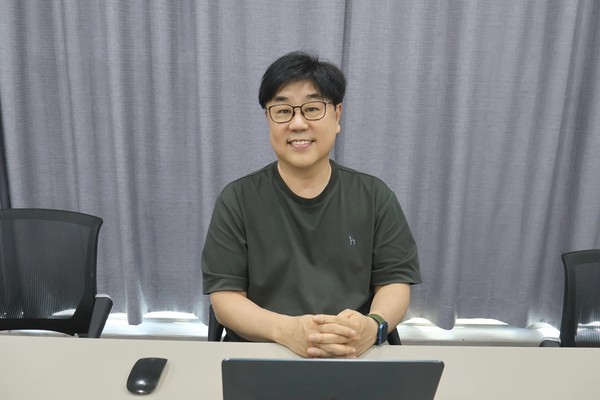
We make the factory's machines smart, rather than the factory itself.Hoon Paek
The distinction is his wedge. A full smart-factory project can require new infrastructure, specialist integration and a budget that makes a smaller manufacturer stare sadly at the quotation. A machine-first project can begin with the equipment already earning its keep. EdgeCross's MODLINK device gathers and transmits data. Its M Cube platform stores that data, enables remote management and adds machine-learning tools for prediction and operating optimization. The goal is not to make every customer assemble an AI department. It is to make the connection sufficiently standard that an ordinary operator can begin.
The numbers are not enormous by consumer-internet standards. Industrially, that is the point. Eight thousand connections represent eight thousand negotiations with age, firmware, protocol, installation and environment. Paek recalls that even two units of the same model could behave differently because versions and communications settings had drifted. The team visited sites, tested, revised and returned. The polished promise of plug-and-play rests on a large compost heap of things that did not plug in and refused to play.
The meal-kit test
Paek has a pleasingly domestic metaphor for this work. He wants “meal-kit-like technology” that a customer can install and use without mastering everything that happened in the kitchen. The phrase reveals his product philosophy. Complexity does not disappear. Somebody moves it. EdgeCross tries to absorb the protocol wrangling, cloud plumbing and model preparation so the person near the machine receives a manageable set of steps.
This also explains the company's subscription model. A smaller manufacturer can choose capabilities and receive updates and support without commissioning a large custom system. Remote service is an early, concrete benefit. A maker of cooling equipment might previously send a technician to inspect a customer's unit because the fault could not be diagnosed by telephone. Once the machine's condition is visible, some visits become remote sessions and some routine inspections become reports. The saved journey is not science fiction, but it has an excellent return on imagination.
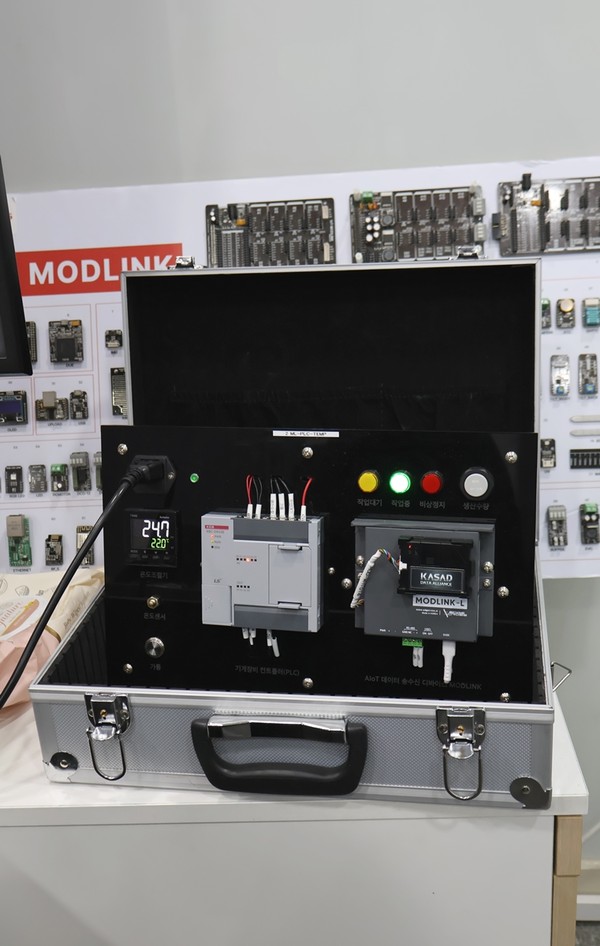
Paek offers a vending-machine example. An operator with one hundred scattered units can drive around to check inventory, or connect the units and see which location is empty. The same logic applies to pumps, boilers, compressors, packaging equipment and environmental systems. A machine does not need to reside in a dazzling automated factory to benefit from knowing its own condition.
Paek compares remote machine management with joining a video call or running a web search. The engineering challenge is hidden; the action presented to the user is familiar.
An Android for machines
His larger platform analogy is Android. Early mobile devices were fragmented across proprietary systems. A common operating layer made it possible for many services to work across a broader market. Industrial machines are far more unruly than phones, but Paek sees a similar opening: a shared layer that structures data and makes management functions compatible across diverse equipment. EdgeCross calls its architecture M Cube. The sequence moves from collection and storage, through software-based remote management, to AI-assisted prediction and optimization.
Self.AI lets domain specialists create and manage models with their own operational knowledge. MachineGPT adds a conversational layer, combining live information with manuals so a worker can ask about a machine's condition and receive an answer tied to that material. The interface matters because factories do not run on models alone. They run on handoffs between veteran technicians, new workers, managers, vendors and increasingly international teams. A useful answer must survive that social machinery too.
Technology gains value only when it is easy to use.Hoon Paek
That belief is the clearest glimpse of Paek's operating personality. He says the first task is understanding people, because sophisticated technology that burdens the person at the site has missed its purpose. He also asks colleagues to understand the intention inside a request, not merely its literal words. The comparison he reaches for is a language model parsing an ambiguous prompt. Context, in his account, is both an AI problem and an office skill.
His most satisfying stories are similarly grounded. One customer ran a factory on old equipment and struggled with failures and inefficient operations. Once its machines produced visible data, the company could manage them with greater stability. Another project connected an overseas factory, allowing support across distance and time zones. In a further case, the system detected a developing problem before it became a larger incident. Paek returns to these moments because the point of intelligence, for him, is intervention.
Physical AI without the parade
The current fashion in physical AI favors robots and autonomous vehicles, machines that move handsomely across a stage. Paek argues for a wider frame. A stationary press or boiler is still a physical system acting in the world. Give it data, a model and a means to cooperate with people, and it belongs in the same industrial transition. This view is less cinematic and potentially more pervasive. Most machinery is not auditioning to become a humanoid. It simply needs to operate better tomorrow than it did today.
EdgeCross is pushing that thesis abroad. At a 2025 electronics manufacturing exhibition in Tokyo, Paek described plans to expand Japanese customers and partners around a system designed to avoid separate communications construction and bespoke programming. The company is also continuing to turn its accumulated methods into intellectual property. A Korean patent registered in May 2025 names Paek among the inventors of a system that detects changes in industrial IoT data, reorganizes device groups and retrains anomaly models.
The aspiration is not a factory emptied of people. Paek describes technology taking repetitive or dangerous tasks while people concentrate on judgment and creative work. That is a familiar promise in automation, but his path toward it is unusually incremental. Connect one machine. Make its state visible. Reduce one trip. Catch one fault. Let one worker ask a better question.
There is discipline in refusing to skip those steps. Paek's career began with recovering meaning from visual signals traveling through constrained environments. Three decades later, the environment has grease, noise and an old controller bolted to a cabinet. The signal now says that a bearing is warming or a compressor is consuming too much power. The intellectual arc remains intact: preserve the information, move it to the right place and make it intelligible before something important is lost.
The machine of the future, in Paek's version, may look suspiciously like the machine of the past. The giveaway will be that somebody can finally have a useful conversation with it.