The client work is finished. The business, inconsiderately, has more to say. There are books to reconcile, a payroll question to answer and a deadline that has developed a taste for attention. Hooman Radfar’s current company lives in this unglamorous interval. Collective gives self-employed people help with the financial machinery of working for themselves. Its co-founder and CEO has spent much of his career around founders with investors and advisers on call. He now builds for the person who is also the entire staff.
His route here runs through a web company, a venture firm and a decision to become an operator again. It also runs through a persistent question: why should access to a capable back office depend on how many people a business employs? A consultant has accounts. A designer has deadlines. Freedom from a boss does remarkably little to discourage paperwork. Radfar treats these independent professionals as founders, with all the responsibilities that the word implies.
Late fees and an early idea
Radfar was born in London to Iranian parents and grew up in Pittsburgh. The family had left Iran following the 1979 Revolution. His education eventually joined two useful ways of looking at the world: computer science and economics at the University of Pennsylvania, followed by graduate work at Carnegie Mellon. Software asks how a system can work. Economics has an interest in why anyone would use it. His later companies would require an answer to both questions.
One undergraduate idea began with a less elevated concern: Blockbuster late fees. Around 2001, he wanted to build a video-on-demand business and investigated delivering video over DSL. The dot-com collapse intervened. An adviser’s assessment reduced the would-be company to a senior project. Timing had cast its vote. Radfar went on to study networking, with research into representing relationships through software. The proposed video business went nowhere; the habit of examining an everyday irritation for a possible product survived.
That abandoned idea is a useful opening to his career. It contains the engineer, the dissatisfied customer and the young founder learning that a plausible future does not arrive on demand. There is something pleasantly democratic about a business ambition born from a late fee. Even a grand theory of technological change occasionally begins with someone who would rather keep a few dollars.
Fifteen million front doors
In 2004, Radfar and fellow Carnegie Mellon graduate Austin Fath co-founded Clearspring. Their work concerned the social web: helping publishers distribute content, understand engagement and reach people beyond the confines of a single website. Clearspring acquired AddThis in 2008 and took the AddThis name in 2012. The little sharing tools belonged to a much larger effort to make sites participate in the increasingly social internet. A visitor could encounter the product without ever learning the founders’ names.
Reported reach before the 2016 Oracle acquisition.
Before its sale to Oracle in 2016, AddThis reached roughly two billion users across a network of 15 million websites. Those numbers describe a very particular kind of scale: infrastructure dispersed across other people’s properties. The company’s presence was distributed, while the task of building it was concentrated in an organization that had to learn how to operate. Radfar served as CEO and later executive chairman. Making something people use and organizing the people who make it are related occupations, with different daily examinations.
“I was a great founder but only an okay CEO at first.”
Hooman Radfar
His recollections include a useful embarrassment. Consulting work helped finance the early company, and he once left a client a voicemail correcting their requests with excessive directness. The client gave him an earful and another chance. He took away a lesson about both the message and the medium. A voicemail is an efficient place to deposit certainty. It is a rather poor place to discover, halfway through, that the conversation needs tact.
The university connection mattered beyond the original partnership. Radfar has credited Carnegie Mellon with giving him technical preparation, mentors and a network that supported the company’s early development. The story of a founder inventing alone is tidier than the experience he describes. His account contains other people at consequential moments. That is a thread worth keeping in view as his customer changes from a website publisher to someone trying to run a business alone.
The investor who missed the workshop
Through AddThis, Radfar met Garrett Camp while Camp was running StumbleUpon. After moving west, he joined Camp at Expa, the venture firm and company studio. The work put him beside people at the start of their own companies. Helping founders became an occupation in its own right, with opportunities to contribute money, judgment and the experience of having made mistakes already. It also gave him a close view of the support that surrounds a company admitted to the venture ecosystem.
His investing interests extend beyond one sector. The companies listed by 10e9, which he leads, include financial infrastructure, logistics, artificial intelligence and consumer businesses. Uber, Hinge and Sweetgreen appear alongside newer enterprises. The common element is the founder and the task of building. Yet proximity to builders did not entirely satisfy him. He has explained that he missed operating and wanted to help founders on a broader scale. Collective offered a way to put those two desires into the same working day.
His approach to choosing investors also gives relationships a practical test. Ask how someone behaved when a founder was low or facing a transition. A polished introduction tells you how a relationship looks when everyone is hopeful; the difficult period supplies different information. It is sensible advice from someone who has occupied both sides of the table. Capital comes with people attached. Their conduct becomes part of the product, especially when the business plan has ceased to be agreeable.
A team for the company of one
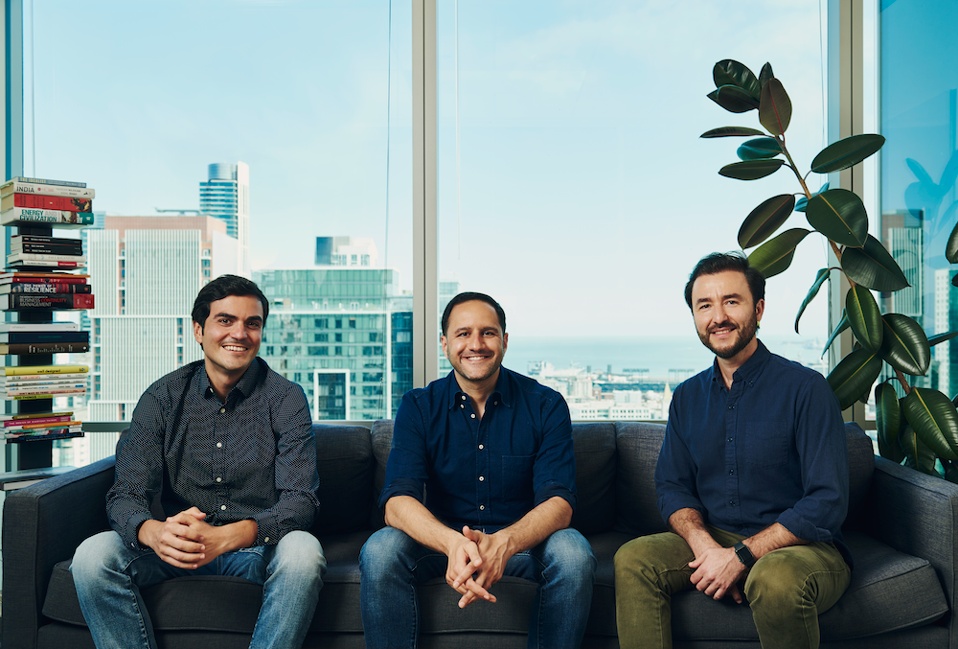
Radfar co-founded Collective with Ugur Kaner and Bugra Akcay. The team began building in 2019 and launched publicly in September 2020, announcing $8.65 million in funding. The proposition brought business formation and financial administration together for the self-employed. Early backing included General Catalyst, QED Investors, Gradient Ventures and Expa. The customers might work independently; the company serving them was assembling a considerable network of its own.
The problem became especially clear when Radfar compared his experience as a venture-backed founder with the circumstances of a freelancer. Both need answers to business questions. Their access to help can be quite different. In his telling, the category of founder had become too closely associated with the funded startup. Collective’s customers widened that definition to include people whose businesses might never have a board meeting, an investment round or a second employee.
“All the tools I get as a venture-backed founder aren’t available to a lot of people who are freelancing.”
Hooman Radfar
Collective’s work includes formation, bookkeeping, payroll, taxes and support. Each item sounds orderly in a list. The customer encounters them as questions that interrupt other work. A unified service has to make those pieces fit together over time. The ambition has a human scale even when the technology is complex: help someone remain focused on the skill that made a business possible. Having chosen to work independently should leave some time for the work.
- 2004Build the social web
Clearspring - 2014Help other builders
Expa - 2020Back the solo founder
Collective launch - 2026Expand the machinery
Open Ledger acquisition
In July 2023, Radfar announced another $50 million in financing for Collective, with plans to deepen its platform and introduce more AI capabilities. These included tools for the team serving members and features for members themselves. The distinction matters operationally. A customer may benefit because a task behind the scenes becomes faster, even without opening a new interface. Radfar’s version of the AI opportunity includes the less theatrical work of improving a service people already depend on.
From A to B, before Z
A smaller piece of his thinking survives in someone else’s memory. Sarah Hipps has described seeking his advice in 2011 after her plans changed abruptly. He encouraged her to identify an attainable next step rather than fixate on a distant fresh start. Get from A to B, then consider what follows. It is advice with little appetite for spectacle. A useful action today receives priority over a magnificent destination that cannot yet be reached.
There is room for imagination elsewhere. He names Epictetus’s The Manual as a favorite non-business book. He plays guitar and grew up interested in comics and drawing. Asked in 2026 about a business he might start for joy, he talked about making animated films for children. He also entertained returning to research in complex adaptive systems. The financial-platform CEO retains the interests of someone who likes making things and investigating how complicated things behave.
Meanwhile, his current company is taking its next step. In April 2026, Collective acquired Open Ledger. Radfar described an ambition for a financial system that works continuously on a solo owner’s behalf, anticipating tasks and helping with decisions. It is an aspiration that reaches beyond recording what has already happened. For the person doing the client work, the value would be measured in fewer interruptions and more confidence about what comes next. The books may always have something to say. Radfar would like his customer to have help answering.