Holly Rockweiler's favorite day at Boston Scientific was called Quality Day. Patients came in. They stood before the people who designed, tested and documented devices, and they explained what all that work meant once it left the building. Rockweiler, then a research scientist working on cardiovascular technology, remembers the day as emotional. It was also clarifying. For most of the year, the patient could feel like the final noun in a very long technical sentence. On Quality Day, the noun walked into the room and spoke.
The rest of her career can be read as an effort to keep that door propped open. She had done what a mathematically inclined student was advised to do: become an engineer. At Washington University in St. Louis, one classroom problem asked her to calculate the torque of a drill on a tooth. She was delighted. Here was mechanics with a pulse, a tidy calculation attached to a human consequence. She earned bachelor's and master's degrees in biomedical engineering, graduated magna cum laude, and entered the medical-device industry.
Boston Scientific gave her serious technical ground. She developed therapies for people living with heart failure, worked across preclinical and clinical research, won internal technology-assessment grants and became an inventor on a broad patent portfolio. The work was credible, complex and consequential. Yet the annual glimpse of the people behind it was not enough. She wanted to understand the problem before it had been translated into a specification.
The discipline of delaying the answer
In 2013, Rockweiler entered Stanford's Biodesign Innovation Fellowship. Its method contains a rule that sounds obvious and is routinely ignored: do not fall in love with a solution before you have earned a precise understanding of the need. Fellows observe care, interview stakeholders and write needs statements stripped of pet inventions. They compare the size of the problem, the constraints of the team, the competitive landscape and the likelihood that anyone will accept the eventual answer.
Rockweiler found the process liberating. A good filter reduced the burden of choosing among hundreds of possible projects. The need, in her telling, could begin to choose the team. One classmate liked the technique enough to write needs statements for ordinary decisions, including the purchase of a condo. There are worse things to bring home from Stanford.
Working with fellow Ryan Krone, Rockweiler noticed a striking gap between institutional assumptions and lived reports in an overlooked corner of women's health. Professionals sometimes treated the area as adequately served or too narrow to merit a new category. Interviews suggested otherwise. Dozens of people volunteered time, asked how the project could move faster and made clear that the absence of alternatives was neither abstract nor small.
Write the need without sneaking the product into the sentence. If the need remains compelling, the solution has somewhere honest to begin.
When the prospective audience was dismissed as a niche, Rockweiler answered with arithmetic and dry surprise: “I don't know how helping 43 million women is a niche, but that's interesting.” The remark is a compact sample of her public style. She does not pretend the awkwardness is absent. She lets it reveal itself, then moves the conversation back to scale, evidence and engineering.
A pitch can carry a taboo
Madorra emerged from the fellowship in 2014, with Rockweiler as co-founder and CEO and Krone as co-founder. The company later moved from the Bay Area to Portland, where the local bioscience and startup networks offered a new room in which to practice the explanation. In 2016, Madorra won the audience-favorite vote at an Oregon Bio showcase. In March 2017, it beat 73 other presenting startups at PitchFestNW.
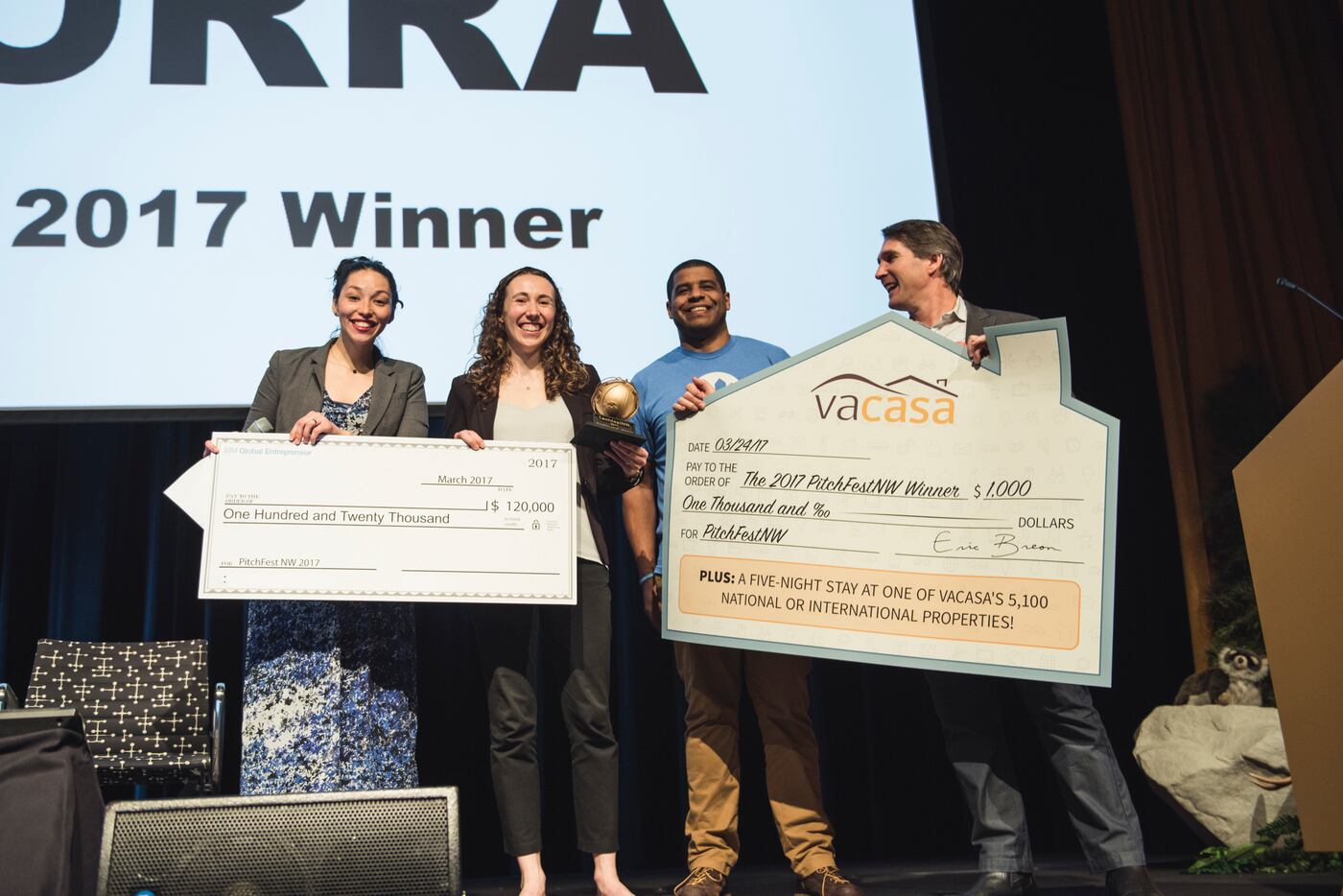
A month later came the Angel Oregon Showcase. Rockweiler opened by acknowledging that her subject could make a room giggle. “It's best to get the giggles out now,” she said. Then she made the case. Madorra won a $200,000 investment and a $15,000 cash award.
This was more than a charming pitch trick. When a market is hidden partly by embarrassment, plain speech becomes an operating advantage. Euphemism can make the founder sound as uncomfortable as the audience. Rockweiler used a flicker of humor as a release valve, not a disguise. The laugh happened; the data remained.
Traction before the cash register
A regulated device company spends a long time in the country before revenue. The familiar startup dashboard can look almost comically blank. Rockweiler learned to describe traction through the risks removed: a strong response to interviews, a prototype improved, a patent allowed, a grant awarded, a clinical study completed, a regulatory conversation advanced. These are not consolation metrics. They are the work made visible.
Her financing path mixed private capital with non-dilutive support. The early competition wins helped validate both speaker and market. A Series A led by Australia's OneVentures gave the company room for further studies and regulatory preparation. Federal programs backed development and clinical work. In 2024, Madorra received a Direct-to-Phase II award from the National Institutes of Health's child health and human development institute.
The method is useful well outside medtech. Name the next uncertainty. Choose evidence capable of shrinking it. Make that evidence legible to the people whose trust buys the next experiment. Revenue is one proof of demand, but it is not the only proof of motion.
The scientist learns a second vocabulary
Founding Madorra also required Rockweiler to move beyond the part of the work she already knew. She entered with the instincts of a research scientist: control variables, ask what the data permits, and be suspicious of claims that travel farther than the evidence. A CEO needs those instincts, but she also has to recruit, finance, negotiate and make a case before every relevant fact is available. The lab rewards precision. A startup adds judgment under constraint.
Rockweiler has spoken about learning this new vocabulary in public. Her interviews return to the power of teachers, investors, consultants and patients, each of whom sees a different edge of the same company. Her advice to early founders is correspondingly social. Know the patients, customers and stakeholders. Remember the larger purpose. Know the strength of the team behind you. The solitary inventor is a particularly poor myth for a product that must pass through engineering, clinical work, manufacturing and regulation.
Her own record makes the point. The early cardiovascular research produced conference presentations and patents with groups of collaborators. Madorra's patents name co-inventors. Its leadership spans operations, engineering and finance. Even the public triumphs belong to teams: the event photograph shows Rockweiler holding a trophy in a row of people, checks and slightly improbable stage scenery. Entrepreneurship likes a single face because posters have limited room. The actual object is collective.
That may explain why Rockweiler's preferred stories keep returning to conversations. The breakthrough in her career was not a lone night at a workbench. It was a day when patients visited a company, a fellowship built around observation, and interviews that contradicted what the professional consensus had assumed. She learned to treat attention as technical equipment. Used carefully, it detects what a spreadsheet has not yet been designed to count.
One mountain, five visible steps
The mountain, reduced to steps
Rockweiler has repeated a piece of advice from another Biodesign alum: how do you climb a mountain? One step at a time. It is deliberately unglamorous counsel for an industry that enjoys futuristic renderings. The timeline explains why she keeps it close. Madorra was founded in 2014. Its FDA Breakthrough Device designation arrived in 2021. The first participant enrolled in the pivotal WAVES study in March 2026.
The twelve years between founding and pivotal enrollment are the actual shape of the job. They contain studies, design revisions, patents, fundraising cycles, regulatory planning, hiring and the stubborn repetition of an unfamiliar story. A company cannot sprint through evidence. It can only make the next piece of evidence worth the time.
Rockweiler keeps comments from study participants near her desk. The gesture is sentimental in the best sense: it attaches feeling to direction. It is also managerial. Long projects invite proxy goals. The grant, the meeting and the submission begin to impersonate the mission. A human voice restores the proper scale.
An activist in a lab coat
Rockweiler has described herself as an “activist in a lab coat.” She is careful about what that means. Her natural arena is not the marble corridor or the rally stage. It is the design review, the clinical protocol and the patient interview. Engineering is the instrument she knows how to use.
That identity has widened alongside her executive role. She has spoken on customer outreach and pitching, joined the Ferolyn Fellowship, served as an entrepreneur-in-residence with OHSU Innovates, and appeared on panels connecting Oregon's research and startup communities. In May 2026, she joined a Portland Startup Week conversation about the region's next chapter in health-care innovation. The founder who once moved to Portland to meet the ecosystem is now one of the people explaining how it can grow.
Her career offers no shortcut disguised as wisdom. Listen before solving. Find measures appropriate to the stage. Tell the awkward truth clearly enough that a room can stay with you. Keep the people behind the paperwork close. Then take the next step.
It is a modest playbook for immodestly difficult work. That may be its chief appeal. Rockweiler's story is not about a flash of inspiration outrunning reality. It is about reality, listened to closely, becoming specific enough to build around.