A company gets homework
In 2010, Hiroshi Mikitani gave Rakuten’s employees an assignment that no amount of Japanese business fluency could complete. The company was moving to English. Thousands of people had two years to become proficient, with possible demotion attached to failure. A working day could now contain both a management problem and an irregular verb.
The announcement had the force of a corporate reorganization because, in practice, it was one. Language decides who can follow a meeting, who can offer an objection and who can be hired without an interpreter hovering nearby. Mikitani wanted Rakuten to operate internationally. He was prepared to make that ambition inconvenient at home.
English became the official internal language in 2012. He later argued that the change improved communication across the group and helped it recruit internationally. There was a characteristic piece of Mikitani reasoning inside the decision: if the existing arrangement limited the company’s future, the arrangement had to move.
The same reasoning has carried him from banking to online shopping, through financial services and into mobile networks. It has produced opportunities, deadlines and considerable bills. A portrait of Rakuten’s founder needs all three. His is a story about what happens after a person decides that the accepted way of doing something is negotiable.
The banker considers the exit
Mikitani was born in Kobe in 1965. He graduated from Hitotsubashi University in 1988 with a commerce degree and joined the Industrial Bank of Japan. It was a recognizable route into an established institution, with an established ladder to climb. His early ambition was a job that would take him around the world.
Harvard Business School changed the meaning of advancement for him. He received his MBA in 1993, having encountered a business culture in which starting a company could be the achievement to aim for. “It was in an HBS classroom that I first considered starting my own company,” he recalled.
Then the 1995 Great Hanshin earthquake struck Kobe. The loss of his aunt and uncle made the question of how to spend his life urgent. He has connected that experience to his decision to leave banking and help revitalize Japan’s economy. The career he had could no longer settle the question of what he wanted to do.
By 1996 he had established the consulting business Crimson Group. The following February came MDM, the company that became Rakuten. The transition was less tidy than a business-school diagram: an education had opened the possibility, a personal rupture had given it urgency, and a workable business still had to be found.
Thirteen shops, each with a voice
The founders considered more than 100 ideas. Among them were a chain of small craft breweries and bringing an American natural-yeast bakery franchise to Japan. The future chairman of a technology group could, under a different set of assumptions, have spent more time discussing fermentation.
They chose an internet shopping mall for its potential, its relatively modest capital needs and the opportunity to create something useful. Rakuten Ichiba launched in May 1997 with six employees and 13 merchants. Those figures have the pleasing compactness of a beginning: a team small enough to know everyone, a marketplace small enough to count.
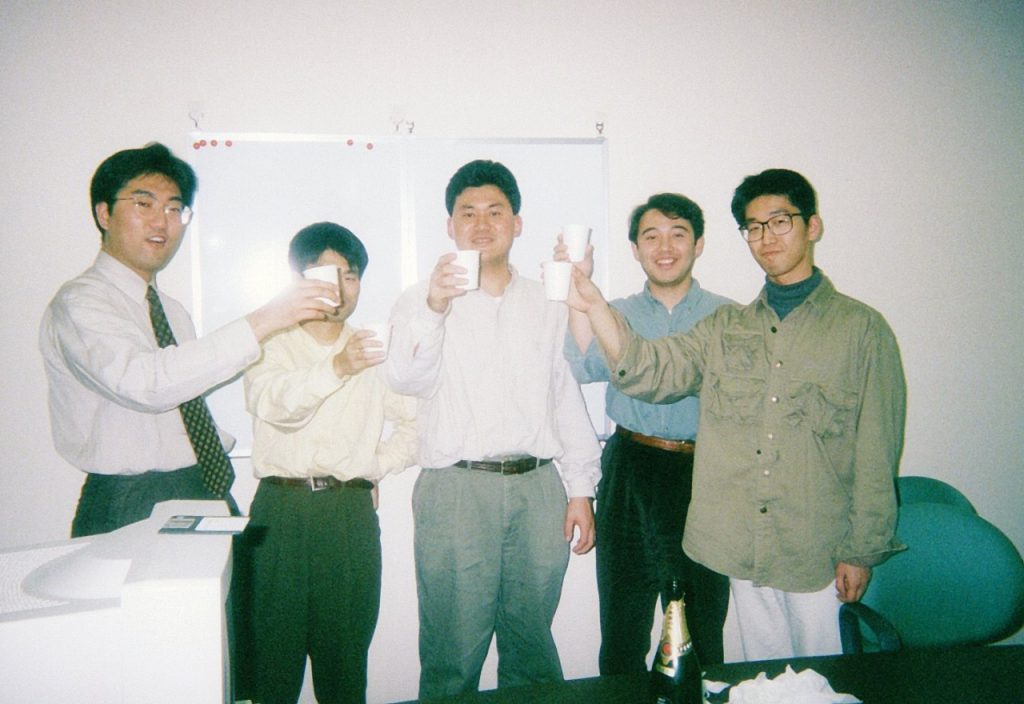
The important choice concerned the seller. Rakuten gave merchants tools to create and change their own pages. Existing online malls often depended on professional webpage builders, leaving shopkeepers facing difficulty and expense when they wanted an alteration. A merchant who understood the merchandise could still be stranded by the machinery.
Mikitani’s proposition put that merchant’s knowledge back to work. The shop could explain itself, present its products and develop relationships with customers. Regional businesses would have a chance to compete beyond the limits of their location. Personality had a commercial function; it helped a customer understand why this particular shop deserved a visit.
Rakuten went public in 2000. As the group spread into travel, finance and digital content, the original shop remained a useful way of understanding its founder. He had begun with a practical redistribution of capability: give smaller businesses access to tools and customers they could struggle to reach alone.
Optimism, entered in a spreadsheet
Rakuten means optimism. Mikitani’s writing suggests an optimism with a fairly demanding office routine. In an essay on setting goals, he described a process he calls “getting to the spreadsheet”: establish a destination, work backward through the required steps, then track what happens. The hopeful thought must eventually submit to arithmetic.
His example was Rakuten Mobile’s call center. He asked how many calls each staff member handled in an hour, received a number, and proposed tripling it. He wrote in 2021 that changes to the process had already doubled the rate. The third multiple remained a target. That distinction matters: even his own account separates progress from completion.
Business-Do, his book about leadership, sets out methods and habits behind the ambitions. The title uses do, the Japanese character associated with a way or path. In this telling, an entrepreneur’s inspiration needs a repeatable practice. There is room for the dream, followed by a rather pointed request to show the workings.
He returned to execution when addressing new graduates in April 2026. His term was genba-ryoku, the capacity to get things done where the actual work happens. He described communicating almost daily with participants in the Mikitani Entrepreneurship Program about improving Rakuten Mobile shops. A founder discussing global systems was also concerning himself with the shop floor.
“Hopes and goals are not the same thing.”
Hiroshi Mikitani · 2021
A walk, a book, a different kind of team
For someone whose business connects people through screens, Mikitani places considerable value on being in the same place. He has described walking beside the Tama River with members of his leadership team when he is in Tokyo. The conversations cover business and life. A riverbank offers a different arrangement from a conference table, including fewer obvious places for a presentation deck.
Conversation also shaped The Power to Compete, the book he co-authored with his father, economist Ryoichi Mikitani. Their exchanges addressed Japan’s challenges, including education, regulation and international relations. The dialogue form preserved their disagreements and the process of working through them. It gave a public record of a relationship in which the country’s future was a family subject.
His interests also take him into organizations whose results cannot be summarized by a checkout conversion rate. He chairs the Tokyo Philharmonic Orchestra and Vissel Kobe, and is the owner of the Rakuten Eagles baseball team. The Eagles won their first Japan Series in 2013. These are distinct responsibilities, with audiences quite willing to express an opinion.
Tennis is a personal enthusiasm. In discussing Rakuten’s Davis Cup partnership in 2019, he spoke about sport’s ability to bring people together across national and cultural boundaries. It is a recurring concern in his public life: assembling people who bring different experiences, then finding a way for them to act together. Sometimes that requires a common language. Sometimes the rules are already painted on the court.
The phone bill comes due
Mobile took that appetite for changing an industry into a business that requires physical infrastructure. Rakuten launched full-scale mobile network operator service in 2020, using a virtualized, software-based approach and Open RAN. The internet marketplace founder had entered a field where an appealing webpage could do very little about a missing signal.
At MWC Barcelona in 2026, Mikitani explained the sequence behind the gamble. Rakuten had already built shopping, travel and financial services. Mobile would connect an existing collection of businesses. He argued that joining the network encouraged customers to use more of those services, making connectivity valuable beyond the monthly subscription itself.
The financial test remained substantial. In the second quarter of 2026, Rakuten reported 7.7 billion yen in net income attributable to owners of the parent, its first positive quarter on that measure in six years. The mobile segment still posted a Non-GAAP operating loss of 33.1 billion yen. A profitable group quarter and a loss-making segment can occupy the same results announcement.
In September, Rakuten Mobile announced that total subscriptions had passed 11 million. That headline count included MNO, MVNO and MVNE lines, including business-continuity subscriptions. The narrower MNO count excluding those other categories and business-continuity lines was 10.18 million. Growth was visible. So was the need to keep definitions attached to the numbers. Mikitani’s thesis still had work to do.
The shopkeeper returns as an avatar
His next set of proposals returns to the merchant. At Rakuten AI Optimism in 2026, Mikitani presented plans for a Super Agent connecting services such as shopping, travel and banking. The ambition is for an assistant that can move from a conversation toward a booking or payment, using the relationships and information already inside Rakuten.
Alongside it came an AI shop manager concept, tentatively named Ichiko. A merchant’s product knowledge and personality would inform an avatar able to answer customer questions around the clock. These were presented capabilities and ambitions, with their value depending on what shops and customers ultimately experience. A demonstration opens the argument; daily use will test it.
The connection to 1997 is unusually direct. Then, a shopkeeper needed the means to build a page. Now, the proposed tool would help answer more questions than a shopkeeper could personally handle. Mikitani’s stated aim preserves the individual character of the shop. “We need AI with a human touch,” he said.
The career has grown complicated: networks, payments, orchestras, football, algorithms. The underlying question remains quite plain. Who could do more if the system around them worked differently? Mikitani has spent decades proposing answers, and requiring other people to help make them work. The next answer has arrived with a familiar condition: it still has to earn its place in the shop.
Keep the conversation going
Follow Mikitani’s writing, revisit the founding years, or watch him discuss language and company culture.
- Official biography · Rakuten on YesPress
- LinkedIn · X in Japanese · X in English · Instagram
- Mickey’s Voice: essays and commentary
- Watch: Mikitani on Englishnization and diversity
- The founding story and its early photographs
- Q2 2026 financial results · September 2026 subscription announcement
- Mikitani’s 2026 AI Optimism presentation