Heungyeol Lee arrived at brain science by a route that looks, at first, like a filing error. He studied business at Dankook University. He began in accounting. Then he wandered into advertising, where the sight of a line of copy meeting the right image could keep him delighted through hours that began at six in the morning and ended, somehow, at four the next. Brand marketing followed. So did telecommunications and a company of his own. None of this resembles the standard apprenticeship for building a neuroscience company. All of it explains why he did.
The technical founder is expected to invent; the commercial founder is expected to sell. Lee chose a more awkward role. He would translate. Neurogazer, the company he founded with his older brother Daeyeol Lee in 2014, sits between brain-imaging research, machine learning and the ordinary person's wish to understand something about themselves. Daeyeol brought a career in neuroscience. Heungyeol brought the instinct to ask how a hard idea could cross the room.
This was not a division between serious science and cheerful packaging. Before Heungyeol could persuade researchers, he knew he had to stop sounding like a visitor. His brother arranged meetings with established scientists. Lee has called what followed “harsh training.” He learned enough of the domain to ask useful questions, assemble a credible advisory network and recognize the distance between an intriguing paper and a dependable platform.
“Even when the company was in crisis due to serious financial difficulties, I never hesitated for a moment about the research support the company is conducting.”Heungyeol Lee
The useful sibling rivalry
The brothers had lived on opposite sides of an old family comparison. Both parents were educators. Daeyeol was praised early for exceptional academic ability. Heungyeol liked drawing and music, and later said that being told to measure up to his brother pressed on him. He did not feel he understood himself until well into his twenties. It is the sort of childhood detail that can harden into resentment or soften into a question. Lee eventually built a company around the question.
In 2011, the brothers began sharing their work and sketching what a venture might become. Computing was changing. Cloud infrastructure made intensive analysis more practical. Neuroscience was producing extraordinary quantities of knowledge, yet much of it remained inside laboratories and specialist journals. Lee saw a translation problem with a business hiding inside it.
The premise carried a quiet rebuke to the way people often judge one another. Lee's public comments return to parents and children, to the temptation to mistake familiarity for understanding, and to the possibility that better information might produce a better conversation. He was not proposing that a scan could reduce a person to a number. He was interested in whether evidence could interrupt a lazy assumption.
This is where his unusual CV starts to look less unusual. Accounting taught structure. Advertising taught attention. Brand work taught him that presentation changes whether an idea gets invited in. Telecom taught systems. Entrepreneurship taught him to absorb uncertainty without pretending it had disappeared. Neurogazer needed each language, because the company was trying to build a bridge between groups that rarely use the same vocabulary.
A starship among the neurons
Lee's most revealing product story begins with Star Trek. He and Daeyeol are fans. When they needed a name for Neurogazer's first age-specific service, they chose Alcyone, a star in the Taurus constellation. The idea was to name later destinations after other stars beginning with A. In Lee's telling, Neurogazer would be a starship sailing among neurons, arriving at one new world after another.
It is whimsical, perhaps even nerdy, and entirely strategic. A machine-learning model is difficult to hold in the mind. A voyage is easy. Lee understood from advertising that metaphor is not the enemy of precision; used carefully, it is the vehicle that precision travels in. The company name, the imaging-center design and the titles of its reports were all treated as part of the experience, not as wrapping paper added at the end.
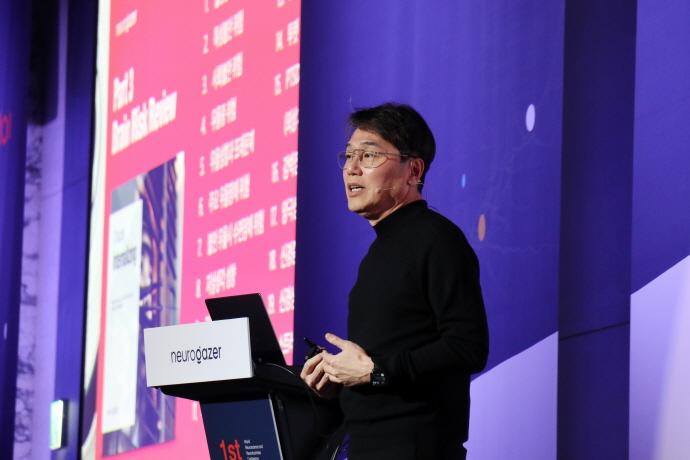
At the first World Neuroscience & Neurobusiness Conference, held after years of patient work, Lee worried he might become emotional during his presentation. The moment carried the weight of everything that does not show up on a product screen: the early prototype in 2015, research partnerships, patent applications, a U.S. company, and moves through Irvine, New Haven and finally Baltimore. Neurogazer's official history is a chain of institutional milestones. Lee's recollection is simpler. It had been a long wait to show the world.
The American route
The long middle
In startup folklore, patience is often a polite word for insufficient speed. Research companies live under another clock. Neurogazer spent six years building toward commercialization. It collected expertise, developed predictive models and supported research through periods when money was painfully short. The work produced a Korean patent application naming Lee as an inventor, as well as peer-reviewed papers that list him among the authors.
One paper, published in Human Brain Mapping in 2023, examined how several measures of the brain vary together during adolescence. Another, published online in 2025 by The Journal of Neuroscience, studied patterns in resting-state cortical activity across the lifespan. The arc matters because Lee began as the outsider in the scientist meetings. A decade later, his name sat on the work.
There is a useful distinction here between credentials and credibility. Lee never publicly recast himself as the laboratory authority. The teams named on those papers include researchers across Neurogazer, Seoul National University, Korea University, Yale, University College London, Dartmouth, Delaware and Johns Hopkins. His achievement was organizational: keep enough disciplines at the same table, for long enough, that the work could become cumulative. In founder profiles, the person at the center often swallows the institution around him. Neurogazer's record suggests a different arrangement. Lee is most visible when the connections hold.
Make decisions while mistakes are still affordable. Lee once told an early employee to choose and execute rather than wait for permission, because the company was still small enough to absorb a wrong turn.
He made the case more sharply in a 2015 essay about innovation. Most people, he wrote, can run 100 meters in under 18 seconds. Doing it 422 times is the difficult part. The arithmetic turns a sprint into a marathon and a slogan into an operating principle. Neurogazer's record has been less about a single flash of invention than the unphotogenic discipline of taking the next hundred meters.
That temperament also leaves room for failure. In the company's early days, an employee once asked Lee to decide a small matter. Lee told the employee to make the call. If it went wrong, he reasoned, the loss was still small. Failure was inevitable somewhere; better to encounter it when the company could afford the tuition. It is a founder's version of experimental design: reduce the cost of being wrong, then learn faster.
A forest, not a factory
Lee reaches for another metaphor when he describes the business he wants. A platform, to him, is a forest. The builder cannot know which trees will take root or which creatures will eventually live there. The useful work is to create conditions in which an ecosystem can form. Neurogazer's network of researchers, advisers, data, models and service partners follows that logic.
The forest is also a good correction to founder mythology. No one plants a mature canopy. Lee's contribution is not that he became the neuroscientist his brother already was. It is that he learned enough science to connect it with software, enough software to see a platform, and enough storytelling to make the platform approachable. His edge sits in the joints.
It also explains why the company has moved between two cities without treating either as a decorative pin on a map. Seoul supplied the founding context, early studies and a public audience for the first services. Baltimore placed the U.S. operation near a dense research community and the academic work of Lee's brother. The route was not a victory lap through innovation hubs. It was a practical search for the people, institutions and data that a small research company could not manufacture alone.
“In the end, I think business is a process of creating a forest.”Heungyeol Lee
There is a playful symmetry in the career. The young advertising worker loved the instant when text and image locked together. The founder now works at a slower collision: scholarship and computation, a scan and a story, one brother's laboratory fluency and the other's instinct for an audience. The medium changed. The pleasure of making separate things intelligible together did not.
Lee's aspiration is grand but not especially loud. He wants Neurogazer to become a place where knowledge about the brain can be shared, and where other people can build scientifically grounded services around it. The measure of the company, in this framing, is not simply how much information its systems can produce. It is whether the information helps someone look again - with more curiosity, less certainty, and a little more respect for the person in front of them.
That is an oddly humane destination for a journey through machine learning and MRI data. It is also the destination his biography has been pointing toward all along. Heungyeol Lee did not take a straight road into neuroscience. He took the road of someone learning, repeatedly, how one world speaks to another. Neurogazer is what happened when he decided to build the interpreter.